
&w=3840&q=75)
&w=3840&q=75)
&w=3840&q=75)
&w=3840&q=75)
&w=3840&q=75)
&w=3840&q=75)
&w=3840&q=75)
&w=3840&q=75)


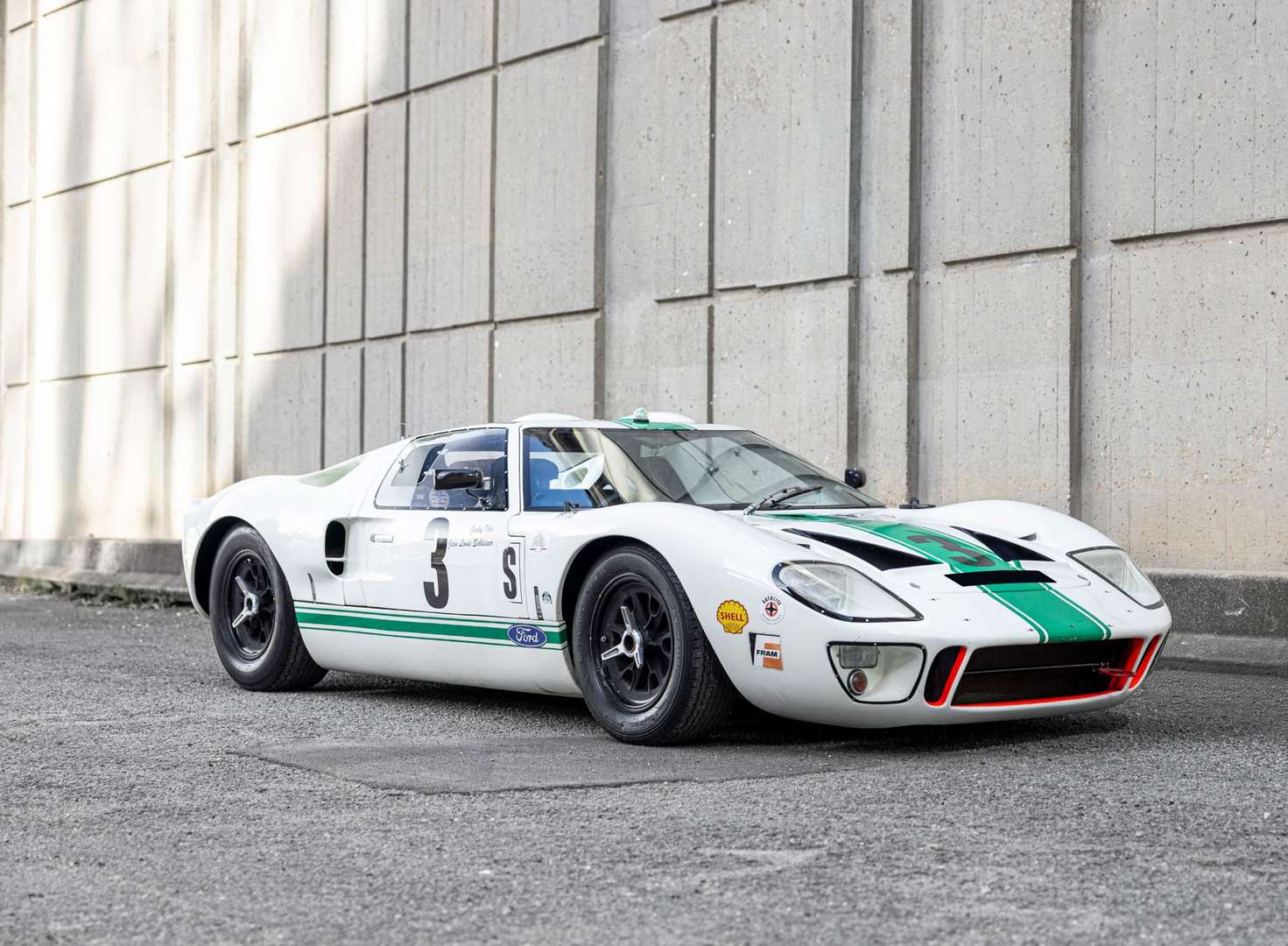
Ford GT 40 P/1000-W FIA
1965
Chassis n° P/1000-W
British registration
UK registration title
In the early 1960s, Henry Ford II, head of the Ford Motor Company, wanted to enter a Ford at Le Mans,
in particular to beat Ferrari's stranglehold on the event.
Eric Broadley was chosen to design the car, based on his Lola GT Mk6, already powered by a Ford V8. The
thanks to the development and fine-tuning work of the team led by the inimitable Texan driver-builder Caroll Shelby, the car now known as the Ford GT 40 became one of the most successful and legendary racing cars of the 1960s, not least thanks to a hat-trick of victories at Le Mans in 1966.
The P/1000 chassis was the very first GT 40 Mk1 built.
Initially, it was used to fit the body panels (subcontracted to Abbey Panels) of the first GT 40s, before they were delivered to the factory.
delivered to Ford Advanced Vehicles (FVA) in Slough, England. P/1000 was finally completed
winter 1965 - 1966, with parts salvaged from the wreck of P/1006, destroyed during a test session at Monza. Painted
white with dark green stripes, it was allocated to the Canadian Comstock Racing team for the 1966 season,
with P/1037. Both cars competed in the 12 Hours of Sebring, during which P/1000, qualified in 16th position, crashed, resulting in the death of its driver, the talented Bob McLean, who was also Canadian champion in 1965.
While the history of the car's remains is uncertain (they may have been burnt or buried), it wasn't until the early 1980s that P/1000 was rediscovered.
It was around this time that one of FVA's most important figures, engineer Bryan Wingfield (also
known for his Jaguar Type C, Type D or XJ 13 copies), decided to raise P/1000 from the ashes, using a new, vintage reserve chassis from FVA, purchased from John Wyer and John Willment. "During the rebuild/restoration of P/1000 carried out by myself, I confirm that the running gear and steering are original, that the engine and gearbox are dated 1966, and that only the chassis and a few body parts are new", wrote Bryan Wingfield in an attestation in July 1984 (copy attached to file), to enable P/1000-W (for Wingfield) to be registered. The car changed hands several times until it was bought again by Bryan Wingfield in 1996. He returned the car to its 1966 Sebring configuration, before selling it to the famous gentleman driver, well known on the historic racing scene, Grant Tromans. It was Tromans who had the car prepared
by Paul Lanzante Limited, again under Wingfield's supervision. The car still has its current PTH, valid until the end of 2026.
Since then, P/1000-W has never stopped racing, maintained and assisted by the highly reputed English tuner Raceworks Motorsport. And
no less than two former F1 drivers have taken their turn at the wheel: Paolo Barilla and Gerhard Berger. Notable results include pole position at the 6 Heures de Spa in 2016, 3rd place in 2018, victory in the 3rd Plateau 4 race at the 2018 Le Mans Classic, and a stage win at the Tour Auto 2023...
Beyond its mythical identity, P/1000-W is today one of the most successful GT 40s in historic competition.
As in its day, it's a versatile car, ideal for the Tour Auto as well as Le Mans Classic, the
6 Hours of Spa or the Peter Auto season, and even to compete at Goodwood. Starting, but also winning...
To be continued! The car is sold with a substantial on-board package,
including several sets of wheels, specific exhausts, a complete engine to be overhauled, a headlamp ramp, etc., all to be collected from the owner at the
to be collected from the owner at the end of the sale.
In addition to the hammer price, the successful bidder must pay the following buyer's fees per lot:
- For sales in the Classic Automobiles department (sliding scale fees) :
- 16% exclusive of tax + VAT at the prevailing rate, i.e. 19.2% inclusive of tax on the first €900,000 inclusive of tax
- 12% exclusive of tax + VAT at the prevailing rate, i.e. 14.4% inclusive of tax above €900,001
1965
Chassis n° P/1000-W
British registration
UK registration title
In the early 1960s, Henry Ford II, head of the Ford Motor Company, wanted to enter a Ford at Le Mans,
in particular to beat Ferrari's stranglehold on the event.
Eric Broadley was chosen to design the car, based on his Lola GT Mk6, already powered by a Ford V8. The
thanks to the development and fine-tuning work of the team led by the inimitable Texan driver-builder Caroll Shelby, the car now known as the Ford GT 40 became one of the most successful and legendary racing cars of the 1960s, not least thanks to a hat-trick of victories at Le Mans in 1966.
The P/1000 chassis was the very first GT 40 Mk1 built.
Initially, it was used to fit the body panels (subcontracted to Abbey Panels) of the first GT 40s, before they were delivered to the factory.
delivered to Ford Advanced Vehicles (FVA) in Slough, England. P/1000 was finally completed
winter 1965 - 1966, with parts salvaged from the wreck of P/1006, destroyed during a test session at Monza. Painted
white with dark green stripes, it was allocated to the Canadian Comstock Racing team for the 1966 season,
with P/1037. Both cars competed in the 12 Hours of Sebring, during which P/1000, qualified in 16th position, crashed, resulting in the death of its driver, the talented Bob McLean, who was also Canadian champion in 1965.
While the history of the car's remains is uncertain (they may have been burnt or buried), it wasn't until the early 1980s that P/1000 was rediscovered.
It was around this time that one of FVA's most important figures, engineer Bryan Wingfield (also
known for his Jaguar Type C, Type D or XJ 13 copies), decided to raise P/1000 from the ashes, using a new, vintage reserve chassis from FVA, purchased from John Wyer and John Willment. "During the rebuild/restoration of P/1000 carried out by myself, I confirm that the running gear and steering are original, that the engine and gearbox are dated 1966, and that only the chassis and a few body parts are new", wrote Bryan Wingfield in an attestation in July 1984 (copy attached to file), to enable P/1000-W (for Wingfield) to be registered. The car changed hands several times until it was bought again by Bryan Wingfield in 1996. He returned the car to its 1966 Sebring configuration, before selling it to the famous gentleman driver, well known on the historic racing scene, Grant Tromans. It was Tromans who had the car prepared
by Paul Lanzante Limited, again under Wingfield's supervision. The car still has its current PTH, valid until the end of 2026.
Since then, P/1000-W has never stopped racing, maintained and assisted by the highly reputed English tuner Raceworks Motorsport. And
no less than two former F1 drivers have taken their turn at the wheel: Paolo Barilla and Gerhard Berger. Notable results include pole position at the 6 Heures de Spa in 2016, 3rd place in 2018, victory in the 3rd Plateau 4 race at the 2018 Le Mans Classic, and a stage win at the Tour Auto 2023...
Beyond its mythical identity, P/1000-W is today one of the most successful GT 40s in historic competition.
As in its day, it's a versatile car, ideal for the Tour Auto as well as Le Mans Classic, the
6 Hours of Spa or the Peter Auto season, and even to compete at Goodwood. Starting, but also winning...
To be continued! The car is sold with a substantial on-board package,
including several sets of wheels, specific exhausts, a complete engine to be overhauled, a headlamp ramp, etc., all to be collected from the owner at the
to be collected from the owner at the end of the sale.
In addition to the hammer price, the successful bidder must pay the following buyer's fees per lot:
- For sales in the Classic Automobiles department (sliding scale fees) :
- 16% exclusive of tax + VAT at the prevailing rate, i.e. 19.2% inclusive of tax on the first €900,000 inclusive of tax
- 12% exclusive of tax + VAT at the prevailing rate, i.e. 14.4% inclusive of tax above €900,001