
&w=3840&q=75)
&w=3840&q=75)
&w=3840&q=75)
&w=3840&q=75)
&w=3840&q=75)
&w=3840&q=75)
&w=3840&q=75)
&w=3840&q=75)


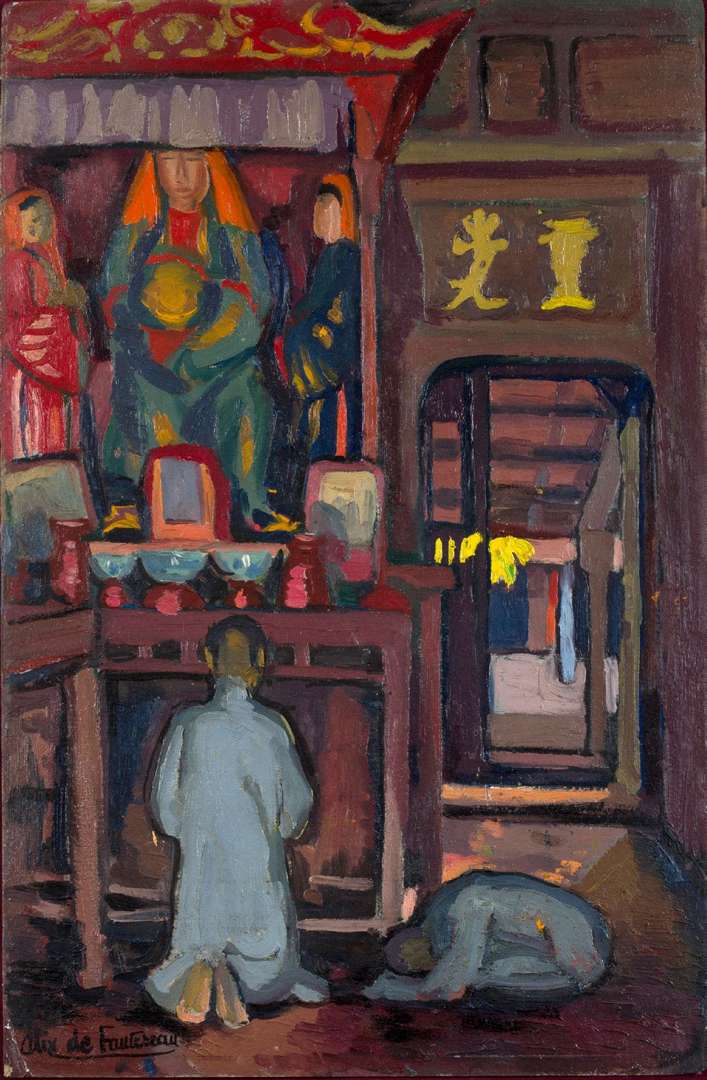
ALIX AYMÉ (1894-1989)
Prière au temple, circa 1928
Huile sur carton, porte une signature rapportée Alix de Fautereau en bas à gauche, numérotée 32, 70 et 18 au dos
50 x 32,7 cm - 19 3/4 x 12 7/8 inches
Oil on cardboard, bearing a signature Alix de Fautereau lower left, numbered 32, 70 and 18 on the back
Cette oeuvre sera incluse par l'Association des amis d'Alix Aymé sous le numéro HT88 au catalogue raisonné en ligne de l'artiste. Un certificat pourra être délivré à la charge de l'acquéreur.
PROVENANCE
Collection particulière, sud-est de la France (acquis directement auprès de la famille de l'artiste)
Alix Aymé, ayant épousé en premières noces Paul de Fautereau-Vassel, signe entre 1920 et 1928 Alix de Fauterau. Probablement réalisé à Yunnan Fou.
Ar tiste voyageuse et pluridisciplinaire, Alix Aymé n'a cessé d'explorer des techniques artistiques. En France, elle explore la peinture, le dessin et le bois gravé. La Prière au temple est un témoignage du travail à l'huile de l'artiste et de l'un de ses nombreux voyages en Asie.
A traveling and multidisciplinary artist, Alix Aymé has continuously explored artistic techniques. In France, she explores painting, drawing, and wood engraving. The Prière au temple is a testament to the artist's oil work and one of her many trips to Asia.
Là một nghệ sĩ đa tài và đam mê du lịch, Alix Aymé không ngừng khám phá các kỹ thuật nghệ thuật khác nhau. Tại Pháp, bà thử nghiệm hội họa, ký họa và kỹ thuật khắc gỗ. Tác phẩm “La Prière au temple” (Lời nguyện cầu trong đền) là một ví dụ cho các tác phẩm sơn dầu của bà, đồng thời phản ánh một trong nhiều chuyến đi của bà tới châu Á.
ALIX AYMÉ
Élève de Maurice Denis, avec qui elle entretient une correspondance soutenue durant toute sa carrière, Alix Aymé se prend de passion pour le continent asiatique lors d’un premier voyage en 1920 où elle accompagne son mari missionné en Chine par le gouvernement français. Elle sillonne le Laos, le Cambodge ou encore le Vietnam pendant plus de vingt ans. Ses oeuvres sont le lieu de la rencontre entre le style des Nabis, dont elle subit l’influence, et de la peinture traditionnelle vietnamienne pour laquelle elle se prend d’affection. Elle s’installe à Hanoï en 1933 avec le général Georges Aymé, son second mari. Dans un premier temps professeur de dessin au lycée Albert Sarraut, elle devient en 1935 enseignante
à l’École des beaux-arts de l’Indochine. C’est ici qu’elle contribue au développement de l’apprentissage de l’art de la laque avec Joseph Inguimberty.1
1 Charlotte Aguttes-Reynier, L’art moderne en Indochine, éditions In Fine, Paris, 2023, p. 168-178
A student of Maurice Denis, with whom she maintained a lively correspondence throughout her career, Alix Aymé developed a passion for Asia during her first trip there in 1920, when she accompanied her husband on a mission to China for the French government. She traveled extensively in Laos, Cambodia, and Vietnam for more than twenty years. Her works are a meeting point between the style of the Nabis, who influenced her, and traditional Vietnamese painting, which she grew to love. She moved to Hanoi in 1933 with General Georges Aymé, her second husband. Initially a drawing teacher at the Lycée Albert Sarraut, she became a teacher at the School of Fine Arts of Indochina in 1935. It was here that she contributed to the development of the art of lacquer with Joseph Inguimberty.1
Là học trò của Maurice Denis, người mà bà duy trì thư từ đều đặn suốt cả sự nghiệp nghệ thuật, Alix Aymé đã nảy sinh niềm đam mê với châu Á kể từ chuyến đi đầu tiên vào năm 1920, khi bà tháp tùng người chồng được chính phủ Pháp cử đi công tác tại Trung Quốc. Bà đã chu du khắp Lào, Campuchia và cả Việt Nam trong hơn hai mươi năm. Các tác phẩm của bà là sự giao thoa giữa phong cách Nabis mà bà chịu ảnh hưởng sâu sắc, và nghệ thuật truyền thống Việt Nam mà bà luôn yêu quý và trân trọng. Bà định cư tại Hà Nội vào năm 1933 cùng với tướng Georges Aymé, người chồng thứ hai của mình. Ban đầu, bà giảng dạy môn mỹ thuật tại trường trung học Albert Sarraut, sau đó, bà trở thành giáo viên tại Trường Mỹ thuật Đông Dương vào năm 1935. Chính tại đây, bà đã góp phần vào công cuộc giảng dạy nghệ thuật sơn mài cùng với Joseph Inguimberty.1
Prière au temple, circa 1928
Huile sur carton, porte une signature rapportée Alix de Fautereau en bas à gauche, numérotée 32, 70 et 18 au dos
50 x 32,7 cm - 19 3/4 x 12 7/8 inches
Oil on cardboard, bearing a signature Alix de Fautereau lower left, numbered 32, 70 and 18 on the back
Cette oeuvre sera incluse par l'Association des amis d'Alix Aymé sous le numéro HT88 au catalogue raisonné en ligne de l'artiste. Un certificat pourra être délivré à la charge de l'acquéreur.
PROVENANCE
Collection particulière, sud-est de la France (acquis directement auprès de la famille de l'artiste)
Alix Aymé, ayant épousé en premières noces Paul de Fautereau-Vassel, signe entre 1920 et 1928 Alix de Fauterau. Probablement réalisé à Yunnan Fou.
Ar tiste voyageuse et pluridisciplinaire, Alix Aymé n'a cessé d'explorer des techniques artistiques. En France, elle explore la peinture, le dessin et le bois gravé. La Prière au temple est un témoignage du travail à l'huile de l'artiste et de l'un de ses nombreux voyages en Asie.
A traveling and multidisciplinary artist, Alix Aymé has continuously explored artistic techniques. In France, she explores painting, drawing, and wood engraving. The Prière au temple is a testament to the artist's oil work and one of her many trips to Asia.
Là một nghệ sĩ đa tài và đam mê du lịch, Alix Aymé không ngừng khám phá các kỹ thuật nghệ thuật khác nhau. Tại Pháp, bà thử nghiệm hội họa, ký họa và kỹ thuật khắc gỗ. Tác phẩm “La Prière au temple” (Lời nguyện cầu trong đền) là một ví dụ cho các tác phẩm sơn dầu của bà, đồng thời phản ánh một trong nhiều chuyến đi của bà tới châu Á.
ALIX AYMÉ
Élève de Maurice Denis, avec qui elle entretient une correspondance soutenue durant toute sa carrière, Alix Aymé se prend de passion pour le continent asiatique lors d’un premier voyage en 1920 où elle accompagne son mari missionné en Chine par le gouvernement français. Elle sillonne le Laos, le Cambodge ou encore le Vietnam pendant plus de vingt ans. Ses oeuvres sont le lieu de la rencontre entre le style des Nabis, dont elle subit l’influence, et de la peinture traditionnelle vietnamienne pour laquelle elle se prend d’affection. Elle s’installe à Hanoï en 1933 avec le général Georges Aymé, son second mari. Dans un premier temps professeur de dessin au lycée Albert Sarraut, elle devient en 1935 enseignante
à l’École des beaux-arts de l’Indochine. C’est ici qu’elle contribue au développement de l’apprentissage de l’art de la laque avec Joseph Inguimberty.1
1 Charlotte Aguttes-Reynier, L’art moderne en Indochine, éditions In Fine, Paris, 2023, p. 168-178
A student of Maurice Denis, with whom she maintained a lively correspondence throughout her career, Alix Aymé developed a passion for Asia during her first trip there in 1920, when she accompanied her husband on a mission to China for the French government. She traveled extensively in Laos, Cambodia, and Vietnam for more than twenty years. Her works are a meeting point between the style of the Nabis, who influenced her, and traditional Vietnamese painting, which she grew to love. She moved to Hanoi in 1933 with General Georges Aymé, her second husband. Initially a drawing teacher at the Lycée Albert Sarraut, she became a teacher at the School of Fine Arts of Indochina in 1935. It was here that she contributed to the development of the art of lacquer with Joseph Inguimberty.1
Là học trò của Maurice Denis, người mà bà duy trì thư từ đều đặn suốt cả sự nghiệp nghệ thuật, Alix Aymé đã nảy sinh niềm đam mê với châu Á kể từ chuyến đi đầu tiên vào năm 1920, khi bà tháp tùng người chồng được chính phủ Pháp cử đi công tác tại Trung Quốc. Bà đã chu du khắp Lào, Campuchia và cả Việt Nam trong hơn hai mươi năm. Các tác phẩm của bà là sự giao thoa giữa phong cách Nabis mà bà chịu ảnh hưởng sâu sắc, và nghệ thuật truyền thống Việt Nam mà bà luôn yêu quý và trân trọng. Bà định cư tại Hà Nội vào năm 1933 cùng với tướng Georges Aymé, người chồng thứ hai của mình. Ban đầu, bà giảng dạy môn mỹ thuật tại trường trung học Albert Sarraut, sau đó, bà trở thành giáo viên tại Trường Mỹ thuật Đông Dương vào năm 1935. Chính tại đây, bà đã góp phần vào công cuộc giảng dạy nghệ thuật sơn mài cùng với Joseph Inguimberty.1