
&w=3840&q=75)
&w=3840&q=75)
&w=3840&q=75)
&w=3840&q=75)
&w=3840&q=75)
&w=3840&q=75)
&w=3840&q=75)
&w=3840&q=75)

37
NGUYỄN GIA TRÍ (1908-1993)
Vendu : 120 704 €
Les prix s'entendent commission et taxes comprises.
NGUYỄN GIA TRÍ (1908-1993)
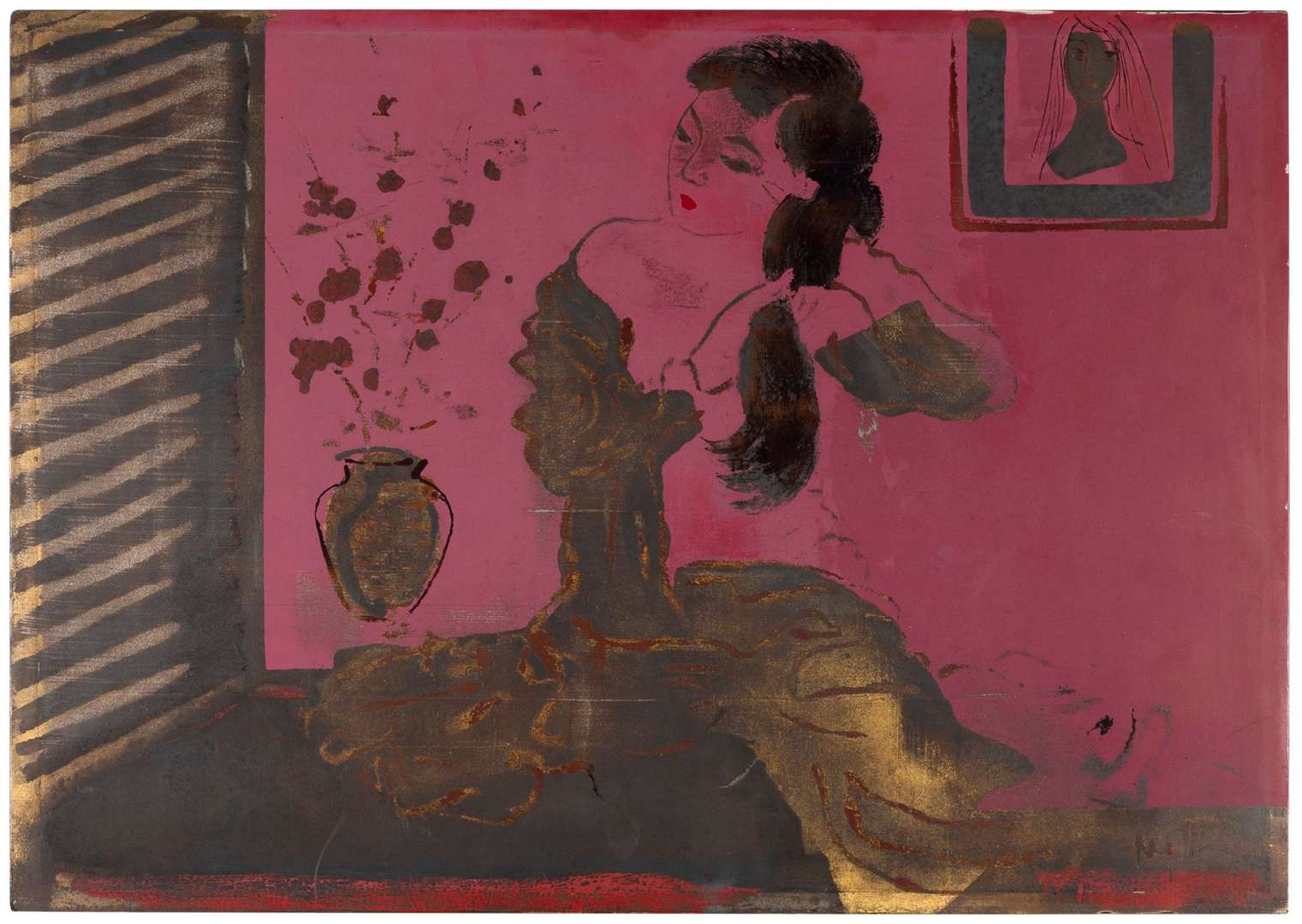
Femme se coiffant, circa 1960
Laque rehaussée d'or, signée en bas à droite
32 x 45 cm - 12 5/8 x 17 3/4 in.
Lacquer enhanced with gold, signed lower right
PROVENANCE
Collection particulière, région parisienne
Nguyễn Gia Trí intègre la IVe promotion de l’École des beaux-arts de l’Indochine en 1928, mais la quitte après deux ans de formation. Il reprend ses études quelques années plus tard et se forme avec les élèves de la VIIe promotion, incité par Victor Tardieu à rejoindre l’atelier de laque dirigé par Joseph Inguimberty. La laque devient alors son mode d’expression principal. Son talent est applaudi et ses expositions rencontrent rapidement du succès. Il s’exile entre 1946 et 1953-1954 à Hong-Kong puis revient à Saïgon où il ouvre un atelier. En 2011, son talent est récompensé, de façon posthume, par ses pairs du prix Hồ Chí Minh de littérature et d’art.
Ici, une femme est représentée dans un intérieur. Son vêtement glisse négligemment sur son épaule tandis qu’elle est occupée à sa coiffure. Nguyễn Gia Trí choisit de mettre en exergue son talent à jouer avec les rehauts d’or, donnant ainsi vie à cette jeune élégante. Le trait précis et efficace de l’artiste est reconnaissable, typique de ses compositions mettant en scène de jolies femmes dans des ambiances lascives et poétiques.
Nguyễn Gia Trí joined the IVth graduating class of the Indochina School of Fine Arts in 1928, but left after two years' training. He resumed his studies a few years later and trained with the students of the VIIth class, encouraged by Victor Tardieu to join the lacquer workshop run by Joseph Inguimberty. Lacquer became his main mode of expression. His talent was applauded and his exhibitions quickly met with success. He went into exile between 1946 and 1953-1954 in Hong Kong, then returned to Saigon where he opened a workshop. In 2011, his talent was posthumously recognized by his peers with the Hồ Chí Minh Prize for Literature and Art.
Here, a woman is depicted in an interior. Her garment slides carelessly over her shoulder while she is busy doing her hair. Nguyễn Gia Trí chooses to highlight his talent by playing with gold highlights, bringing this elegant young woman to life. The artist's precise, effective line is recognizable, typical of his compositions featuring pretty women in lascivious, poetic atmospheres.
Nguyễn Gia Trí theo học khóa IV của Trường Cao đẳng Mỹ thuật Đông Dương vào năm 1928, nhưng rời trường sau hai năm học. Vài năm sau, ông quay lại tiếp tục học cùng với các học sinh khóa VII theo sự khuyến khích của Victor Tardieu để gia nhập xưởng sơn mài do Joseph Inguimberty điều hành. Sơn mài từ đó trở thành phương tiện biểu đạt chính của ông. Tài năng của ông được ca ngợi và các cuộc triển lãm của ông nhanh chóng gặt hái được nhiều thành công. Ông sống lưu vong từ năm 1953 đến 1954 tại Hồng Kông, sau đó trở về Sài Gòn và mở một xưởng vẽ. Năm 2011, ông được truy tặng giải thưởng Hồ Chí Minh về văn học và nghệ thuật cho tài năng và các đóng góp của mình.
Trong tác phẩm này, một người phụ nữ được vẽ trong phòng. Chiếc áo buông trễ trên vai khi cô đang chăm chút cho mái tóc của mình. Nguyễn Gia Trí chọn cách làm nổi bật tài năng khi sử dụng vàng để tạo điểm nhấn, mang lại sức sống cho cô gái thanh lịch. Nét vẽ chân thật và tinh tế của nghệ sĩ rất dễ nhận biết và là đặc trưng cho những tác phẩm của ông, trong đó những người phụ nữ xinh đẹp được thể hiện trong một không gian gợi cảm và thơ mộng.
Femme se coiffant, circa 1960
Laque rehaussée d'or, signée en bas à droite
32 x 45 cm - 12 5/8 x 17 3/4 in.
Lacquer enhanced with gold, signed lower right
PROVENANCE
Collection particulière, région parisienne
Nguyễn Gia Trí intègre la IVe promotion de l’École des beaux-arts de l’Indochine en 1928, mais la quitte après deux ans de formation. Il reprend ses études quelques années plus tard et se forme avec les élèves de la VIIe promotion, incité par Victor Tardieu à rejoindre l’atelier de laque dirigé par Joseph Inguimberty. La laque devient alors son mode d’expression principal. Son talent est applaudi et ses expositions rencontrent rapidement du succès. Il s’exile entre 1946 et 1953-1954 à Hong-Kong puis revient à Saïgon où il ouvre un atelier. En 2011, son talent est récompensé, de façon posthume, par ses pairs du prix Hồ Chí Minh de littérature et d’art.
Ici, une femme est représentée dans un intérieur. Son vêtement glisse négligemment sur son épaule tandis qu’elle est occupée à sa coiffure. Nguyễn Gia Trí choisit de mettre en exergue son talent à jouer avec les rehauts d’or, donnant ainsi vie à cette jeune élégante. Le trait précis et efficace de l’artiste est reconnaissable, typique de ses compositions mettant en scène de jolies femmes dans des ambiances lascives et poétiques.
Nguyễn Gia Trí joined the IVth graduating class of the Indochina School of Fine Arts in 1928, but left after two years' training. He resumed his studies a few years later and trained with the students of the VIIth class, encouraged by Victor Tardieu to join the lacquer workshop run by Joseph Inguimberty. Lacquer became his main mode of expression. His talent was applauded and his exhibitions quickly met with success. He went into exile between 1946 and 1953-1954 in Hong Kong, then returned to Saigon where he opened a workshop. In 2011, his talent was posthumously recognized by his peers with the Hồ Chí Minh Prize for Literature and Art.
Here, a woman is depicted in an interior. Her garment slides carelessly over her shoulder while she is busy doing her hair. Nguyễn Gia Trí chooses to highlight his talent by playing with gold highlights, bringing this elegant young woman to life. The artist's precise, effective line is recognizable, typical of his compositions featuring pretty women in lascivious, poetic atmospheres.
Nguyễn Gia Trí theo học khóa IV của Trường Cao đẳng Mỹ thuật Đông Dương vào năm 1928, nhưng rời trường sau hai năm học. Vài năm sau, ông quay lại tiếp tục học cùng với các học sinh khóa VII theo sự khuyến khích của Victor Tardieu để gia nhập xưởng sơn mài do Joseph Inguimberty điều hành. Sơn mài từ đó trở thành phương tiện biểu đạt chính của ông. Tài năng của ông được ca ngợi và các cuộc triển lãm của ông nhanh chóng gặt hái được nhiều thành công. Ông sống lưu vong từ năm 1953 đến 1954 tại Hồng Kông, sau đó trở về Sài Gòn và mở một xưởng vẽ. Năm 2011, ông được truy tặng giải thưởng Hồ Chí Minh về văn học và nghệ thuật cho tài năng và các đóng góp của mình.
Trong tác phẩm này, một người phụ nữ được vẽ trong phòng. Chiếc áo buông trễ trên vai khi cô đang chăm chút cho mái tóc của mình. Nguyễn Gia Trí chọn cách làm nổi bật tài năng khi sử dụng vàng để tạo điểm nhấn, mang lại sức sống cho cô gái thanh lịch. Nét vẽ chân thật và tinh tế của nghệ sĩ rất dễ nhận biết và là đặc trưng cho những tác phẩm của ông, trong đó những người phụ nữ xinh đẹp được thể hiện trong một không gian gợi cảm và thơ mộng.