
&w=3840&q=75)
&w=3840&q=75)
&w=3840&q=75)
&w=3840&q=75)
&w=3840&q=75)
&w=3840&q=75)
&w=3840&q=75)
&w=3840&q=75)


MICHAEL JACKSON
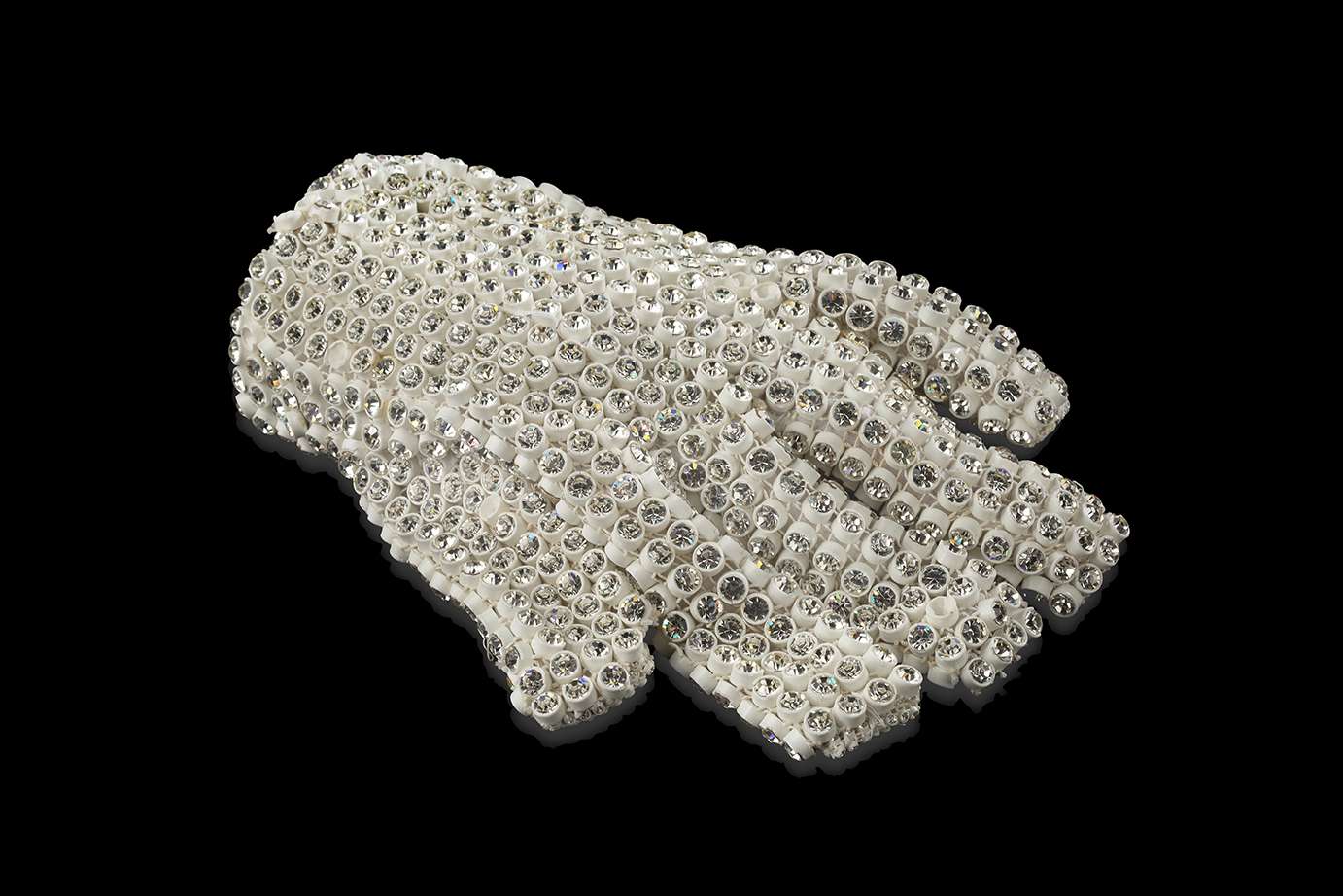
A unique “left-hand” prototype glove attributed to Bill Whitten’s workshop.
The glove is described by Keith Holman as having been made for Michael Jackson by Bill Whitten’s workshop; it represents a transitional piece between the “Motown 25” glove and later stage designs.
A unique “left-hand” prototype glove attributed to Bill Whitten’s workshop.
The glove is described by Keith Holman as having been made for Michael Jackson by Bill Whitten’s workshop; it represents a transitional piece between the “Motown 25” glove and later stage designs.
In the mid-1980s, as Michael Jackson was cementing his global image following *Thriller*, the ‘Billie Jean’ look – a glittering black jacket, white T-shirt, black trousers, loafers and a single glove – established itself as one of the most recognisable outfits in the history of pop.
The glove worn during Motown 25: Yesterday, Today, Forever in 1983 – a white golf glove for the left hand, studded with rhinestones – became a visual icon. It was no longer merely an accessory, but a symbol. It paved the way for more complex variations, designed to meet the demands of the stage and the evolution of Michael Jackson’s on-stage image. In this context, Bill Whitten and his workshop embarked on a process of adaptation and iteration: prototypes were developed to refine the design, its performance under the spotlights and the clarity of the choreographed movements. The glove on display belongs to this intermediate phase, where the accessory oscillates between an initial handmade solution and a fully realised stage prop.
Originally introduced to emphasise the gestures of the left hand in ‘Billie Jean’, the crystal glove became a signature feature, revisited and transformed throughout performances and tours.
A signed letter from Keith Holman, written on Holman Harper Designs letterhead and presented to the buyer, accompanies the lot. Keith Holman, assistant to Bill Whitten—the costume designer central to the construction of Michael Jackson’s visual identity—describes the conditions under which the gloves were created in the context of the Victory Tour. He recounts Michael Jackson’s request for an accessory that was “different, unique, unprecedented”, followed by the shift from the concept of a pair to that of a single glove. He traces the technical evolution: from a golf glove embroidered with rhinestones to versions embellished with Swarovski crystals of various sizes. The glove is described as a prototype, or ‘tester glove’, part of the workshop’s own research and development process.
According to this same account, the glove was kept for several years in the workshop’s archives before being put back into circulation for charitable purposes, notably in connection with ‘Bubbles the Chimp’ and the ‘Center for Great Apes’. The associated documents mention this initiative and depict the item in this context, adding a narrative dimension to its history.
The glove clearly stands at the crossroads between the original golf glove and the future stage gloves: designed to be worn on the left hand—the left hand, as at Motown’s 25th anniversary—and entirely covered, on both the palm and the back, with strips and patches of hand-sewn crystals. This design corresponds to Keith Holman’s description of a pattern comprising approximately 1,200 Swarovski crystals of various sizes, individually mounted on a flexible five-finger base, in keeping with the creations of the Bill Whitten workshop during this period. The overall condition is consistent with a workshop piece: most of the crystals appear to be in place, with a few isolated missing crystals and scuffing at the edges indicating genuine wear rather than a recent, purely decorative creation.
The glove is the result of a process entirely carried out by individually attaching crystals to a flexible textile base. Each rhinestone is applied stitch by stitch, following a design drawn directly onto the hand. The Swarovski crystals, of varying sizes, are distributed in zones of density, creating distinct light effects depending on the angle and movement. The structure reveals visible stitching in places, with alterations and adjustments typical of workshop pieces. The piece is clearly a stage prototype, where its value lies in the craftsman’s hand and the time taken to create it.
Based on the available information, the piece should be presented as a prototype glove attributed to Bill Whitten’s workshop, designed for Michael Jackson according to Keith Holman’s account. Its uniqueness lies in its status as a genesis piece, resulting from the workshop’s work on the development of the iconic glove. This prototype forms part of the history of the construction of Michael Jackson’s iconography.
– Bill Whitten Workshop, Los Angeles: a prototype/test glove created for Michael Jackson by Bill Whitten and his team in the mid-1980s, subsequently kept in the costume designer’s archives, according to a letter from Keith Holman.
– Keith Holman, Whitten’s assistant, who preserves and documents the glove, provides a detailed description and a letter of authenticity explaining its place in the evolution of Michael Jackson’s gloves.
– The Memorabilia Vault, USA: online auction, February 2016, lot 50, presents the glove under the title ‘MICHAEL JACKSON PROTOTYPE GLOVE CREATED BY BILL WHITTEN’, echoing Holman’s analysis and stating that it is the only prototype glove of this type, made for and worn by Michael Jackson
– Richard Fossaas Collection, Norway
– Private collection, New York