
&w=3840&q=75)
&w=3840&q=75)
&w=3840&q=75)
&w=3840&q=75)
&w=3840&q=75)
&w=3840&q=75)
&w=3840&q=75)
&w=3840&q=75)


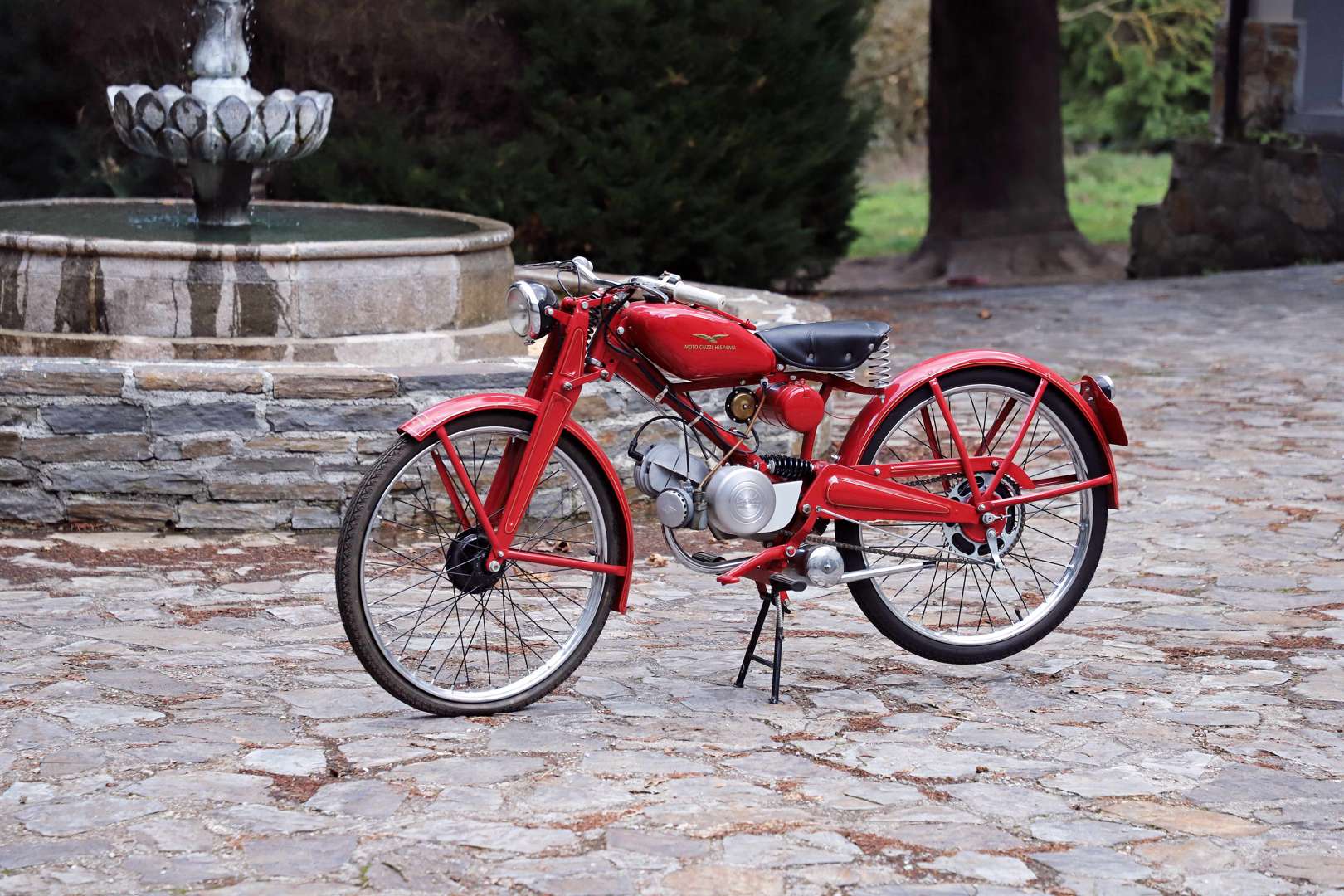
c.1963 Moto Guzzi Hispania 65cc
Chassis no. MGH-721692
Engine no. 693702
No reserve price
Fees include commission and taxes.
Chassis no. MGH-721692
Engine no. 693702
No reserve price
No registration certificate
No MOT
The story begins in 1948, when Oscar Ravà, an Italian entrepreneur of Jewish origin and former FIAT director who had taken refuge in Catalonia during the war, negotiated with Carlo Guzzi for the licence to manufacture the famous 65cc model in Spain. The arrangement was ingenious: Ravà did not build his own factory, but relied on prestigious subcontractors. The engines were entrusted to ISA, Industrias Subsidiarias de Aviación in Seville, and the frames to Rabasa in Mollet, which would later become Derbi. Final assembly was carried out by his own company, Motorhispania, in Barcelona. A decentralised industrial model, remarkably efficient for the time.
Success was immediate and spectacular. Lightweight, reliable and economical, with a retail price that never exceeded 15,500 pesetas over fifteen years on the market, the Moto Guzzi Hispania 65 became the best-selling lightweight motorcycle in Europe for nearly a decade.
Its 63.7 cm³ horizontal single-cylinder two-stroke engine with three-speed gearbox was remarkably simple and robust, a mechanical design conceived in Mandello del Lario to withstand the toughest conditions, and perfectly suited to the roads and needs of a Spain still in the process of reconstruction. The parallelogram front suspension and rear spring suspension completed a simple, efficient machine, offering superior comfort to the ordinary bicycle it replaced in the daily lives of thousands of Spaniards.
1963 was precisely the year when everything changed. A change in legislation set the limit for mopeds at 50 cm³, immediately requiring the 65 to undergo registration and for its rider to obtain a driving licence – a fatal blow to its sales, which plummeted by more than 50% in a single year.
A 1963 model is therefore one of the very last to have rolled off the Motorhispania production line before the company’s future took a new direction.
For any enquiries or to receive a condition report, please contact us on 06.52.56.31.11 or write to the following address: motos@aguttes.com
Please note that this lot must be collected after the sale near Bagnères-de-Luchon, in the Central Pyrenees, in the town of Les - Lérida; collection must take place between 5 and 10 May 2026.
Aguttes can assist you with the transport and delivery of your motorbikes; personalised quotes can be provided, so please do not hesitate to contact us regarding this.
The story begins in 1948, when Oscar Ravà, an Italian entrepreneur of Jewish origin and former FIAT director who had taken refuge in Catalonia during the war, negotiated with Carlo Guzzi for the licence to manufacture the famous 65cc model in Spain. The approach was ingenious: Ravà did not build his own factory, but relied on prestigious subcontractors. The engines were entrusted to ISA, Industrias Subsidiarias de Aviación in Seville, and the frames to Rabasa in Mollet, which would later become Derbi. Final assembly was carried out by his own company, Motorhispania, in Barcelona. A decentralised industrial model, remarkably efficient for its time.
Success was immediate and spectacular. Lightweight, reliable and economical, with a retail price that never exceeded 15,500 pesetas over fifteen years on the market, the Moto Guzzi Hispania 65 became the best-selling lightweight motorcycle in Europe for nearly a decade.
Its 63.7 cm³ horizontal single-cylinder two-stroke engine with three-speed gearbox was remarkably simple and robust; a mechanical design conceived in Mandello del Lario to withstand the toughest conditions, and perfectly suited to the roads and needs of a Spain still in the process of reconstruction. The parallelogram front suspension and rear spring suspension completed a simple, efficient machine, offering superior comfort to the ordinary bicycle it replaced in the daily lives of thousands of Spaniards.
1963 was precisely the year when everything changed. A change in legislation set the limit for mopeds at 50 cm³, immediately requiring the 65 to undergo registration and for its rider to obtain a driving licence – a fatal blow to its sales, which plummeted by more than 50% in a single year.
A 1963 model is therefore one of the very last to have rolled out of the Motorhispania workshops before the company’s fortunes took a turn.
No reserve price