
&w=3840&q=75)
&w=3840&q=75)
&w=3840&q=75)
&w=3840&q=75)
&w=3840&q=75)
&w=3840&q=75)
&w=3840&q=75)
&w=3840&q=75)


15
Paul-Elie GERNEZ (1888-1948)
The item was sold for 5 850 €
Fees include commission and taxes.
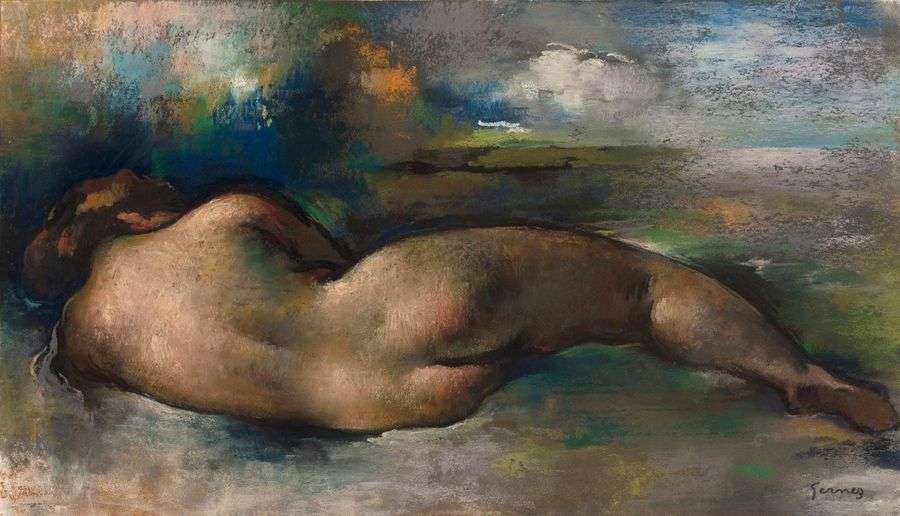
Paul-Elie GERNEZ (1888-1948)
Nu allongé de dos dans un paysage, 1938
Pastel on paper, signed lower right.
13 3/4 x 23 5/8 in.
PAUL-ÉLIE GERNEZ
In 1888, Paul-Élie Gernez was born into a humble farm family in Onnaing, near Valenciennes. From the age of 13 to 22, he studied at the Valenciennes School of Fine Arts and took classes with Fortuné Layraud (1833- 1913).
Gernez greatly admired Northern painting, which he studied at Northern museums. His artistic training deeply influenced his taste for academicism. In 1911, he became a drawing teacher at the Honfleur middle school, a position he held for over a decade. That city in Calvados is where he spent his entire career, splitting his time between his home on the banks of the Seine Estuary and frequent stays in Paris, where shows at the Bernheim-Jeune, Berthe Weill, Armand Drouant and Eugène Druet galleries and the Salon de la Société des Artistes Indépendants, Salon d'Automne and Salon des Tuileries raised his artistic profile. He also frequented a small circle of artist friends who introduced him to Félix Vallotton.
The young Gernez painted religious subjects before turning mainly to five genres, occasionally drawing on examples from past centuries: landscapes, seascapes, still-lifes, nudes and portraits almost bordering on genre scenes. They make up most of his plentiful output, estimated at several thousand works.
Unlike Henri de Saint-Delis, for example, Gernez did not chronicle the port's working activities or daily life in Honfleur. Instead, he focused on a feeling, examining the landscape in a much more atmospheric than anecdotal way. Like Eugène Boudin, he painted many excellent studies of the sky.
Neo-impressionism, the Nabis and Cubism clearly influenced his early work, from the 1910s to the early 1920s. In 1922, he gradually returned to more realistic figurative art and developed a more personal sensibility. The forms grew softer, but his signature “sty
Nu allongé de dos dans un paysage, 1938
Pastel on paper, signed lower right.
13 3/4 x 23 5/8 in.
PAUL-ÉLIE GERNEZ
In 1888, Paul-Élie Gernez was born into a humble farm family in Onnaing, near Valenciennes. From the age of 13 to 22, he studied at the Valenciennes School of Fine Arts and took classes with Fortuné Layraud (1833- 1913).
Gernez greatly admired Northern painting, which he studied at Northern museums. His artistic training deeply influenced his taste for academicism. In 1911, he became a drawing teacher at the Honfleur middle school, a position he held for over a decade. That city in Calvados is where he spent his entire career, splitting his time between his home on the banks of the Seine Estuary and frequent stays in Paris, where shows at the Bernheim-Jeune, Berthe Weill, Armand Drouant and Eugène Druet galleries and the Salon de la Société des Artistes Indépendants, Salon d'Automne and Salon des Tuileries raised his artistic profile. He also frequented a small circle of artist friends who introduced him to Félix Vallotton.
The young Gernez painted religious subjects before turning mainly to five genres, occasionally drawing on examples from past centuries: landscapes, seascapes, still-lifes, nudes and portraits almost bordering on genre scenes. They make up most of his plentiful output, estimated at several thousand works.
Unlike Henri de Saint-Delis, for example, Gernez did not chronicle the port's working activities or daily life in Honfleur. Instead, he focused on a feeling, examining the landscape in a much more atmospheric than anecdotal way. Like Eugène Boudin, he painted many excellent studies of the sky.
Neo-impressionism, the Nabis and Cubism clearly influenced his early work, from the 1910s to the early 1920s. In 1922, he gradually returned to more realistic figurative art and developed a more personal sensibility. The forms grew softer, but his signature “sty