
&w=3840&q=75)
&w=3840&q=75)
&w=3840&q=75)
&w=3840&q=75)
&w=3840&q=75)
&w=3840&q=75)
&w=3840&q=75)
&w=3840&q=75)


13
Francis PICABIA (1879-1953)
The item was sold for 127 400 €
Fees include commission and taxes.
Francis PICABIA (1879-1953)
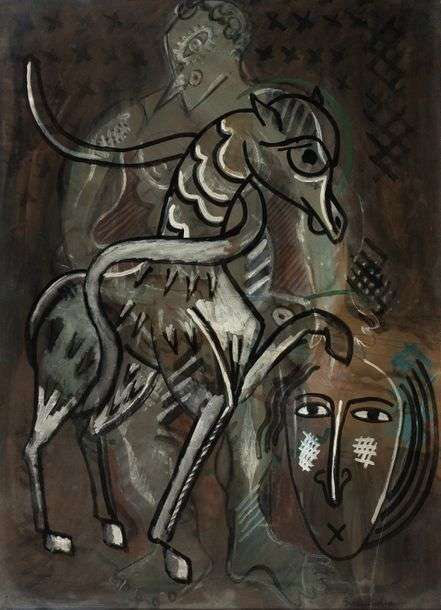
Transparence, 1925-1927
40 1/2 x 29 1/2 in.
Gouache, watercolor and ink on cardboard, signed lower right.
FRANCIS PICABIA
Francis Picabia was a Spanish avant-garde artist born in Paris in 1879. He began drawing and painting when he was very young. In 1895, he entered the Ecole des Arts Décoratifs, where he met George Braque and Marie Laurencin. In 1899, he made his debut at the Salon des Artistes Français. Picabia was interested and participated in all the artistic movements of his time, starting with Impressionism under the influence of Sisley and Pissarro. His work was highly successful and brought him critical acclaim. In 1909, his art took a new direction, and he experimented with abstraction. But his patrons and galleries did not go along with him in this new phase, though he continued to exhibit in various salons.
To quote art historian Marc le Bot in his thesis on Picabia, «In the years leading up to the 1914 war, Picabia came up with more ideas than any other artist of the avant-garde. A Cubist like Braque and Picasso| an Orphic like Delaunay, he even invented abstract art, without ever systematically adopting any of these approaches.»
Ces transparences avec leur coin d'oubliettes me permettent de m'exprimer à la ressemblance de mes volontés intérieures
In February 1928, Picabia took part in the opening exhibition of the Favre Gallery in Cannes. As well as the Spanish watercolours known and admired by the public, this featured the prototype for his future «Transparences», Caraïbe et Papillon. While it seemed to be cold-shouldered by critics and public alike, this was the only work La Révolution surréaliste deigned to reproduce in its issue of the following month.
The artist began working on these «transparences» in 1927. They involved a personal visual and aesthetic innovation. In technical terms, Picabia superimposed several layers by using transparent paper or cellophane. He mixed techni
Transparence, 1925-1927
40 1/2 x 29 1/2 in.
Gouache, watercolor and ink on cardboard, signed lower right.
FRANCIS PICABIA
Francis Picabia was a Spanish avant-garde artist born in Paris in 1879. He began drawing and painting when he was very young. In 1895, he entered the Ecole des Arts Décoratifs, where he met George Braque and Marie Laurencin. In 1899, he made his debut at the Salon des Artistes Français. Picabia was interested and participated in all the artistic movements of his time, starting with Impressionism under the influence of Sisley and Pissarro. His work was highly successful and brought him critical acclaim. In 1909, his art took a new direction, and he experimented with abstraction. But his patrons and galleries did not go along with him in this new phase, though he continued to exhibit in various salons.
To quote art historian Marc le Bot in his thesis on Picabia, «In the years leading up to the 1914 war, Picabia came up with more ideas than any other artist of the avant-garde. A Cubist like Braque and Picasso| an Orphic like Delaunay, he even invented abstract art, without ever systematically adopting any of these approaches.»
Ces transparences avec leur coin d'oubliettes me permettent de m'exprimer à la ressemblance de mes volontés intérieures
In February 1928, Picabia took part in the opening exhibition of the Favre Gallery in Cannes. As well as the Spanish watercolours known and admired by the public, this featured the prototype for his future «Transparences», Caraïbe et Papillon. While it seemed to be cold-shouldered by critics and public alike, this was the only work La Révolution surréaliste deigned to reproduce in its issue of the following month.
The artist began working on these «transparences» in 1927. They involved a personal visual and aesthetic innovation. In technical terms, Picabia superimposed several layers by using transparent paper or cellophane. He mixed techni