
&w=3840&q=75)
&w=3840&q=75)
&w=3840&q=75)
&w=3840&q=75)
&w=3840&q=75)
&w=3840&q=75)
&w=3840&q=75)
&w=3840&q=75)


9
Rembrandt BUGATTI (1884-1916)
The item was sold for 80 600 €
Fees include commission and taxes.
Rembrandt BUGATTI (1884-1916)
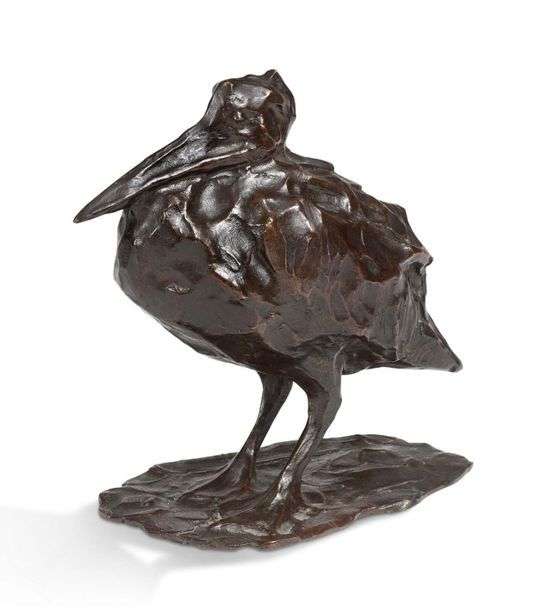
Pélican au repos, circa 1904
Brown patined bronze, stamped by the founder and signed on the base
Height: 5 7/8 in.
Length: 5 3/8 in.
Width: 3 1/4 in.
REMBRANDT BUGATTI
Rembrandt Annibale Bugatti was one of the early twentieth century's most notable animal sculptors. Born in Milan, he moved to Paris in 1903 and began a fruitful collaboration with Adrien-Aurélien Hébrard, a founder recognised for the precision and quality of his bronzes' patinas. Hébrard's gallery was located at 8 rue Royale, ensuring the sculptor a high profile. Several of his signature pieces are in public collections, notably at the Musée d'Orsay.
Bugatti's fascination with animals led him to spend many hours observing the wildlife at the Jardin des Plantes menagerie. Several years later, he was invited to Antwerp by the Royal Zoological Society, which set up a studio for him right inside the zoo. That is where his singularity lies. Unlike his contemporaries, he did not work from sketches or photographs of the creatures he depicted but sculpted them from life, in front of the enclosure.
Between 1904 and 1906, Bugatti devoted part of his large bestiary to pelicans in various situations. Our Pelican at Rest, whose wings are folded, hides its throat pouch in its feathers, which seem to be ruffling in the wind. The sense of instantaneousness is a direct result of how Bugatti crafted his sculptures. He used plastiline, a highly malleable material that, unlike plaster, which is more constraining, allowed him to work in situ at his own pace for as long as he needed to and, consequently, to be more precise and expressive in what he produced. Favouring free modelling without preparatory drawings, through the spontaneity of his gesture he made captivatingly naturalistic sculptures where his fingerprints can be found.
Pélican au repos, circa 1904
Brown patined bronze, stamped by the founder and signed on the base
Height: 5 7/8 in.
Length: 5 3/8 in.
Width: 3 1/4 in.
REMBRANDT BUGATTI
Rembrandt Annibale Bugatti was one of the early twentieth century's most notable animal sculptors. Born in Milan, he moved to Paris in 1903 and began a fruitful collaboration with Adrien-Aurélien Hébrard, a founder recognised for the precision and quality of his bronzes' patinas. Hébrard's gallery was located at 8 rue Royale, ensuring the sculptor a high profile. Several of his signature pieces are in public collections, notably at the Musée d'Orsay.
Bugatti's fascination with animals led him to spend many hours observing the wildlife at the Jardin des Plantes menagerie. Several years later, he was invited to Antwerp by the Royal Zoological Society, which set up a studio for him right inside the zoo. That is where his singularity lies. Unlike his contemporaries, he did not work from sketches or photographs of the creatures he depicted but sculpted them from life, in front of the enclosure.
Between 1904 and 1906, Bugatti devoted part of his large bestiary to pelicans in various situations. Our Pelican at Rest, whose wings are folded, hides its throat pouch in its feathers, which seem to be ruffling in the wind. The sense of instantaneousness is a direct result of how Bugatti crafted his sculptures. He used plastiline, a highly malleable material that, unlike plaster, which is more constraining, allowed him to work in situ at his own pace for as long as he needed to and, consequently, to be more precise and expressive in what he produced. Favouring free modelling without preparatory drawings, through the spontaneity of his gesture he made captivatingly naturalistic sculptures where his fingerprints can be found.