
&w=3840&q=75)
&w=3840&q=75)
&w=3840&q=75)
&w=3840&q=75)
&w=3840&q=75)
&w=3840&q=75)
&w=3840&q=75)
&w=3840&q=75)


9
Moïse KISLING (1891-1953)
The item was sold for 20 800 €
Fees include commission and taxes.
Moïse KISLING (1891-1953)
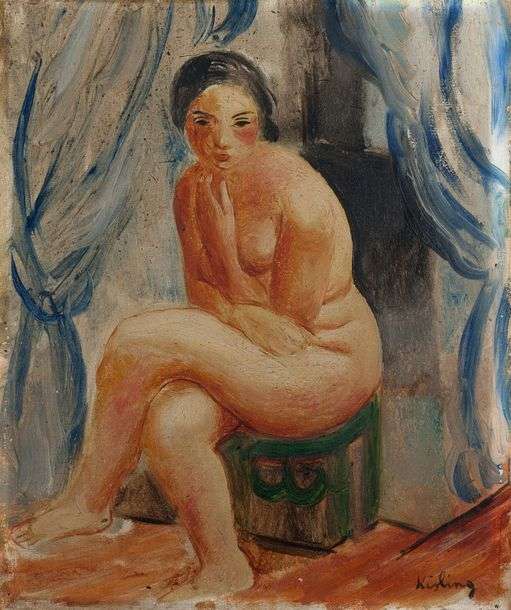
Oil on canvas, signed lower right
10 5/8 x 8 11/16 in.
Moïse Kisling (1891-1953) was born in Krakow, in Poland. He studied at the Krakow Fine Arts School with Josef Pankiewicz, a figurehead of 20th Polish century Impressionist art. In the 1910s, much taken by his pupil's remarkable talent, he suggested he go to Paris.
In the bubbling atmosphere of early 20th century art in Paris, Kisling met various prominent artists like Picasso, Soutine and particularly Modigliani, who became a close friend. Alongside these artists, he became part of what became known as the "Paris School": a whole generation of artists at the origin of Modern Art. In 1919, he exhibited at the Druet gallery, enabling him to establish a certain reputation. First inspired by the painting of André Derain and Jean Cocteau, he then turned to the forerunners of abstraction under the influence of cubists like Braque and Picasso.
Known and liked above all for his approach to the feminine, he made a name with his nudes and portraits. The piece presented today is a perfect example of his talent and ability to show women in all their humanity. This work is remarkable as it is constructed around a carefully studied ambivalence. The young woman is presented to the gaze in all her untrammelled nudity, set off by the curtains in the background evoking the stage of a theatre or cabaret. Yet, in a beautiful, modest gesture, she veils her body, protecting herself from the probing eye of the artist and the viewer. The play on opposites is not only thematic| it is also found in the palette, where Kisling uses cool shades for the curtains but very warm colours for the protagonist's body. The sense of surprising this young woman in a private moment is emphasised by the small size of the picture and its very tight composition, which isolates the figure.
Here, the eternal subject of the nude is given extremely modern treatment by Kisling, who creates a fragile balance in this work b
Oil on canvas, signed lower right
10 5/8 x 8 11/16 in.
Moïse Kisling (1891-1953) was born in Krakow, in Poland. He studied at the Krakow Fine Arts School with Josef Pankiewicz, a figurehead of 20th Polish century Impressionist art. In the 1910s, much taken by his pupil's remarkable talent, he suggested he go to Paris.
In the bubbling atmosphere of early 20th century art in Paris, Kisling met various prominent artists like Picasso, Soutine and particularly Modigliani, who became a close friend. Alongside these artists, he became part of what became known as the "Paris School": a whole generation of artists at the origin of Modern Art. In 1919, he exhibited at the Druet gallery, enabling him to establish a certain reputation. First inspired by the painting of André Derain and Jean Cocteau, he then turned to the forerunners of abstraction under the influence of cubists like Braque and Picasso.
Known and liked above all for his approach to the feminine, he made a name with his nudes and portraits. The piece presented today is a perfect example of his talent and ability to show women in all their humanity. This work is remarkable as it is constructed around a carefully studied ambivalence. The young woman is presented to the gaze in all her untrammelled nudity, set off by the curtains in the background evoking the stage of a theatre or cabaret. Yet, in a beautiful, modest gesture, she veils her body, protecting herself from the probing eye of the artist and the viewer. The play on opposites is not only thematic| it is also found in the palette, where Kisling uses cool shades for the curtains but very warm colours for the protagonist's body. The sense of surprising this young woman in a private moment is emphasised by the small size of the picture and its very tight composition, which isolates the figure.
Here, the eternal subject of the nude is given extremely modern treatment by Kisling, who creates a fragile balance in this work b