
&w=3840&q=75)
&w=3840&q=75)
&w=3840&q=75)
&w=3840&q=75)
&w=3840&q=75)
&w=3840&q=75)
&w=3840&q=75)
&w=3840&q=75)


28
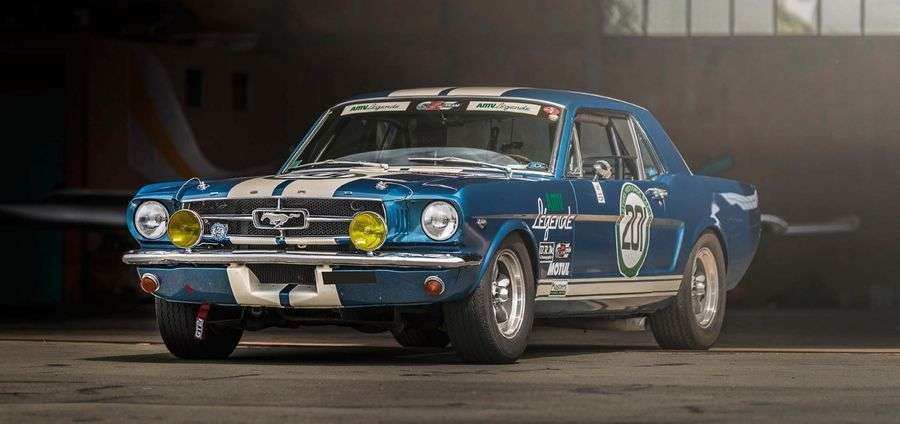
Ford MUSTANG FIA 289 1965
The item was sold for 71 400 €
Fees include commission and taxes.
Ford MUSTANG FIA 289 1965
Eligible for all major historic events
Prepared by Curt Vogt and Cobra Automotive
Road-registered
French historic-vehicle logbook
Chassis N° 5R07T213816
The Mustang hit the American market like a bombshell. On 17 April 1964 Ford unveiled its new model at the New York Word’s Fair, and on that very first day no fewer than 22,000 examples were ordered. Lee Iacocca, then general manager of the Ford Division of the Ford Motor Company, had introduced a new concept, the ‘Pony Car’ – a compact sporting model of European inspiration, sold at a low price and able to be personalised according to the customer’s wishes. Initially available as a coupé and a convertible, in 1965 a fastback joined the range. At first three engines were offered – a 2.8-litre straight-six, a 260ci 4.2- litre V8, and the well-regarded 289ci 4.7-litre V8 in three different tunes – but for ’65 the ‘six’ was up-gunned to 3.3 litres and the smaller V8 dropped. By 1966 more than a million Mustangs had been produced, and its youthful, fashionable and sporting image had attracted tuners such as Carroll Shelby, who would achieve fame with his GT-350 and GT-500 conversions.
France wasn’t imune to the spell the car cast: Claude Lelouch, aided by Henri Chemin, then PR director at Ford, gave the Mustang legendary status by using it in the film Un homme et une femme – with the car taking part in the Monte Carlo Rally. Chemin also hired singer Johnny Hallyday as a driver for the ’67 Monte, a brilliant marketing coup. It was Henri Greder, though, who gained the Mustang its laurels in top European rallies, while Jacky Ickx won the European Touring Car Championship in 1965 after securing an incredible second place overall at the Nürburgring 24-hour race.
The Mustang presented in this catalogue has the famed ‘thinwall’ 289ci V8 and was fully competition-prepared about ten years ago in the United States, by the highly-respected Curt Vogt, fo
Eligible for all major historic events
Prepared by Curt Vogt and Cobra Automotive
Road-registered
French historic-vehicle logbook
Chassis N° 5R07T213816
The Mustang hit the American market like a bombshell. On 17 April 1964 Ford unveiled its new model at the New York Word’s Fair, and on that very first day no fewer than 22,000 examples were ordered. Lee Iacocca, then general manager of the Ford Division of the Ford Motor Company, had introduced a new concept, the ‘Pony Car’ – a compact sporting model of European inspiration, sold at a low price and able to be personalised according to the customer’s wishes. Initially available as a coupé and a convertible, in 1965 a fastback joined the range. At first three engines were offered – a 2.8-litre straight-six, a 260ci 4.2- litre V8, and the well-regarded 289ci 4.7-litre V8 in three different tunes – but for ’65 the ‘six’ was up-gunned to 3.3 litres and the smaller V8 dropped. By 1966 more than a million Mustangs had been produced, and its youthful, fashionable and sporting image had attracted tuners such as Carroll Shelby, who would achieve fame with his GT-350 and GT-500 conversions.
France wasn’t imune to the spell the car cast: Claude Lelouch, aided by Henri Chemin, then PR director at Ford, gave the Mustang legendary status by using it in the film Un homme et une femme – with the car taking part in the Monte Carlo Rally. Chemin also hired singer Johnny Hallyday as a driver for the ’67 Monte, a brilliant marketing coup. It was Henri Greder, though, who gained the Mustang its laurels in top European rallies, while Jacky Ickx won the European Touring Car Championship in 1965 after securing an incredible second place overall at the Nürburgring 24-hour race.
The Mustang presented in this catalogue has the famed ‘thinwall’ 289ci V8 and was fully competition-prepared about ten years ago in the United States, by the highly-respected Curt Vogt, fo