
&w=3840&q=75)
&w=3840&q=75)
&w=3840&q=75)
&w=3840&q=75)
&w=3840&q=75)
&w=3840&q=75)
&w=3840&q=75)
&w=3840&q=75)

38BIS
TOSHIMITSU IMAÏ (1928-2002)
The item was sold for 4 800 €
Fees include commission and taxes.
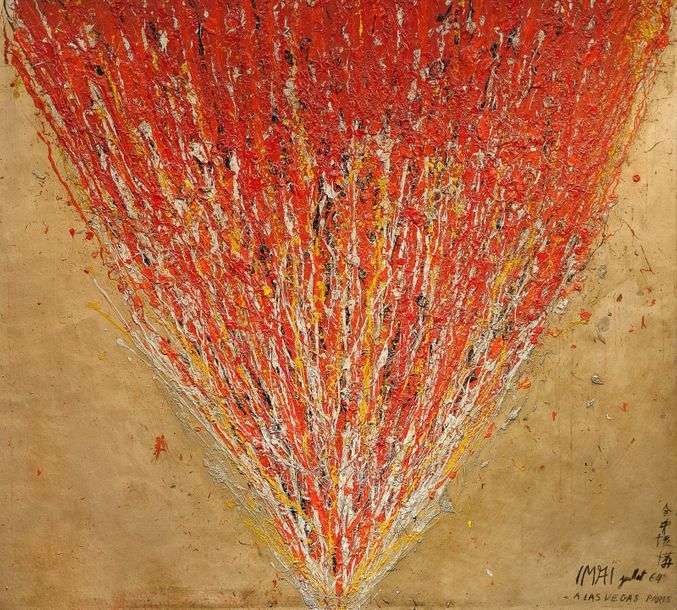
TOSHIMITSU IMAÏ (1928-2002)
Mixed media on panel, signed, located and dated lower right
48 13/16 x 54 5/8 in.
1964 was a very busy year for the artist, as several iconic high society venues called on his skills to create decors on canvas.
For example, the Las Vegas, a fashionable Sixties go-go club in Paris, commissioned several paintings from him, one of which is presented here. It takes up the themes of fire and light, expressing them in "Ariadne threads": a term used by his contemporaries to describes his thin paintbrush lines in relief.
Likewise, on his return from Tokyo in September, he painted the ceiling of the Tokiwaya restaurant and a monumental mural for the Shangri-La in 1965-66.
The Japanese artist Toshimitsu Imai was born in Kyoto in 1928.
After traditional studies, Imai studied at the Tokyo Fine Arts School in 1948. In 1952, he travelled to Paris and entered the Académie de la Grande Chaumière, as well as the Sorbonne, where he studied history and mediaeval philosophy.
Between 1950 and 1954, he exhibited several times in Paris, and became friends with the critic Michel Tapié. His painting, until then similar to Fauvism, with large blocks of warm, flat colours, moved towards Abstraction. In this respect, Imai was the first Japanese artists to join the Informal Art movement. His compositions incorporated figurative motifs, poems and prose texts, making his paintings a medium for his poetry.
The artist was also well-known for his monumental abstract works.
In his compositions, Imai used k impasto, a thickened oil or acrylic paint, and integrated fluid ink lines into it to create a chaotic effect.
His knowledge of history and mediaeval philosophy provided the artist with wide-ranging sources of inspiration for his work.
His considerable success during his lifetime enabled him to exhibit alongside leading exponents of Abstraction, including Georges Mathieu and Sam Francis. He showed pieces at the Sao Paulo Biennial in 1953, and at the Venice Biennial seven years later.
In 1956, Toshimistu Imai staged an exhibition in his homeland with his artist friends Georges Mathieu and Sam Francis, and thus played a crucial role in introducing European Abstract art to Japan.
In the 1970s, the artist's typical Fauvist style gave way to a creative approach that incorporated Japanese characters and cultural elements into his paintings.
During the latter part of his career, Toshimitsu Imai focused particularly on depicting the Sino-Japanese War, and on the Second World War.
The artist died in 2002 after a long illness.
Mixed media on panel, signed, located and dated lower right
48 13/16 x 54 5/8 in.
1964 was a very busy year for the artist, as several iconic high society venues called on his skills to create decors on canvas.
For example, the Las Vegas, a fashionable Sixties go-go club in Paris, commissioned several paintings from him, one of which is presented here. It takes up the themes of fire and light, expressing them in "Ariadne threads": a term used by his contemporaries to describes his thin paintbrush lines in relief.
Likewise, on his return from Tokyo in September, he painted the ceiling of the Tokiwaya restaurant and a monumental mural for the Shangri-La in 1965-66.
The Japanese artist Toshimitsu Imai was born in Kyoto in 1928.
After traditional studies, Imai studied at the Tokyo Fine Arts School in 1948. In 1952, he travelled to Paris and entered the Académie de la Grande Chaumière, as well as the Sorbonne, where he studied history and mediaeval philosophy.
Between 1950 and 1954, he exhibited several times in Paris, and became friends with the critic Michel Tapié. His painting, until then similar to Fauvism, with large blocks of warm, flat colours, moved towards Abstraction. In this respect, Imai was the first Japanese artists to join the Informal Art movement. His compositions incorporated figurative motifs, poems and prose texts, making his paintings a medium for his poetry.
The artist was also well-known for his monumental abstract works.
In his compositions, Imai used k impasto, a thickened oil or acrylic paint, and integrated fluid ink lines into it to create a chaotic effect.
His knowledge of history and mediaeval philosophy provided the artist with wide-ranging sources of inspiration for his work.
His considerable success during his lifetime enabled him to exhibit alongside leading exponents of Abstraction, including Georges Mathieu and Sam Francis. He showed pieces at the Sao Paulo Biennial in 1953, and at the Venice Biennial seven years later.
In 1956, Toshimistu Imai staged an exhibition in his homeland with his artist friends Georges Mathieu and Sam Francis, and thus played a crucial role in introducing European Abstract art to Japan.
In the 1970s, the artist's typical Fauvist style gave way to a creative approach that incorporated Japanese characters and cultural elements into his paintings.
During the latter part of his career, Toshimitsu Imai focused particularly on depicting the Sino-Japanese War, and on the Second World War.
The artist died in 2002 after a long illness.