
&w=3840&q=75)
&w=3840&q=75)
&w=3840&q=75)
&w=3840&q=75)
&w=3840&q=75)
&w=3840&q=75)
&w=3840&q=75)
&w=3840&q=75)

29
Francis PICABIA (1879-1953)
The item was sold for 360 880 €
Fees include commission and taxes.
Francis PICABIA (1879-1953)
Mixed media, drawing (pastel, Indian ink, wash and pencil) on tinted paper laid down on board, signed lowed
45 7/8 x 35 3/4 in.
In February 1928, Picabia took part in the opening exhibition of the Favre Gallery in Cannes. As well as the Spanish watercolours known and admired by the public, this featured the prototype for his future «transparences», Caraïbe et Papillon. While it seemed to be cold-shouldered by critics and public alike, this was the only work La Révolution surréaliste deigned to reproduce in its issue of the following month.
Picabia sought constantly to renew his painting, and would rather have forsaken his art altogether than stagnate in the same stylistic vein for too long.
For example, after an Impressionist and post-Impressionist phase, he embraced the cause of radical abstraction, only to reject it in turn. While he was having his new studio built in Mougins, he took up some earlier watercolours, making almost ghostly forms emerge from them, which he intermingled.
The artist began working on these «transparences» in 1927. By superimposing layers of watercolour wash and pastel, using broad lines in Indian ink to outline the silhouettes, he made the various planes stand out by using transparent paper - and even cellophane. He himself commented on this sudden change of style: «My current aesthetic comes from the boredom I feel looking at paintings that seem to be frozen on an immobile surface, completely divorced from human matters. This third dimension not made of light and shade| these transparences with their hidden aspects enable me to express myself in a way that reflects my inner desires. When I lay the first stone, it lies beneath my painting and my drawing.» What fascinated Picabia's contemporaries was «a sensation of the third dimension expressed without using perspective”, to quote Marcel Duchamp, Picabia's champion in the US.
Picabia abandoned his Spanish watercolours, which had served as a starting point, and made these transparences a sphere of constant exploration in both technical and stylistic terms, while seeking ever-more sources of inspiration. He even created one piece on the back of his mistress, Olga Molher, for the «Nuit Tatouée» gala in September 1930, which opened the winter season in Cannes.
These transparences were an opportunity to revive his quest for aesthetic perfection after a long period of stylistic rebellion when he rejected all forms of figurative art.
While the technical process was decidedly innovative, he drew inspiration from the Christian tradition and two great Renaissance masters: Piero della Francesca and above all Botticelli, whose Madonnas and nymphs he particularly admired for their stylised poses and refined features.
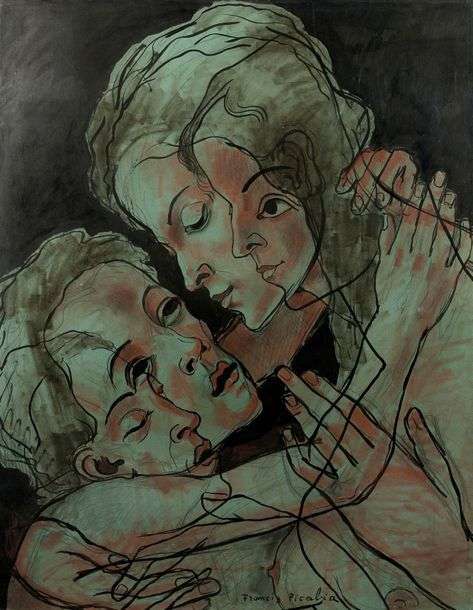
The work here, Quadrilogie amoureuse, produced in 1933, is probably the apotheosis of this pictorial quest, at the heart of a dialogue between a radical discovery and an accumulation of conventional sources of inspiration. The colours in wash and pastel are cleaner and more solid, contained within elaborate linear motifs in Indian ink, while the more tightly intermingled silhouettes (a matter of coexistence rather than cohesion) interact and repeat, giving the composition a decidedly fascinating, kaleidoscopic feel.
The meaning of this monumental drawing is deeply enigmatic, opening the way to myriad readings. It is possible to make out masculine and feminine zones, though the bodies are tightly interwoven. The gazes are kind-hearted, and the female faces are reminiscent of Botticelli's, displaying similarities with the Madonna figures so dear to Picabia. But while a Christian Virgin and Child iconography is suggested, the nudity of the figures and a certain sensuality forbid this interpretation.
In these four figures, we can see the artist, his wife Germaine, his mistress Olga and his son Lorenzo, all of whom lived together under the same roof for much of the time.
The Quadrilogie amoureuse could also be seen in a Symbolist light as representing different forms of love: the relationship between mother and child, father and daughter, husband and wife, and man and woman as lovers. There is thus a discernible oscillation between maternal, filial, marital and erotic love.
After an exhibition of Picabia's pieces at the Briant Gallery in 1929, poet Jean Van Heeckeren stated emphatically that «Picabia has made an extraordinary discovery in painting, which consists of superimposing several figures through the use of transparency. Nobody has done this before. (...) This discovery is as important and fertile as the idea of non-representation twenty-odd years ago.»
Mixed media, drawing (pastel, Indian ink, wash and pencil) on tinted paper laid down on board, signed lowed
45 7/8 x 35 3/4 in.
In February 1928, Picabia took part in the opening exhibition of the Favre Gallery in Cannes. As well as the Spanish watercolours known and admired by the public, this featured the prototype for his future «transparences», Caraïbe et Papillon. While it seemed to be cold-shouldered by critics and public alike, this was the only work La Révolution surréaliste deigned to reproduce in its issue of the following month.
Picabia sought constantly to renew his painting, and would rather have forsaken his art altogether than stagnate in the same stylistic vein for too long.
For example, after an Impressionist and post-Impressionist phase, he embraced the cause of radical abstraction, only to reject it in turn. While he was having his new studio built in Mougins, he took up some earlier watercolours, making almost ghostly forms emerge from them, which he intermingled.
The artist began working on these «transparences» in 1927. By superimposing layers of watercolour wash and pastel, using broad lines in Indian ink to outline the silhouettes, he made the various planes stand out by using transparent paper - and even cellophane. He himself commented on this sudden change of style: «My current aesthetic comes from the boredom I feel looking at paintings that seem to be frozen on an immobile surface, completely divorced from human matters. This third dimension not made of light and shade| these transparences with their hidden aspects enable me to express myself in a way that reflects my inner desires. When I lay the first stone, it lies beneath my painting and my drawing.» What fascinated Picabia's contemporaries was «a sensation of the third dimension expressed without using perspective”, to quote Marcel Duchamp, Picabia's champion in the US.
Picabia abandoned his Spanish watercolours, which had served as a starting point, and made these transparences a sphere of constant exploration in both technical and stylistic terms, while seeking ever-more sources of inspiration. He even created one piece on the back of his mistress, Olga Molher, for the «Nuit Tatouée» gala in September 1930, which opened the winter season in Cannes.
These transparences were an opportunity to revive his quest for aesthetic perfection after a long period of stylistic rebellion when he rejected all forms of figurative art.
While the technical process was decidedly innovative, he drew inspiration from the Christian tradition and two great Renaissance masters: Piero della Francesca and above all Botticelli, whose Madonnas and nymphs he particularly admired for their stylised poses and refined features.
The work here, Quadrilogie amoureuse, produced in 1933, is probably the apotheosis of this pictorial quest, at the heart of a dialogue between a radical discovery and an accumulation of conventional sources of inspiration. The colours in wash and pastel are cleaner and more solid, contained within elaborate linear motifs in Indian ink, while the more tightly intermingled silhouettes (a matter of coexistence rather than cohesion) interact and repeat, giving the composition a decidedly fascinating, kaleidoscopic feel.
The meaning of this monumental drawing is deeply enigmatic, opening the way to myriad readings. It is possible to make out masculine and feminine zones, though the bodies are tightly interwoven. The gazes are kind-hearted, and the female faces are reminiscent of Botticelli's, displaying similarities with the Madonna figures so dear to Picabia. But while a Christian Virgin and Child iconography is suggested, the nudity of the figures and a certain sensuality forbid this interpretation.
In these four figures, we can see the artist, his wife Germaine, his mistress Olga and his son Lorenzo, all of whom lived together under the same roof for much of the time.
The Quadrilogie amoureuse could also be seen in a Symbolist light as representing different forms of love: the relationship between mother and child, father and daughter, husband and wife, and man and woman as lovers. There is thus a discernible oscillation between maternal, filial, marital and erotic love.
After an exhibition of Picabia's pieces at the Briant Gallery in 1929, poet Jean Van Heeckeren stated emphatically that «Picabia has made an extraordinary discovery in painting, which consists of superimposing several figures through the use of transparency. Nobody has done this before. (...) This discovery is as important and fertile as the idea of non-representation twenty-odd years ago.»