
&w=3840&q=75)
&w=3840&q=75)
&w=3840&q=75)
&w=3840&q=75)
&w=3840&q=75)
&w=3840&q=75)
&w=3840&q=75)
&w=3840&q=75)


12
SANYU 常玉 (1901-1966)
The item was sold for 8 797 500 €
Fees include commission and taxes.
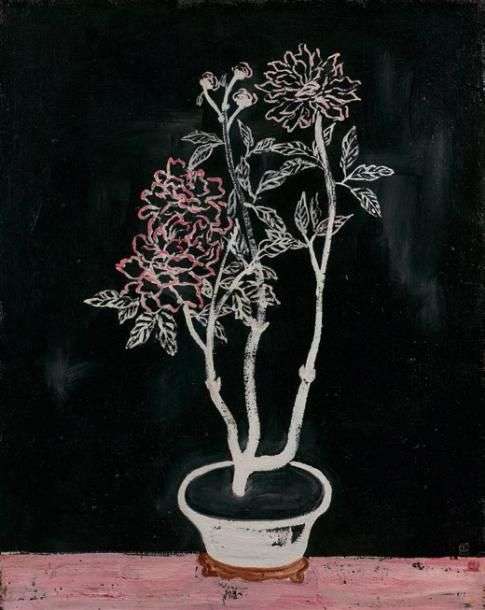
SANYU 常玉 (1901-1966)
Flowerpot or
Peonies, circa 1930《花盆与牡丹》约1930
Oil on canvas, signed lower right annotated on the back "Peonies by Sanyu" and numbered S 342 on the frame
92 x 73,5 cm - 36 1/4 x 29 in.
Oil on canvas, signed lower right, inscribed on reverse Pivoines par Sanyu
画布油画,署名于右下方,背面注有 "常玉牡 丹",木框注有编号S342。
BIBLIOGRAPHY
Sanyu, catalogue raisonné: oil paintings. Rita Wong. Yageo Foundation & Lin & Keng Art Publications, 2001. Reproduced in black and white p.268, no. 154
Sanyu, catalogue raisonné: oil paintings. Volume two. Rita Wong. Li-Ching Cultural and Educational Foundation, 2011. Reproduced p.24 figure 5, p.133 no.154 and p.160 figure 22
书录 《常玉油画全集》衣淑凡,国巨基金会大 未来艺术出版社联合出版,2001年,黑白 版,268页,编号154。 《常玉油画全集》第二册,衣淑凡,财团 法人立青文教基金会,2011年,第二版发 行,24页 图5,133页 编号154,160页 图 22。
EXHIBITION
Sanyu, Holland, in the 1930s-1940s (reproduced in situ in the centre of the exhibition - see catalogue raisonné volume II, p.24 figure 5 and p.160 figure 22)
PROVENANCE
Private collection, Ile de France
展览 1940年常玉荷兰个展(照片来自于《常玉油 画全集》第二册,24页图5和160页)图22. 来源 巴黎私人收藏
A FORGOTTEN WORK BY SANYU
«
You'd have to be a real killjoy not to be charmed by Sanyu's work, because his light grace and refined colors create an enchantment that's hard to resist. The young Chinese painter Sanyu... has joyfully accepted the heritage of the art of his ancestors, but he has also, in his own way, taken advantage of some of the new European ideas.
»
Yu Sanyu, Jan D. Voskuil (Dutch critic), Haarlem Courant, 22 October 1932, page 17
A young Chinese painter in Paris
As soon as he arrived in 1921, Sanyu enrolled at the Académie de la Grande Chaumière, and in the early 1920s he began to associate with his Chinese friends, especially Xu Beihong and his wife. Financially comfortable thanks to the support of his older brother, he gradually detached himself from his companions and devoted himself fully to academic courses in nude painting on a live model, thus demonstrating his interest in a subject that is emblematic of Western painting, to which he was seeking to become closer. He applied the method of Chinese calligraphy, which consisted of reproducing the same character until it was completely mastered: the brush strokes were incisive, and the sketches multiplied.
From 1925, he exhibited at the Salon d'Automne (1925, 1928) and sometimes in Parisian galleries. He produced his first oil paintings in 1929, thus further materialising his desire for integration through this choice, when his peers often remained faithful to rice paper, silk, ink and calligraphy brushes.
Patrons and protectors
The period of the early 1930s was very productive, although the death of his brother marked the end of a certain financial ease for the artist and the beginning of what he called his "bohemian life". Providentially, Sanyu's work came to the attention of the discerning art dealer Henri-Pierre Roché (1879-1959), who was known to have been a very active supporter of the artist's work.
PA2021
Flowerpot or
Peonies, circa 1930《花盆与牡丹》约1930
Oil on canvas, signed lower right annotated on the back "Peonies by Sanyu" and numbered S 342 on the frame
92 x 73,5 cm - 36 1/4 x 29 in.
Oil on canvas, signed lower right, inscribed on reverse Pivoines par Sanyu
画布油画,署名于右下方,背面注有 "常玉牡 丹",木框注有编号S342。
BIBLIOGRAPHY
Sanyu, catalogue raisonné: oil paintings. Rita Wong. Yageo Foundation & Lin & Keng Art Publications, 2001. Reproduced in black and white p.268, no. 154
Sanyu, catalogue raisonné: oil paintings. Volume two. Rita Wong. Li-Ching Cultural and Educational Foundation, 2011. Reproduced p.24 figure 5, p.133 no.154 and p.160 figure 22
书录 《常玉油画全集》衣淑凡,国巨基金会大 未来艺术出版社联合出版,2001年,黑白 版,268页,编号154。 《常玉油画全集》第二册,衣淑凡,财团 法人立青文教基金会,2011年,第二版发 行,24页 图5,133页 编号154,160页 图 22。
EXHIBITION
Sanyu, Holland, in the 1930s-1940s (reproduced in situ in the centre of the exhibition - see catalogue raisonné volume II, p.24 figure 5 and p.160 figure 22)
PROVENANCE
Private collection, Ile de France
展览 1940年常玉荷兰个展(照片来自于《常玉油 画全集》第二册,24页图5和160页)图22. 来源 巴黎私人收藏
A FORGOTTEN WORK BY SANYU
«
You'd have to be a real killjoy not to be charmed by Sanyu's work, because his light grace and refined colors create an enchantment that's hard to resist. The young Chinese painter Sanyu... has joyfully accepted the heritage of the art of his ancestors, but he has also, in his own way, taken advantage of some of the new European ideas.
»
Yu Sanyu, Jan D. Voskuil (Dutch critic), Haarlem Courant, 22 October 1932, page 17
A young Chinese painter in Paris
As soon as he arrived in 1921, Sanyu enrolled at the Académie de la Grande Chaumière, and in the early 1920s he began to associate with his Chinese friends, especially Xu Beihong and his wife. Financially comfortable thanks to the support of his older brother, he gradually detached himself from his companions and devoted himself fully to academic courses in nude painting on a live model, thus demonstrating his interest in a subject that is emblematic of Western painting, to which he was seeking to become closer. He applied the method of Chinese calligraphy, which consisted of reproducing the same character until it was completely mastered: the brush strokes were incisive, and the sketches multiplied.
From 1925, he exhibited at the Salon d'Automne (1925, 1928) and sometimes in Parisian galleries. He produced his first oil paintings in 1929, thus further materialising his desire for integration through this choice, when his peers often remained faithful to rice paper, silk, ink and calligraphy brushes.
Patrons and protectors
The period of the early 1930s was very productive, although the death of his brother marked the end of a certain financial ease for the artist and the beginning of what he called his "bohemian life". Providentially, Sanyu's work came to the attention of the discerning art dealer Henri-Pierre Roché (1879-1959), who was known to have been a very active supporter of the artist's work.
PA2021