
&w=3840&q=75)
&w=3840&q=75)
&w=3840&q=75)
&w=3840&q=75)
&w=3840&q=75)
&w=3840&q=75)
&w=3840&q=75)
&w=3840&q=75)


CANDLESTICK FOR THE EVANGELISTS
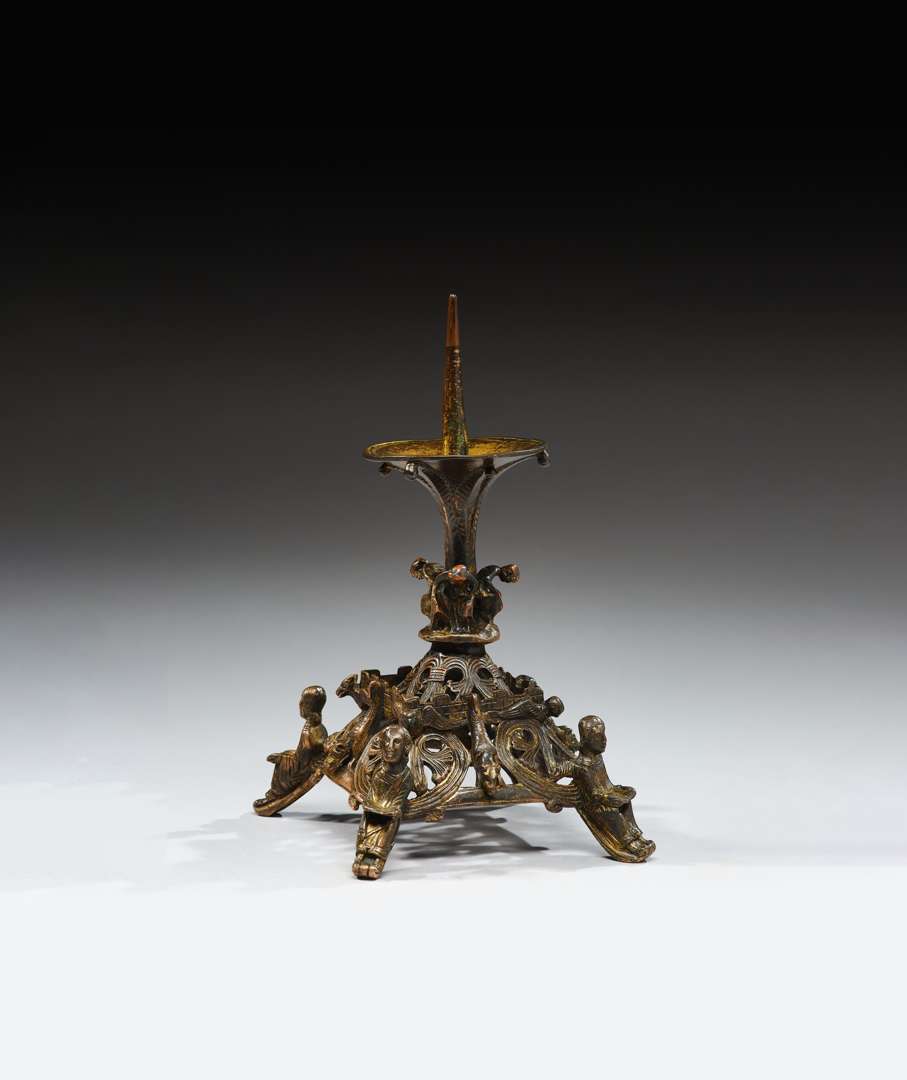
made of a copper alloy, formerly gilded. The base, which is square in cross-section, is richly carved and decorated with the Evangelists. Each leg is formed by a seated figure holding an open book before him, serving as a support. The upper section, a four-sided pyramid openwork with foliage motifs, is adorned with a crenellated parapet, at the corners of which stand the Four Living Creatures of the Tetramorph. In the centre of each side of the parapet are dragons, their heads turned downwards. The upper section takes the form of a circular pavilion. The shaft, decorated with foliage reminiscent of palm leaves, is enlivened by a group of three female figures leaning against the shaft, seated with their gaze directed downwards.
A 12th-century Rhenish-Mosan work?
Height: 16.2 cm (excluding the spike) – Average width of one side: 12.5 cm – Total height: 21.5 cm
(Signs of wear, casting defects)
made of a copper alloy, formerly gilded. The base, which is square in cross-section, is richly carved and decorated with the Evangelists. Each leg is formed by a seated figure holding an open book before him, serving as a support. The upper section, a four-sided pyramid openwork with foliage motifs, is adorned with a crenellated parapet, at the corners of which stand the Four Living Creatures of the Tetramorph. In the centre of each side of the parapet are dragons, their heads turned downwards. The upper section takes the form of a circular pavilion. The shaft, decorated with foliage reminiscent of palm leaves, is enlivened by a group of three female figures leaning against the shaft, seated with their gaze directed downwards.
A 12th-century Rhenish-Mosan work?
Height: 16.2 cm (excluding the spike) – Average width of one side: 12.5 cm – Total height: 21.5 cm
(Signs of wear, casting defects)
made of a copper alloy with traces of gilding, comprising three parts: the base, the shaft and the finial. The base, which is square in cross-section, is richly openwork and adorned with seated figures, each holding an open book, which serve as uprights. The upper section, pyramid-shaped with four sides openworked with foliage motifs, is crowned by a crenellated parapet, at the corners of which stand the Four Living Creatures of the Tetramorph. In the centre of each side are dragons, their heads turned downwards. The shaft is decorated, beneath the finial and the long central spike, with a motif of stylised foliage reminiscent of palm leaves; it features a cluster comprising three seated female figures leaning against one another, their gazes turned downwards.
A Germanic work in the 12th-century Romanesque style.
Height: 16.2 cm excluding the spike – Average width of one side: 12.5 cm – Total height: 21.5 cm.
(Signs of wear, casting defects, restorations)
– Otto von Falke and Erich Meyer, Romanesque Candlesticks and Vessels, Gothic Vessels, Berlin, 1935, pl. 24.
The base of our candlestick faithfully reproduces the design of a Romanesque candlestick—now lost—which was published by Otto von Falke and Erich Meyer in their standard work on Romanesque bronzes, *Romanische Leuchter und Gefässe*, *Giessgefässe der Gotik*, published in Berlin in 1935. The model is reproduced there under number 55 with the caption: ‘Gipsabguss eines verschollenen Altarleuchters, früher in München’ (translation: Plaster cast of a lost altar candlestick, formerly in Munich).
Its iconography belongs to the Germanic and Rhenish-Mosan Romanesque tradition, where the altar candlestick is not merely a source of light, but a miniature representation of the sacred edifice: the Evangelists form its foundations, whilst the Four Living Creatures of the Tetramorph, placed at the corners of the upper register, imbue the object with a theological interpretation of light.