
&w=3840&q=75)
&w=3840&q=75)
&w=3840&q=75)
&w=3840&q=75)
&w=3840&q=75)
&w=3840&q=75)
&w=3840&q=75)
&w=3840&q=75)


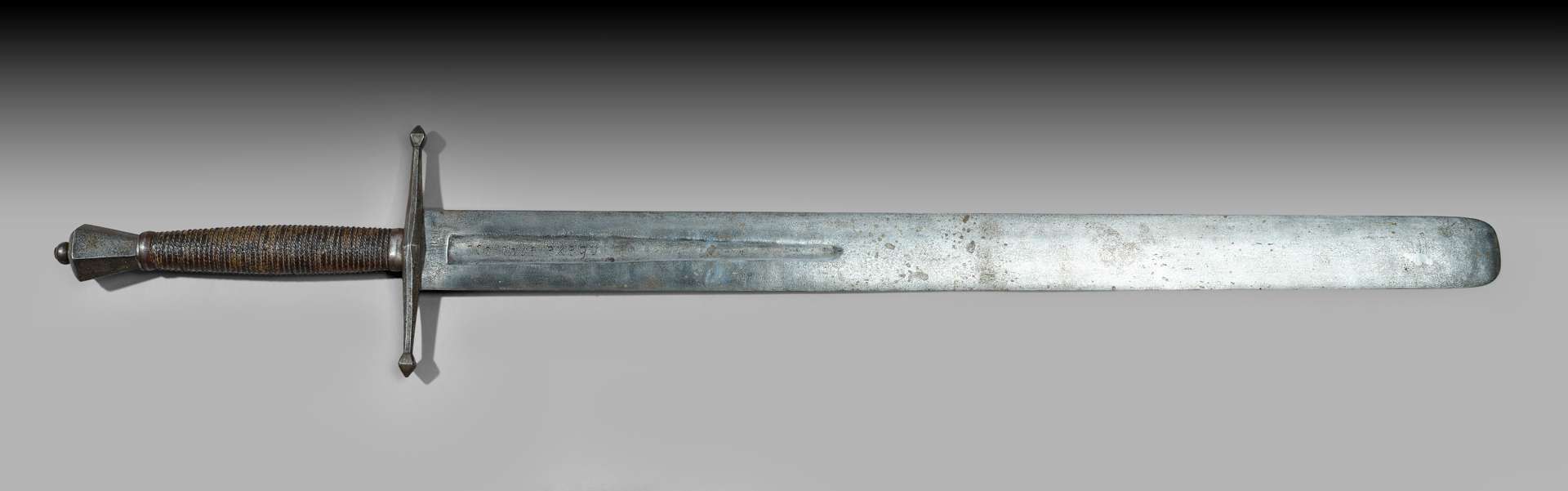
also known as an executioner’s sword, with a powerful double-edged blade, a wide fuller on both sides at one-third of its length, engraved on both sides with ‘Die herren judiciren’ on one side and ‘Ich thue exeguiren’ (translation: ‘The lords judge / I carry out the sentence’), and above the fuller on one side is an inlaid brass wheel of torture.
At the base of the blade is a circular blacksmith’s mark featuring a cross-topped orb (Reichsäpfel) flanked by two dots.
Attributed to Mathias Wundes (1525–1600), of Solingen.
Germany, mid-16th century.
Iron mountings, with a slightly diamond-shaped crossguard measuring 20 cm. Quillons with flanks tapering to solid points. Leather tang with iron filigree. Sturdy conical pommel with flanks, surmounted by a flattened ball.
Total length: 112 cm
(Signs of wear, restorations, added components)
– Gilles Grimm Collection (1955–), France
.– Sold at the previous auction, Aguttes, 29 May 2019, lot no
.337.– Private collection, France.
The design, the engraved inscription and the presence of the wheel of torture clearly link this weapon to the 16th-century German judicial world, where the sword of justice served both as an instrument of execution and a symbol of delegated authority.
The dating of the blade to the first half of the 16th century is supported by comparison with the so-called Sword of Prussian Sovereignty (Schwert der preußischen Souveränität), held in Berlin (Kulturgutschutz Deutschland, no. 03603), whose blade bears an identical hallmark and whose mount is dated to around 1540–1541 (see Julius Lessing, Die Schwerter des Preussischen Krontresors, 1895, pages 103 to 109).
The attribution of this hallmark has long been a subject of debate. Julius Lessing had linked it to the Weyersberg dynasty, a prominent family from Solingen, although their known marks (wolf, trumpet, tongs) differ significantly from the orb and cross seen here.
A more detailed typological analysis suggests the Wundes workshop is the most likely candidate. A hallmark featuring a comparable orb is indeed documented for Johannes Wundes around 1575 (Albert Weyersberg, Solinger Schwertschmiede des 16. und 17. Jahrhunderts), whilst prosopographical sources (Richard H. Bezdek, German Swords and Sword Makers) identify his father, Mathias Wundes (1525–1600), as having been active precisely in the 1540s.
The absence of a formally recorded hallmark for Mathias Wundes does not rule out the attribution: on the contrary, the iconographic continuity of the orb motif within the lineage, combined with the chronological correspondence and direct comparison with the Berlin example, allows us to propose with some plausibility the attribution of this blade to this workshop.
Rare for the quality of its blade, the clarity of its inscriptions and the presence of its hallmark, this sword constitutes a particularly evocative testimony to criminal justice in the Germanic world during the Renaissance, where the object, beyond its function, played a full part in the staging of judicial power.