
&w=3840&q=75)
&w=3840&q=75)
&w=3840&q=75)
&w=3840&q=75)
&w=3840&q=75)
&w=3840&q=75)
&w=3840&q=75)
&w=3840&q=75)


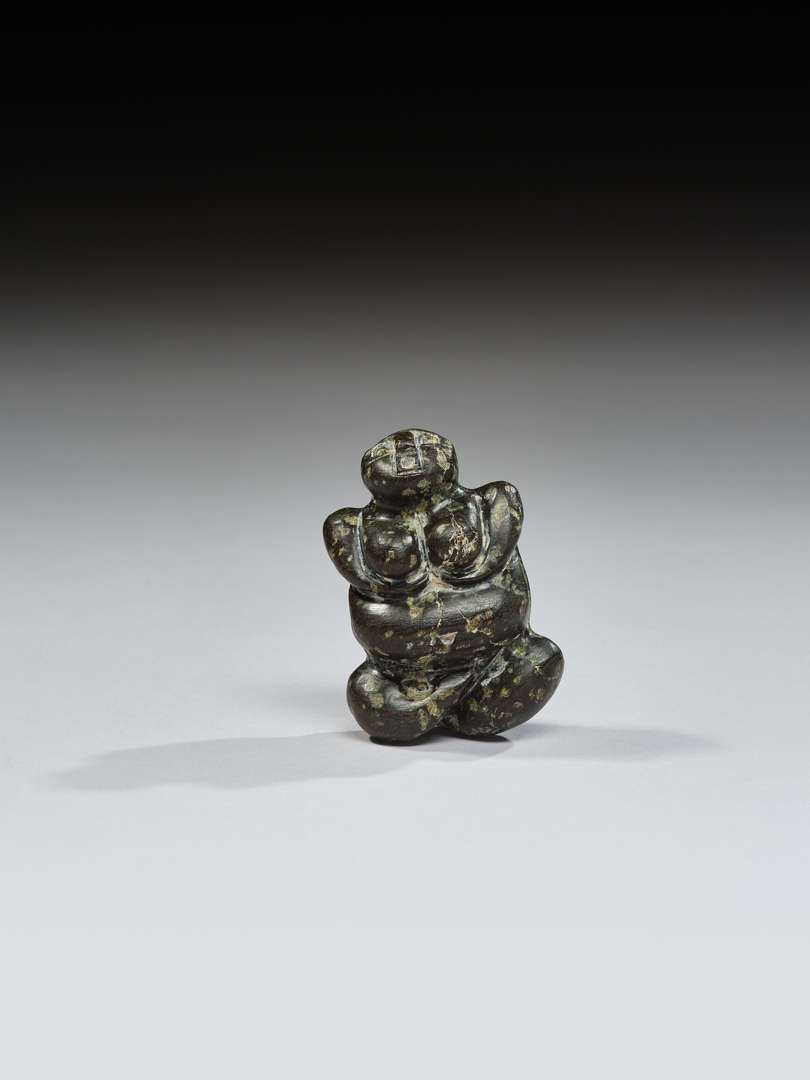
Made of black stone (such as jasper or soapstone), it depicts a crouching female figure with stylised arms folded beneath her chest; her finely carved head is turned upwards and rendered in a geometric style. She is pregnant, with a stylised navel and legs. On the back are geometric incisions, including a star at the nape of the neck. The figure is likely depicted in a childbirth position.
Anatolia, Western Asia, Chalcolithic period, late 5th to early 4th millennium BC.
Height: 7.3 cm – Width: 5 cm – Depth: 2.2 cm
(In very good overall condition)
– believed to be from the former collection of Ambassador Christian Graff, acquired in 1967 or 1968
.– Galerie Noujaïm at the Louvre des Antiquaires, acquired there in 2010
.– A.R. Collection
From the end of the Neolithic period, around 6000 BC, figurines of women and men began to appear throughout the Near East, particularly at the sites of Çatalhöyük and Haçila in southern Anatolia. Depictions of pregnant women may have served as protective amulets for childbirth.