
&w=3840&q=75)
&w=3840&q=75)
&w=3840&q=75)
&w=3840&q=75)
&w=3840&q=75)
&w=3840&q=75)
&w=3840&q=75)
&w=3840&q=75)


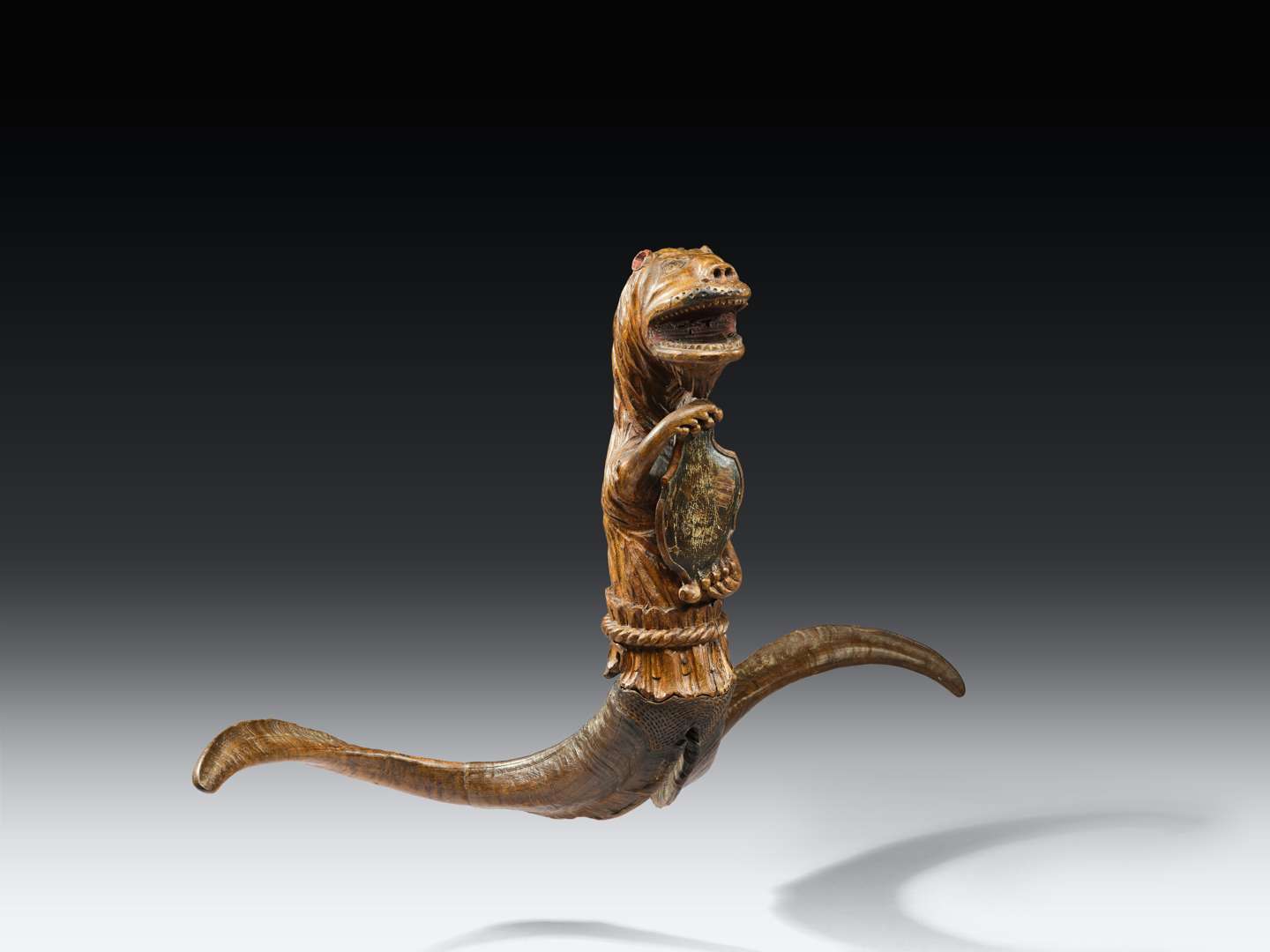
Carved, polychrome and gilded wood depicting a lion holding a coat-of-arms shield (illegible), emerging from a scroll from which two large goat’s horns extend.
Germany, 16th century.
Height: 50 cm – Width: 77 cm
(Minor damage and visible losses, restored)
First appearing in the Germanic world in the late Middle Ages, the Leuchterweibchen, or, more broadly, the Geweihleuchter – literally a ‘horned’ or ‘antlered’ chandelier – combines a sculpted figure, usually polychromed, with a pair of animal horns or antlers arranged horizontally. These suspended objects, straddling the line between lighting fixture, heraldic emblem and decorative sculpture, enjoyed particular popularity in Germanic and Alpine countries at the turn of the 16th century.
Our pendant light takes up this principle in a zoomorphic and heraldic variation: a lion bearing a shield, emerging from a scroll, advances between two large goat’s horns. The object is therefore not a Lusterweibchen in the literal sense (the ‘little female chandelier’) but rather to a broader family of heraldic pendants, where the sculpted figure—whether human, fantastical or animal—serves as a symbol of lineage, office or affiliation.
Several surviving examples help to reconstruct the context of this type of object. The Rijksmuseum, for instance, holds a Leuchterweibchen met wapenschild, attributed to an anonymous sculptor from Mechelen and dated around 1525, comprising a female figure in polychrome and gilded walnut, holding a shield, accompanied by deer antlers and iron chains, [Inv. No. BK-1969-1]. The museum’s entry notes that the exact meaning of this combination of a figure, a shield and suspended antlers remains partly enigmatic, whilst pointing out that such objects might have been displayed in town halls and thus held official significance.
The same civic or representative dimension is found in the Wild Man Chandelier (Lustermännchen) at the Toledo Museum of Art, Germany, Alpine region, c. 1525–1550, [Inv. No. 2021,39], where a carved and polychromed wild man holds a shield whilst a pair of antlers extends from the back of the figure. The museum notes that these antler-mounted chandeliers were placed in civic spaces, guild halls, stately homes, and even ecclesiastical settings.
One of the most famous zoomorphic examples of the genre remains the Drachenleuchter, created in 1522 by Veit Stoß after a drawing by Albrecht Dürer, now in the Germanisches Nationalmuseum in Nuremberg, [Inv. No. HG68]. Commissioned for the council chamber of Nuremberg Town Hall, it brilliantly illustrates this quintessentially Renaissance encounter between sculpted artifice and the natural element: the antlers, far from being mere accessories, become the organic extension of a composite being.
Through its combination of a heraldic animal, a shield and natural antlers, our pendant reflects the German Renaissance taste for hybrid objects, where nature, sculpture and emblem interplay. The lion, a figure of power and vigilance, becomes the guardian of now-illegible coats of arms, preserving not so much the precise identity of a lineage as the material memory of a ceremonial setting.