
&w=3840&q=75)
&w=3840&q=75)
&w=3840&q=75)
&w=3840&q=75)
&w=3840&q=75)
&w=3840&q=75)
&w=3840&q=75)
&w=3840&q=75)


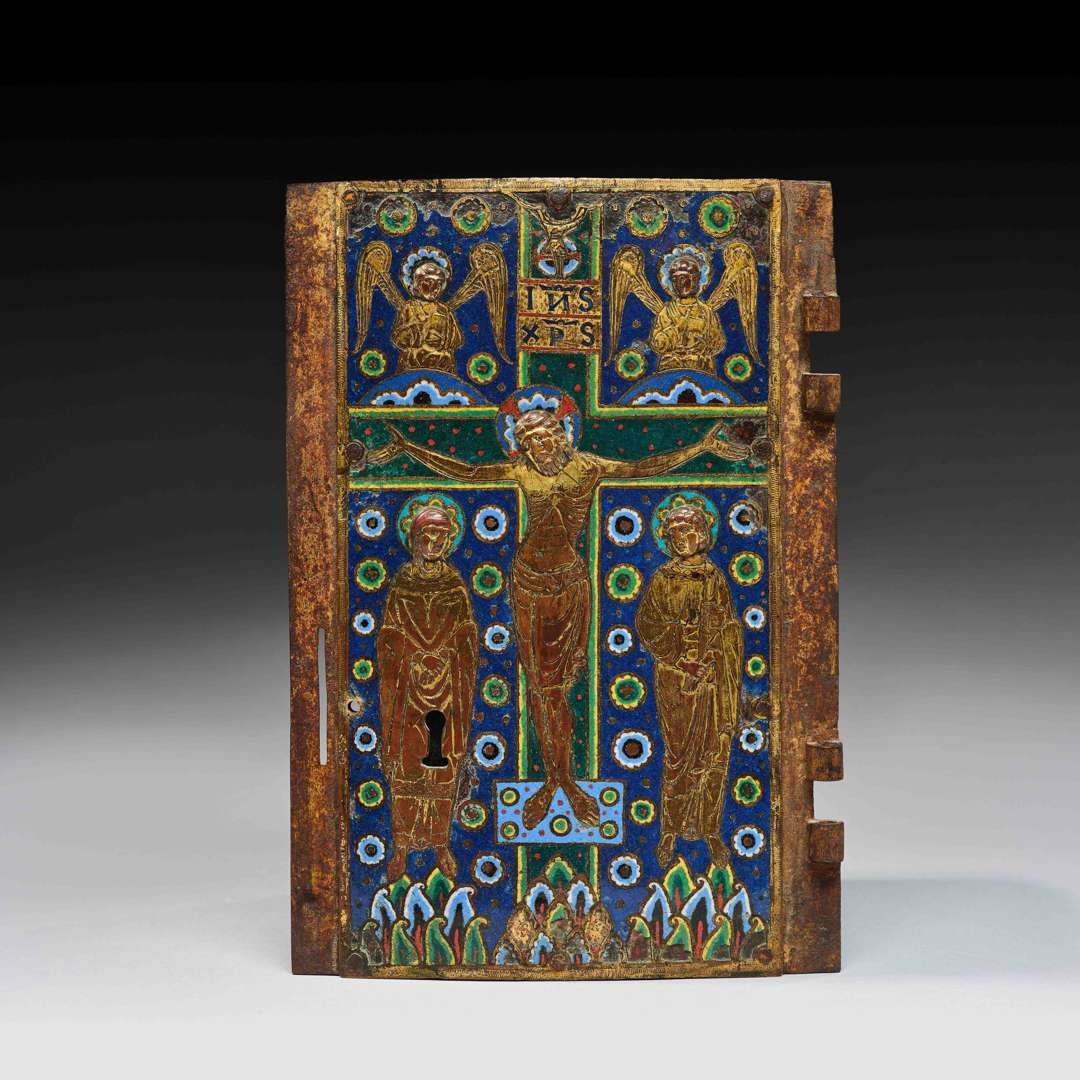
A rectangular Gospel book cover, in gilded copper and champlevé enamel, depicting a Crucifixion. In the centre, Christ on the cross between the Virgin Mary and Saint John; in the upper section above the cross, two angels, shown from the waist up, with outstretched wings. The cross has a bottle-green background dotted with red spots. The figures are carved from engraved and gilded copper, with the five heads in applied relief. Deep lapis blue background, studded with polychrome rosettes.
France, Limoges, late 12th century, early 13th century.
Assembled at a later date and adapted as a tabernacle door.
Height: 23.3 cm – Width: 13 cm – Total width: 16 cm
(Minor damage, visible wear and tear, and missing sections; keyhole on the Virgin’s robe)
– At the Seligmann Gallery, Paris, in December 1924.
– Collection of Countess Antoine Sala, née Laura Kayser (1874–1961), Mrs Edwin Bayer from her first marriage
.– Sale of the above on 19 May 1933, Baudouin-Ader auctioneers, Galerie Charpentier, Paris, lot no. 29 (reproduced, plate XVI).
– Collection of Léon Salavin (1886–1976)
– Sale of the above on 22 November 1972, Ader-Picard-Tajan auctioneers, Drouot, Paris, lot no. 46 (reproduced)
– Collection of Philippe Leclercq (1899–1980), passed down through the family to the present day.
Intended to adorn the precious binding of a Gospel book, this plaque is one of the most characteristic examples of the work produced by Limousin workshops around the year 1200. At that time, Limoges had established itself as one of Europe’s leading centres for champlevé enamel on gilded copper, supplying churches, abbeys and chapels throughout the Western world with reliquaries, crosses, croziers, pyxes and covers for liturgical books.
The scene depicted—the Crucifixion—follows an iconography perfectly suited to the object’s primary function: placed on the cover of a Gospel book, it made the volume not only a vessel for the Word, but also the very image of the sacrifice of which the Word tells the story. Christ, rendered in engraved and gilded copper, stands out against a background of lapis blue enamel of rare intensity, dotted with polychrome rosettes, the freshness and variety of which make this plaque a particularly remarkable example of its kind. The depth of the blue, the brilliance of the gilded reserves, and the red, white, turquoise and green accents of the small flowers combine to create a surface of rare chromatic vibrancy, where the Passion is presented less as a narrative scene than as a precious apparition.
This type of composition is found on several book-binding plaques held in major public collections, notably at the Metropolitan Museum of Art in New York [Inv. No. 17.190.785]; the Louvre [Inv. No. OA 941]; etc.
The subsequent transformation of our plate into a tabernacle door, with the addition of a mounting and the cutting of a keyhole in the Virgin’s robe, bears witness to another phase in its history. Detached from its book, the image continued to fulfil a sacred function: no longer to protect the Gospel, but to enclose the place of the Presence.
Whilst this repurposing altered the object, it probably also ensured its survival. Better still, the keyhole, far from being merely an accidental feature resulting from use, became the decisive clue to its identification: this distinctive feature made it possible to recognise the plaque unequivocally in ancient records and to establish a previously unknown provenance, long since forgotten. The very alteration of the object thus became the key to its rediscovered memory. And one cannot fail to note the almost unintentional resonance of this transformation: the Virgin, whose robe now bears the shape of a keyhole, becomes, in a physical sense, the gateway to the Son, extending the spiritual image of her mediation into the object itself.
Owing to its size, its rediscovered provenance, its iconography, its condition and the exceptional richness of its enamelled background, this plaque ranks among the most eloquent works of the great tradition of Limousin Gospel book covers from the early 13th century: objects of light as much as of devotion, designed to make the holy book a veritable shrine to the Word.