
&w=3840&q=75)
&w=3840&q=75)
&w=3840&q=75)
&w=3840&q=75)
&w=3840&q=75)
&w=3840&q=75)
&w=3840&q=75)
&w=3840&q=75)


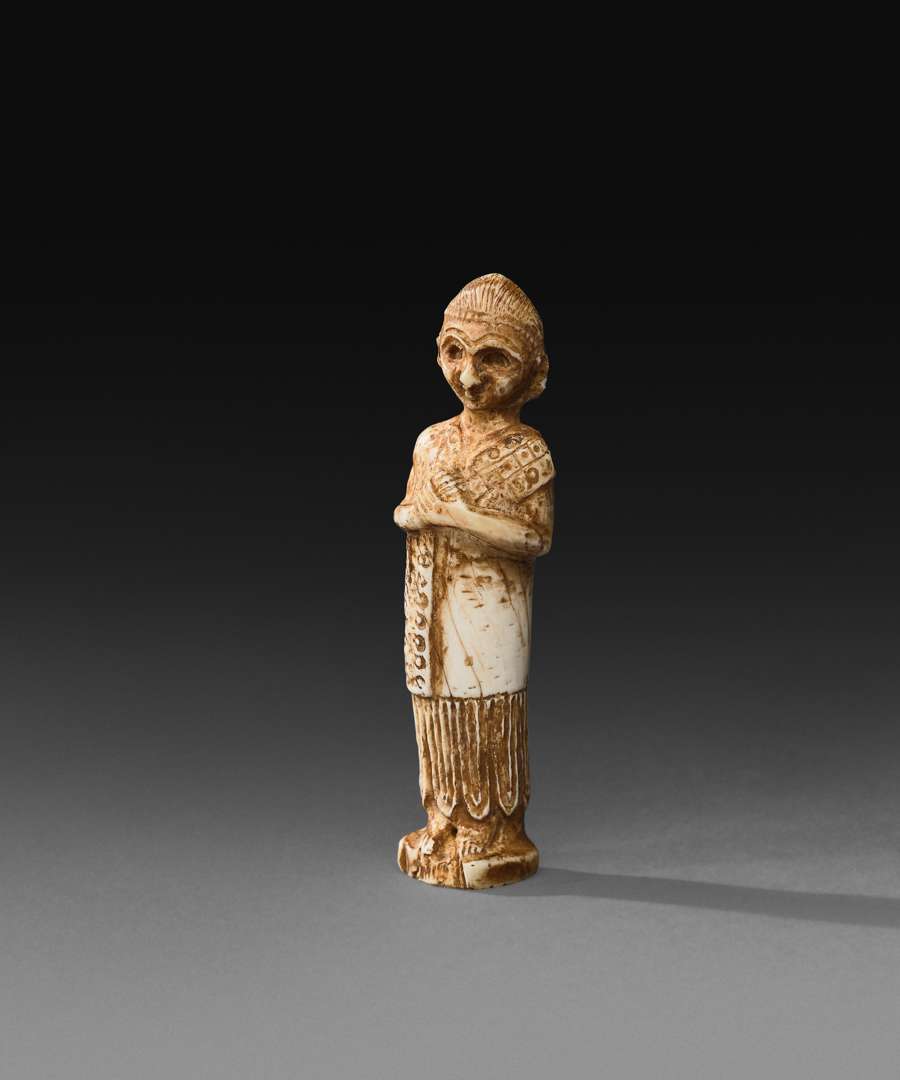
Carved from hippopotamus ivory in the form of a standing male figure with his hands clasped over his chest, his left hand resting on his right. The statuette is entirely clad in a tunic reaching down to the knee; the legs are encased in an ankle-length skirt, composed of nine woolly strands with triangular tips.
Sumerian art, probably from the Ayadé or Akhad period, circa 2300–2100 BC.
Height: 8.2 cm – Width: 2.2 cm – Thickness: 1.4 cm
– Weight: 26 g.
(Minor visible damage)
Hippopotamus amphibius (II/B).
– Believed to originate from the site of Mari (in present-day Syria).
– Believed to be from the collection of Claude Schaeffer (1898–1982), archaeologist, acquired there in the 1950s.
– From the collection of Pierre Ponsich (1912–1999), archaeologist
.– Private collection of A.R.