
&w=3840&q=75)
&w=3840&q=75)
&w=3840&q=75)
&w=3840&q=75)
&w=3840&q=75)
&w=3840&q=75)
&w=3840&q=75)
&w=3840&q=75)


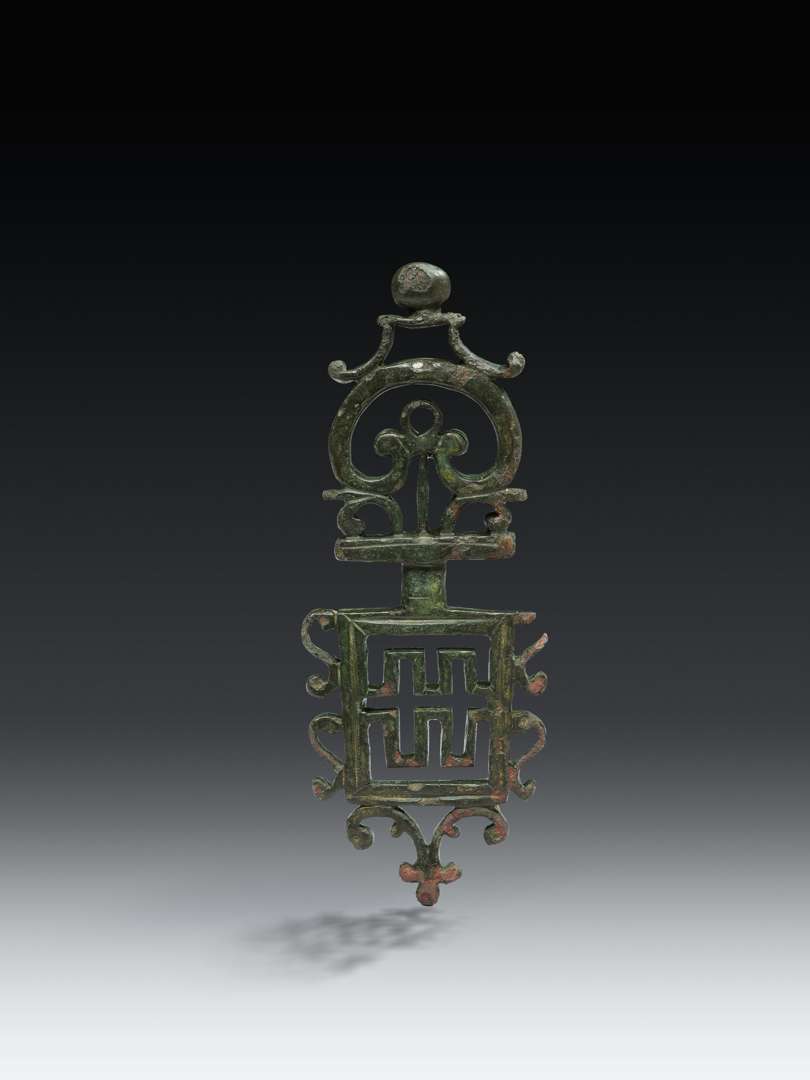
known as a flat-headed push-button key, made of cast bronze, with an openwork plate comprising two superimposed sections.
The upper section, topped by a globular knob, features a symmetrical decoration of scrolls and pelta beneath a crossbar with side hooks; the lower section, set within a rectangular frame, is openwork with a bold geometric motif of a cross with orthogonal arms, flanked by facing scrolls and finished with a trefoil finial.
Roman Gaul, probably Lyonnais Gaul, 2nd century AD.
Length: 13.1 cm – Width: 4.9 cm.
(Corrosion, wear and minor damage visible)
– Babelon, Ernest, and Jules-Adrien Blanchet. Catalogue of Ancient Bronzes in the National Library. Paris: 1895, p. 1889.
Owing to its size, its openwork decoration and the complexity of its outline, this large bronze key stands out as one of the most remarkable known examples of Gallo-Roman flat keys, known as ‘pressure’ or ‘simple translation’ keys.
The closest parallels are found amongst the metal artefacts from Autun-Augustodunum, where the Rolin Museum holds several similar keys, notably Inv. No. A1984.1.3.2 and Inv. No. B 276. Other examples are held in the Cabinet des Médailles [Inv. No. bronze.1898.5 and Inv. No. bronze.1898.2]. These pieces all display a rich ornamental vocabulary (peltae, crosses, stars, rectangular openwork) in which the decoration arises directly from the recesses cut into the plate.
Our specimen, however, stands out from these comparisons due to its size, its composition comprising two superimposed registers, and the quality of its design. The upper register, treated as a crowning element, combines a pelta, volutes and a globular knob; the lower register, set within a rectangular frame, features a powerful geometric cross-shaped cut-out with orthogonal arms, flanked by volutes and finished with a fleur-de-lis.
In terms of size, our key exceeds the main examples published or held in the collections consulted—which are generally under 9 cm, including those considered to be of large scale—by more than 4 cm. Its size, decoration and excellent state of preservation make it as much a ceremonial object as a functional instrument, probably intended for a piece of furniture, a chest or an important locking mechanism – an object of exceptional rarity.