
&w=3840&q=75)
&w=3840&q=75)
&w=3840&q=75)
&w=3840&q=75)
&w=3840&q=75)
&w=3840&q=75)
&w=3840&q=75)
&w=3840&q=75)


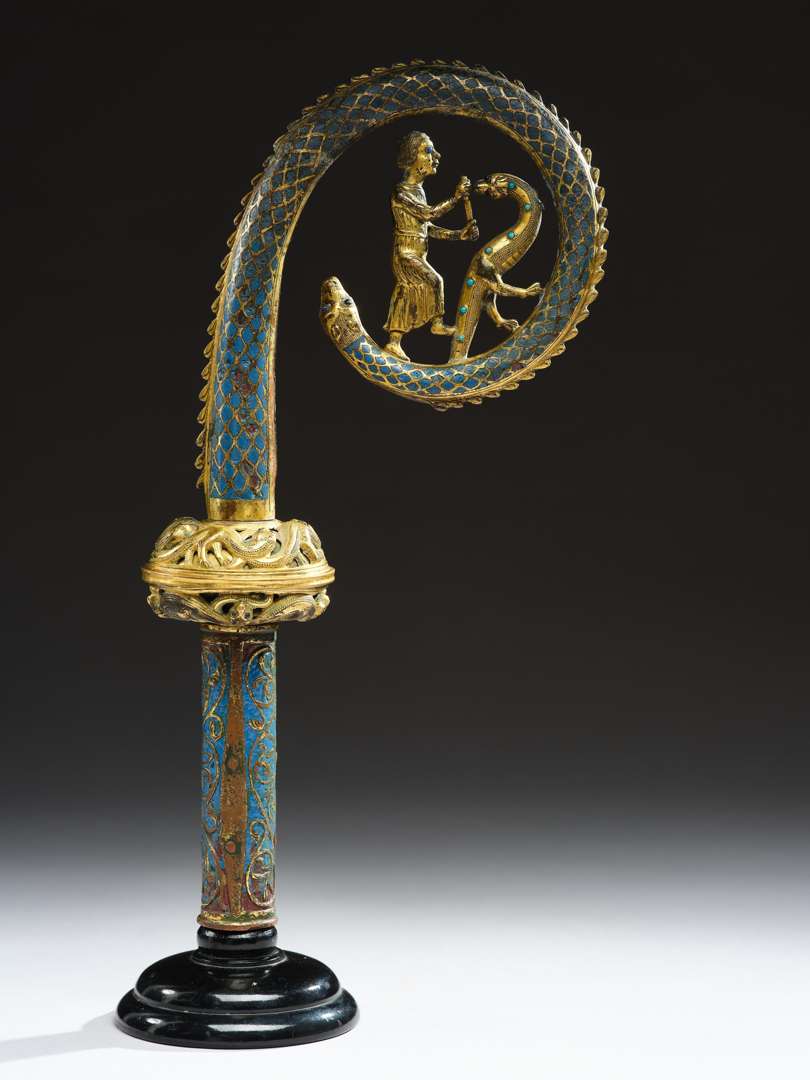
RARE BISHOP'S CROSS-SHAPED BUTT PLATE FEATURING SAINT MICHAEL
Made of gilded copper and champlevé enamel, in three parts: the crosseron, the central knot and the socket at the base. The crosseron depicts the coiling form of a stylised dragon, whose dorsal spines are visible along the outer edge and whose scales are all rendered in blue champlevé enamel; at the centre of the coiled scroll is a depiction of Saint Michael the Archangel vanquishing the demon in the form of a dragon, rendered in chiselled and gilded copper with inlaid eyes and turquoise cabochons on the dragon’s back. The central knot (possibly an added element) consists of two openwork hemispheres joined together, depicting an entanglement of eight small dragons with eyes inlaid with cabochons. The socket is executed in champlevé enamel with a decoration of Gothic foliage against a background of later blue re-enamelling, alternating three uprights which once held now-missing applied elements.
France, Limoges, early 13th century.
Total height: 31.5 cm – Width of the cross-piece: 14 cm – Socket diameter: 3 cm
(Damage, restorations, missing parts and added elements)
Presented in a suitable case.
– Collection of Countess Elizaveta Vladimirovna Shuvalova, née Baryatinskaya (1855–1936), at the Shuvalov Palace, Saint Petersburg.
– Acquired by the Hermitage Museum, Saint Petersburg, in 1924 [Inv. No. Ф.2980]
– Removed from the Hermitage Museum’s collection in 1930, sold at the Soviet auctions (auction not located)
– At the Stora Gallery, Paris, in April 1937.
– Collection of Julien Chappée (1862–1957), Le Mans
.– Collection of Claude Vaudecrane (1915–2002), Le Mans
.– Private collection of E.B., France (believed to have been acquired at an auction on 18 June 1974, not found) and subsequently passed down through the family to the present day.
– Marquet de Vasselot, 13th-Century Limousin Maces, Paris, Firmin-Didot et Cie, 1941. Listed and described under no. 155, p. 287.
Our crozier belongs to the largest group of Limousin croziers, depicting the battle of Saint Michael against the dragon. It is listed in Marquet de Vasselot’s seminal work *Les croziers limousins du XIIIe siècle* (Paris: Firmin-Didot et Cie, 1941). The latter counted forty-six of this type, compared with thirty-nine for the second largest group, that of the Annunciation.
This imbalance is no doubt due to the particular appeal that the figure of Saint Michael, symbol of victory over the devil, held for prelates.
This group, which displays remarkable formal consistency, nevertheless exhibits slight variations from one example to another. Notable examples include: that in the Walter Art Museum [Inv. No. 44.294]; that in the Victoria & Albert Museum [Inv. No. 703-1884]; that in the Fitzwilliam Museum [Inv. No. M.2-1924]; the one in the Metropolitan Museum [Inv. No. 17.190.834a, b]; the one in the Musée de Picardie [Inv. No. M.P.992.4.13]; and the one in the Louvre Museum [Inv. No. OA 7286].
If a relatively large number of these Limousin-style enamelled copper croziers have survived to the present day, it is undoubtedly because they were considered to be of relatively low monetary value and were placed with the deceased in the grave, the context in which they have often been unearthed. Conversely, goldsmith’s croziers, kept in treasuries, were frequently melted down during times of crisis.
Our example also appears to originate from an archaeological context and to have been restored, as it exhibits all the characteristic features: the socket, which is incomplete, has lost all of its original enamel, whilst the scroll bears a patina typical of excavated objects and suffers from gaps and surface damage.
Whilst family documents mentioned a Chappée provenance, consultation of the Louvre Museum’s ‘Objets d’art’ documentation enabled us to identify the prestigious original provenance of our rare crozier, then held in the collections of the Hermitage Museum in Saint Petersburg [inv. no. Ф.2980], it is recorded as having been lost following the Soviet sales, which continued until the late 1930s.
Marquet de Vasselot makes no mention of this provenance in his catalogue entry, which is no doubt due to the sensitive nature of the context surrounding this acquisition; he merely refers to the Chappée collection and also notes that the ferrule was still fitted with a reptile ornament that has since disappeared.
It was following the Soviet sales that Julien Chappée (1862–1957) acquired our crozier, probably through the Stora gallery, if we are to believe an old photograph of our crozier dated 1937 held in the archives of the Louvre Museum. Chappée was one of the most important French collectors of medieval objects at the turn of the 19th and 20th centuries; he owned, in particular, a significant collection of croziers, several of which are now held in museum collections: one, also depicting Saint Michael, is at the Museum of Fine Arts in Houston [Inv. No. 70.38]; three others are in the Louvre Museum, two of which come specifically from archaeological contexts comparable to that suggested by our specimen: the crosier of Jean de Chanlais, discovered in 1856 in his sarcophagus [Inv. No. OA 10407], and the crosier known as that of Saint Pierre de Lisieux, unearthed in 1865 [Inv. No. OA 9593].
Our crosier passed into the collection of Claude Vaudecrane (1915–2002), along with several other objects from the Chappée collection, including the crosier of Jean de Chanlais from the Louvre mentioned above.
Ultimately, our crozier stands out in three respects. Firstly, due to its intrinsic rarity, as a specimen fully representative of the largest and most emblematic corpus of 13th-century Limousin croziers—that of Saint Michael slaying the dragon—whose formal coherence does not detract from either the quality of its execution or its typological interest. Secondly, by its exceptional provenance, which links it to a presumed ancient archaeological context, to the Russian imperial collections of the Hermitage Museum, to the major dispersions resulting from Soviet sales, and subsequently to the prestigious collections of Julien Chappée and Claude Vaudecrane. And finally, by the canonical status conferred upon our crozier through its reference in the works of Marquet de Vasselot. This unique trajectory, intersecting art history and the history of collecting, confers upon our specimen a historical and heritage value of the very highest order, far beyond its mere aesthetic importance.
The establishment of the provenance of this work of art could not have been successfully completed without the indispensable assistance of the administration of the Hermitage Museum and Ms Christine Chabod, from the Department of Works of Art at the Louvre Museum, to whom we extend our sincere thanks.