
&w=3840&q=75)
&w=3840&q=75)
&w=3840&q=75)
&w=3840&q=75)
&w=3840&q=75)
&w=3840&q=75)
&w=3840&q=75)
&w=3840&q=75)


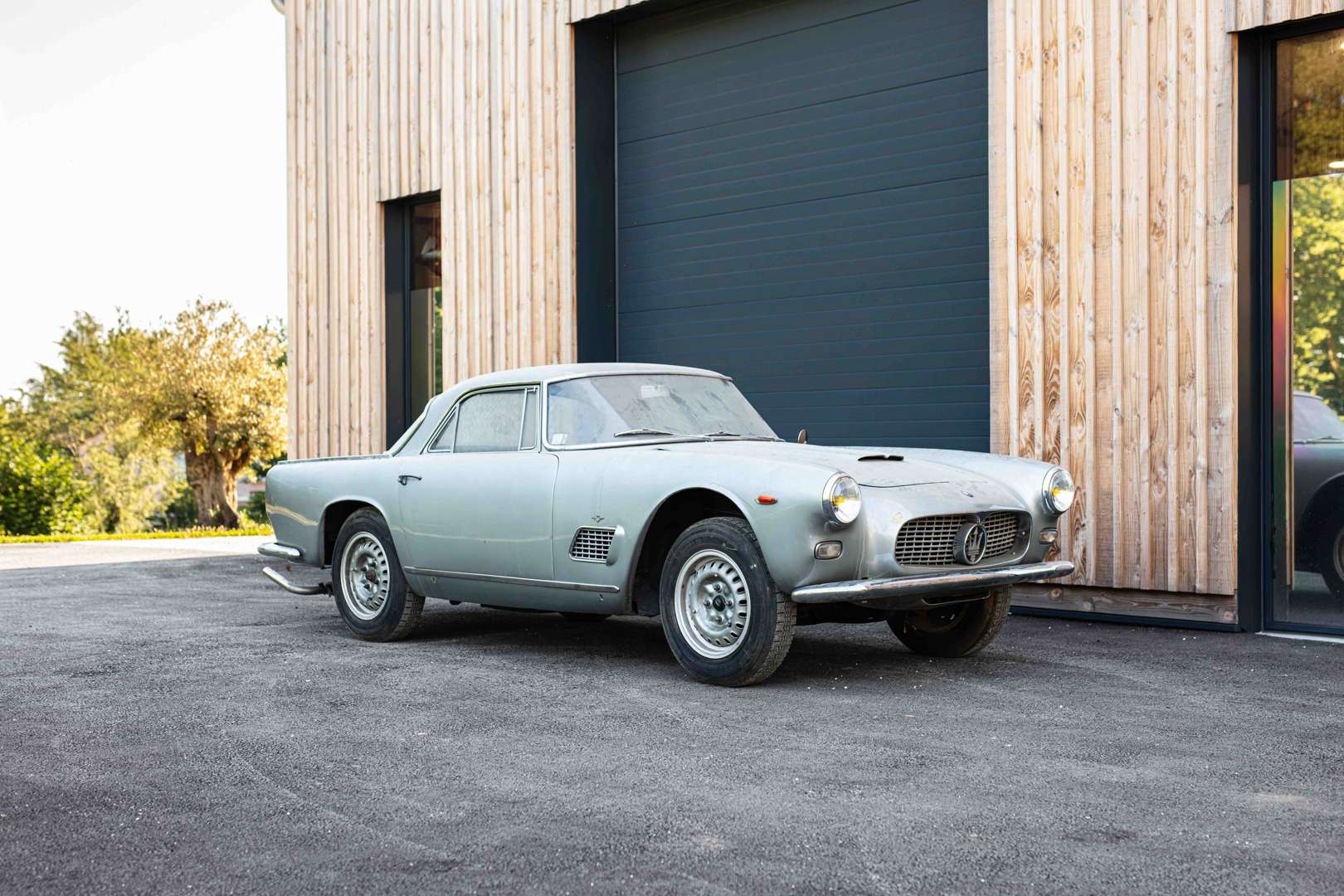
1961 – Maserati 3500 GT “1961 Paris Motor Show”
Châssis n° 101.1824
Châssis n° 101.1824
French historic registration title
Sold without Contrôle Technique.
« Ex-Salon de Paris 1961 »
In 1957, the Maserati 3500 GT marked the beginning of the brand’s modern era. Following its Formula 1 world title with Fangio and its official withdrawal from racing, Maserati turned its attention to production Gran Turismo models capable of competing with Ferrari, particularly in the United States. Designed by Carrozzeria Touring using the Superleggera technique, it captivated with its elegant and sporty lines.
Its 3.5-litre inline-six engine, derived from racing, produced 220 bhp and then 235 bhp from 1961 with Lucas fuel injection, achieving a top speed of 230 km/h. Launched in series production in 1958, the 3500 GT revived Maserati’s fortunes commercially thanks to an international network of importers. With 2,228 units produced up to 1964, it ensured the brand’s revival and inspired its entire future range.
Our example boasts an absolutely unique history… As its documentation shows, it was the Maserati dealership on Quai Carnot in Saint-Cloud that ordered the 3500 GTI #1824 from the Officine Maserati in this metallic grey finish with a navy blue leather interior. The dispatch note, dated 2 October 1961, states ‘vettura destinata salone dell’automobile di parigi’, as the Paris Motor Show was due to begin three days later at the Grand Palais! It was most likely during this show that Mr De P. fell under the spell of this 3500 GTI. Five days after the show closed, on October 20, an invoice was issued by the importer Thépenier for the sale of this car to the collector, with the added bonus of a trade-in for his Lancia Flaminia. He kept #1824 until March 1963, when he traded it in for a Sebring.
The 3500 GTI then passed into the hands of a French businessman. Seven years later, with the fuel injection system playing up, he gave his 3500 to Mr G., who kept it until 2007! It was then bought by a French motoring historian, who took care to trace its entire history through a fascinating collection of documents. He kept the car for just one year, long enough to get it running again and finish the restoration that had been started. #1824 then spent four years with a collector in northern France, who experienced a few mechanical setbacks before selling it back to the historian. It was this collector who removed the car’s engine to have it restored in Italy, the radiator in Belgium, and the running gear in France. The pandemic put an end to the project, and our beautiful Italian car has since remained stored in a dry place, alongside its engine (non-matching block, date of replacement unknown, converted to carburettors).
Today, #1824 has an interesting patina, although its paintwork, likely repainted in the early 2000s, has blistered in places. So it’s up to an enthusiast looking for a classic car and a comprehensive yet straightforward restoration project to take on the task!