
&w=3840&q=75)
&w=3840&q=75)
&w=3840&q=75)
&w=3840&q=75)
&w=3840&q=75)
&w=3840&q=75)
&w=3840&q=75)
&w=3840&q=75)


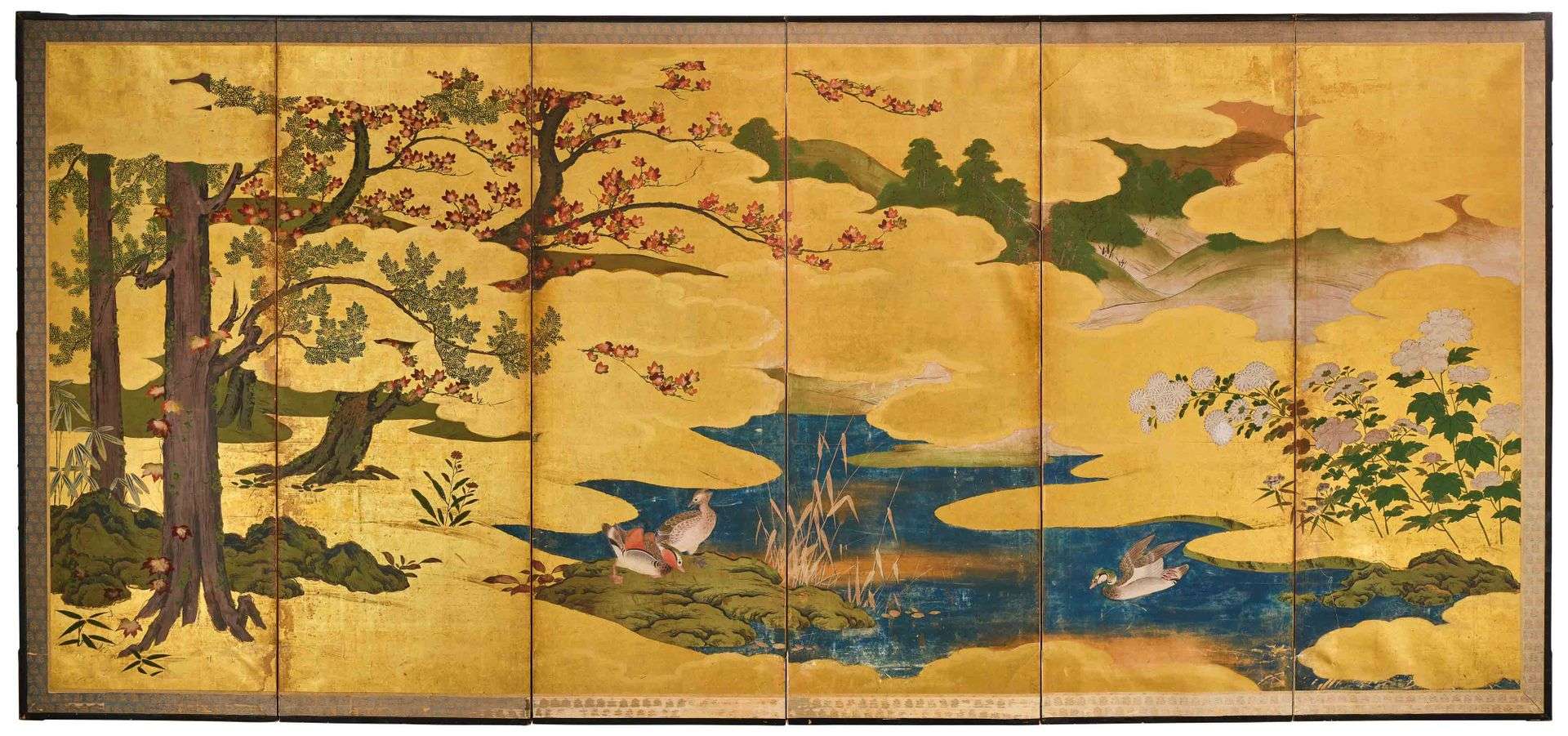
JAPAN EDO PERIOD, 18th CENTURY
Important six-leaf folding screen from the
Kano school, depicting a landscape with, in the center, a pond where a pair of Mandarin ducks are frolicking. To the left, hinoki and red-leaf maple trees whose branches extend towards the center of the composition. To the right, another duck stands beside a grove of peonies and chrysanthemums. The whole is set against a rich background of golden clouds, with a gap revealing a mountainous landscape. Black lacquered frame.
Size: 175 x 384 cm
NOTE
The Kano school, founded in the 15th century by Kano
Masanobu, was one of Japan's most influential schools of painting, influencing the history of Japanese art until the 19th century. Its unique, refined style is based on a skilful fusion of techniques and motifs from Chinese tradition, combined with purely Japanese decorative elements. The artists of the
Kano school excelled, in particular, in large-scale decorative projects on fusuma or screens for castles, temples or palaces, depicting scenes of nature with flowers and birds, trees and plants in a highly colored style with a firm outline, standing out against a sumptuous gold-leaf background.
Rich in symbolism and celebrating the harmony between nature and humanity, works of the Kano school were particularly prized by the Japanese aristocracy and the shogunate, both as decorative elements and as vehicles for spiritual and moral values, reaffirming the power and prestige of the ruling class. On the present screen, the presence of mandarin ducks (Oshidori) symbolizes eternal love and marital fidelity, as they are reputed to live their entire lives with the same partner.
Important six-leaf folding screen from the
Kano school, depicting a landscape with, in the center, a pond where a pair of Mandarin ducks are frolicking. To the left, hinoki and red-leaf maple trees whose branches extend towards the center of the composition. To the right, another duck stands beside a grove of peonies and chrysanthemums. The whole is set against a rich background of golden clouds, with a gap revealing a mountainous landscape. Black lacquered frame.
Size: 175 x 384 cm
NOTE
The Kano school, founded in the 15th century by Kano
Masanobu, was one of Japan's most influential schools of painting, influencing the history of Japanese art until the 19th century. Its unique, refined style is based on a skilful fusion of techniques and motifs from Chinese tradition, combined with purely Japanese decorative elements. The artists of the
Kano school excelled, in particular, in large-scale decorative projects on fusuma or screens for castles, temples or palaces, depicting scenes of nature with flowers and birds, trees and plants in a highly colored style with a firm outline, standing out against a sumptuous gold-leaf background.
Rich in symbolism and celebrating the harmony between nature and humanity, works of the Kano school were particularly prized by the Japanese aristocracy and the shogunate, both as decorative elements and as vehicles for spiritual and moral values, reaffirming the power and prestige of the ruling class. On the present screen, the presence of mandarin ducks (Oshidori) symbolizes eternal love and marital fidelity, as they are reputed to live their entire lives with the same partner.