
&w=3840&q=75)
&w=3840&q=75)
&w=3840&q=75)
&w=3840&q=75)
&w=3840&q=75)
&w=3840&q=75)
&w=3840&q=75)
&w=3840&q=75)


7
JEAN-MICHEL ATLAN (1913 - 1960)
The item was sold for 144 320 €
Fees include commission and taxes.
JEAN-MICHEL ATLAN (1913 - 1960)
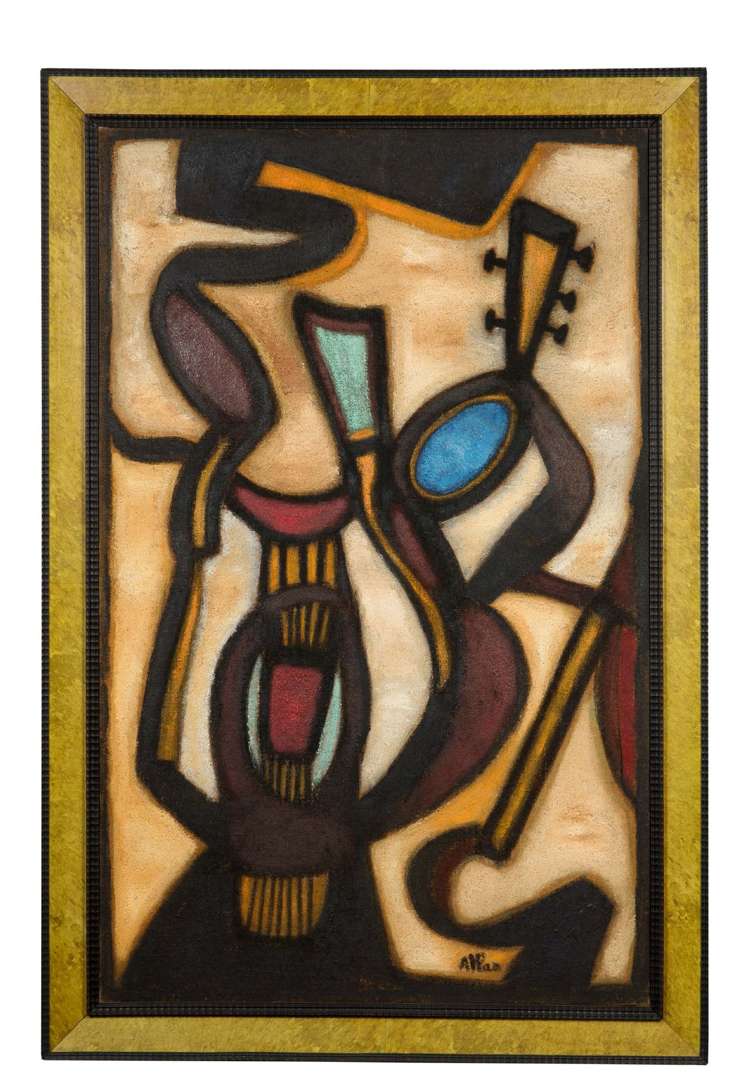
Harlem, 1957
Oil on canvas signed lower right, countersigned and titled on the stretcher
130 x 81 cm - 51 3/16 x 31 7/8 in.
Oil on canvas signed lower right, signed again and titled on the stretcher
PROVENANCE
- Collection Princess H. Gourielli (Mme Helena Rubinstein), Paris Sale, Parke Bernet, New York, April 27, 1966
- Galerie Carpentier, Paris
- Private collection, Paris
EXHIBITIONS
- Atlan, Antibes (France), Musée Picasso, July-August 1957
- Moulin du Breuil (France), 1958
- Atlan, Paris, Musée National d'Art Moderne, January 22-March 17, 1963
- Atlan, Tel Aviv (Israel), Museum of Art, November-December 1964
BIBLIOGRAPHY
- Exhibition catalog, Atlan, Antibes (France), Musée Picasso, 1957, pl. 7
- Bernard DORIVAL, Atlan, essai de biographie artistique, Paris, Éditions Pierre Tisné, 1962, reproduced in color, pl. 41. Second edition Paris, Le Musée de Poche, 1970
- Exhibition catalog, Atlan, Paris, Musée National d'Art Moderne, 1963, N° 54. Exhibition catalog, Atlan, Tel Aviv (Israel), Museum of Art, 1964, N° 31
- J. Polieri, Atlan, Catalogue raisonné de l'oeuvre complet, Paris, 1996, no. 404 (illustrated p. 283)
A major and atypical figure on the post-war Parisian art scene, Jean-Michel Atlan embodies a singular path between lyrical abstraction and art brut.
between lyrical abstraction and art brut. Born in Constantine, Algeria, in 1913, he moved to Paris in the 1930s to study philosophy. At the crossroads of African, Oriental and European influences, Atlan soon broke away from the dominant trends to forge a radically personal pictorial style. By the early 1950s, he had established himself as a precursor of the CoBrA group, while refusing to belong to any particular school or ideology, which he considered sterile. His painting was a direct extension of an inner, instinctive world, often described as "magical" or "shamanic". Harlem, executed in 1957, masterfully illustrates Atlan's plastic maturity, at the height of his artistic recognition. The painting came from the collection of Princess Gourielli, better known as Hélena Rubinstein, a leading figure not only in the world of beauty, but also a patron of African and tribal art. Her deep attachment to these arts has resulted in a unique collection of culturally and ethnographically diverse pieces. In 2020, this richness was highlighted by a major exhibition at the
exhibition at the Musée du Quai Branly, devoted to its collection of African art, testifying to its pioneering role in promoting the
in the Western world. This painting, exhibited at the Musée Picasso d'Antibes the year of its creation, embodies the telluric power of his pictorial language.
the telluric power of his pictorial language. The gesture is assertive, almost ritualistic, and the dense color, saturated with reds and browns, evokes the earth, the heat and the pulsating rhythm of an ancestral world.
The title Harlem is not insignificant: it suggests a free evocation of a district then perceived as a hotbed of black culture and revolt, in full musical and social effervescence. Atlan's work seems to resonate with the syncopated rhythms of jazz, the vital tensions of the city, and the spiritual and tribal traditions that inspired him throughout his career.
Indeed, from the 1940s onwards, he explored the question of rhythm and line, of the balance between line and color, from which emerges the notion of movement. In this respect, Harlem is a fine example of his constantly renewed exploration of this obsession, which reached full maturity in the mid-1950s. This painting is one of his so-called "musical" pictures. Instruments can be seen, and the lines of the strings that structure the composition show the extent to which the artist finds his way in an abstraction that does not deny a direct contact with reality.
direct contact with reality.
While many artists have explored the relationship between music and painting, few have been as fascinated by the issues of rhythm and sound sensation as Jean-Michel Atlan. For him, painting takes on the aspect of a dance, and the canvas thus becomes the retranscription of the vibration provoked by music.
A major and atypical figure of the post-war Parisian art scene, Jean-Michel Atlan embodied a unique path between lyrical abstraction and Art Brut. Born in 1913 in Constantine, Algeria, he moved to Paris in the 1930s to study philosophy. At the crossroads of African, Eastern, and European influences, Atlan quickly distanced himself from dominant artistic movements to develop a radically personal pictorial language. By the early 1950s, he had established himsel
Harlem, 1957
Oil on canvas signed lower right, countersigned and titled on the stretcher
130 x 81 cm - 51 3/16 x 31 7/8 in.
Oil on canvas signed lower right, signed again and titled on the stretcher
PROVENANCE
- Collection Princess H. Gourielli (Mme Helena Rubinstein), Paris Sale, Parke Bernet, New York, April 27, 1966
- Galerie Carpentier, Paris
- Private collection, Paris
EXHIBITIONS
- Atlan, Antibes (France), Musée Picasso, July-August 1957
- Moulin du Breuil (France), 1958
- Atlan, Paris, Musée National d'Art Moderne, January 22-March 17, 1963
- Atlan, Tel Aviv (Israel), Museum of Art, November-December 1964
BIBLIOGRAPHY
- Exhibition catalog, Atlan, Antibes (France), Musée Picasso, 1957, pl. 7
- Bernard DORIVAL, Atlan, essai de biographie artistique, Paris, Éditions Pierre Tisné, 1962, reproduced in color, pl. 41. Second edition Paris, Le Musée de Poche, 1970
- Exhibition catalog, Atlan, Paris, Musée National d'Art Moderne, 1963, N° 54. Exhibition catalog, Atlan, Tel Aviv (Israel), Museum of Art, 1964, N° 31
- J. Polieri, Atlan, Catalogue raisonné de l'oeuvre complet, Paris, 1996, no. 404 (illustrated p. 283)
A major and atypical figure on the post-war Parisian art scene, Jean-Michel Atlan embodies a singular path between lyrical abstraction and art brut.
between lyrical abstraction and art brut. Born in Constantine, Algeria, in 1913, he moved to Paris in the 1930s to study philosophy. At the crossroads of African, Oriental and European influences, Atlan soon broke away from the dominant trends to forge a radically personal pictorial style. By the early 1950s, he had established himself as a precursor of the CoBrA group, while refusing to belong to any particular school or ideology, which he considered sterile. His painting was a direct extension of an inner, instinctive world, often described as "magical" or "shamanic". Harlem, executed in 1957, masterfully illustrates Atlan's plastic maturity, at the height of his artistic recognition. The painting came from the collection of Princess Gourielli, better known as Hélena Rubinstein, a leading figure not only in the world of beauty, but also a patron of African and tribal art. Her deep attachment to these arts has resulted in a unique collection of culturally and ethnographically diverse pieces. In 2020, this richness was highlighted by a major exhibition at the
exhibition at the Musée du Quai Branly, devoted to its collection of African art, testifying to its pioneering role in promoting the
in the Western world. This painting, exhibited at the Musée Picasso d'Antibes the year of its creation, embodies the telluric power of his pictorial language.
the telluric power of his pictorial language. The gesture is assertive, almost ritualistic, and the dense color, saturated with reds and browns, evokes the earth, the heat and the pulsating rhythm of an ancestral world.
The title Harlem is not insignificant: it suggests a free evocation of a district then perceived as a hotbed of black culture and revolt, in full musical and social effervescence. Atlan's work seems to resonate with the syncopated rhythms of jazz, the vital tensions of the city, and the spiritual and tribal traditions that inspired him throughout his career.
Indeed, from the 1940s onwards, he explored the question of rhythm and line, of the balance between line and color, from which emerges the notion of movement. In this respect, Harlem is a fine example of his constantly renewed exploration of this obsession, which reached full maturity in the mid-1950s. This painting is one of his so-called "musical" pictures. Instruments can be seen, and the lines of the strings that structure the composition show the extent to which the artist finds his way in an abstraction that does not deny a direct contact with reality.
direct contact with reality.
While many artists have explored the relationship between music and painting, few have been as fascinated by the issues of rhythm and sound sensation as Jean-Michel Atlan. For him, painting takes on the aspect of a dance, and the canvas thus becomes the retranscription of the vibration provoked by music.
A major and atypical figure of the post-war Parisian art scene, Jean-Michel Atlan embodied a unique path between lyrical abstraction and Art Brut. Born in 1913 in Constantine, Algeria, he moved to Paris in the 1930s to study philosophy. At the crossroads of African, Eastern, and European influences, Atlan quickly distanced himself from dominant artistic movements to develop a radically personal pictorial language. By the early 1950s, he had established himsel