
&w=3840&q=75)
&w=3840&q=75)
&w=3840&q=75)
&w=3840&q=75)
&w=3840&q=75)
&w=3840&q=75)
&w=3840&q=75)
&w=3840&q=75)


4
LÊ PHỔ (1907-2001)
The item was sold for 1 231 839 €
Fees include commission and taxes.
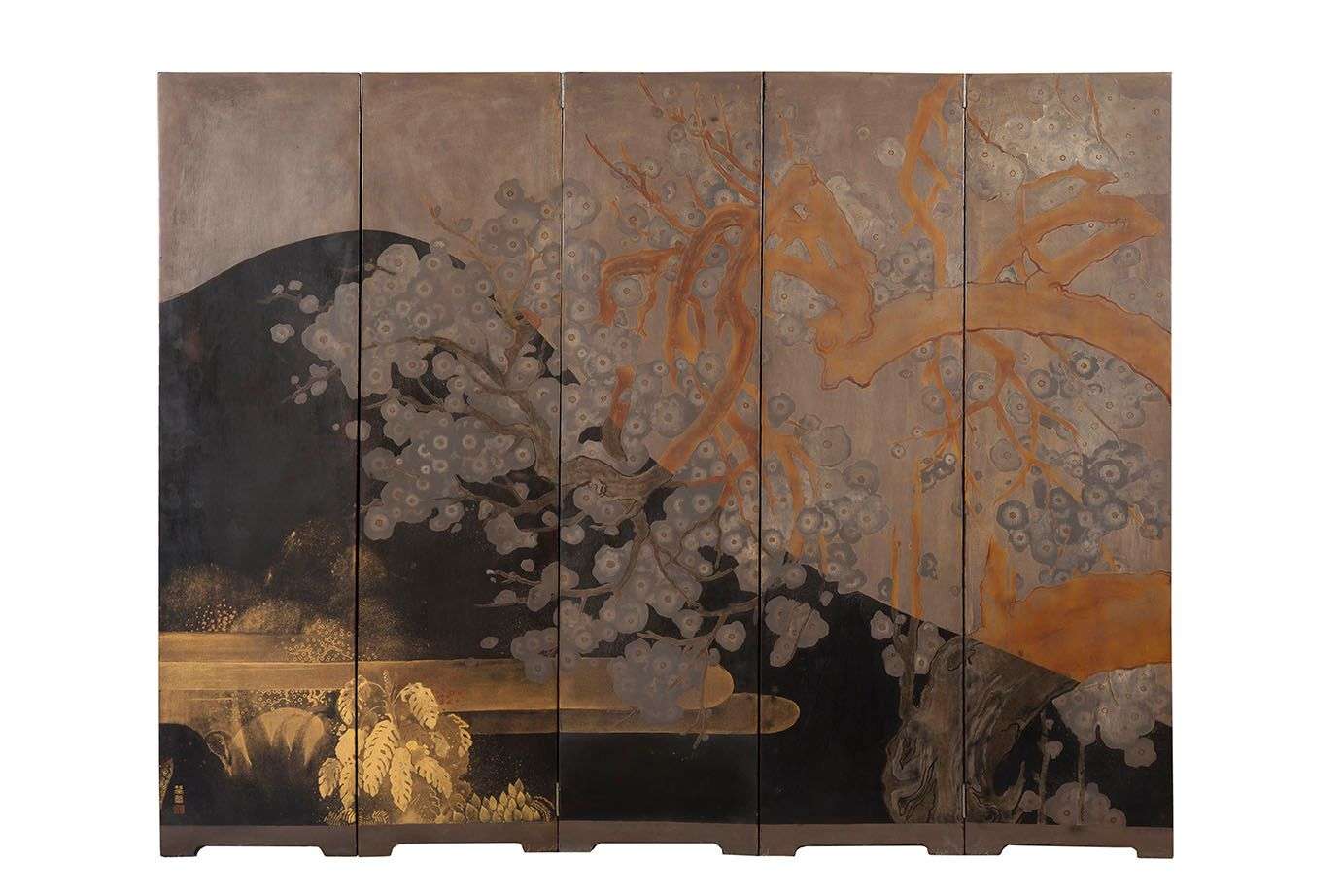
LÊ PHỔ (1907-2001)
Paysage du Tonkin, Hanoï, circa 1930-1935
Gold and silver lacquer, five-panel screen, signed lower left, countersigned on the back
45 1/8 x 57 7/8 in.
A certificate of inclusion in the catalogue raisonné of the artist currently being prepared by Charlotte Aguttes-Reynier for the Association “Artistes d'Asie à Paris” will be given to the buyer.
PROVENANCE
Collection of Governor General Auguste Tholance (1878-1938)
Private collection, Nice (since the late 1930s, by descent from the previous owner)
Private collection, Marseille (since the 1980s and then the 1990s, by successive descent from the previous owners)
EXHIBITIONS (FOR RELATED WORKS)
1931, International Colonial Exhibition in Paris, Vincennes [May 6 - November 15] for Paysage tonkinois (Sai-Son, Son-Tay province) 2023 - 2024, “Paraventi. Folding screens from the 17 th to 21st century,” Fondazione Prada, Milan [October 26–February 22] for Paysage du Tonkin, Lacquer, three-panel screen, 201 x 240 cm, Ill. 5 2024 - 2025, “Lê Phô, Mai-Thu, Vu Cao Dam. Pioneers of Vietnamese Modern Art in France,” Musée Cernuschi, Paris [October 11 - May 4] for Paysage du Tonkin, lacquer, three-panel folding screen, 201 x 240 cm, Ill. 5
2025, “City of Others: Asian Artists in Paris, 1920s-1940s,” National Gallery of Singapore [April 2 - August 17] for Les éternités, circa 1935, lacquer, five-panel screen, 102 x 125 cm, Ill. 4
The son of the viceroy of Tonkin, Lê Phổ was born in 1907 in Hadong, northern Vietnam. He showed a keen interest in the arts from a young age and enrolled at the Indochina School of Fine Arts in 1925. During his formative years in Hanoi, he met his two main mentors, the French artists Victor Tardieu and Joseph Inguimberty, who would play a major role in the development of his style. In 1931, on the occasion of the colonial exhibition organized in the Bois de Vincennes, he embarked on a two-year trip to Europe. He traveled throughout France, Belgium, the Netherlands, and Italy, developing a passion for Renaissance art, Western religious painting, and modern painting. In 1933, he returned to Hanoi and began teaching drawing. A year later, during a trip to Beijing, he deepened his knowledge of traditional Chinese painting thanks to collectors and art lovers. In 1937, Lê Phổ settled permanently in Paris. He began exhibiting his works featuring women, children, bouquets of flowers and an oriental technique that would make him famous in Algeria and France. He marveled at museums and was also interested in the work of painters he met, such as Bonnard and Matisse. His reputation gained new momentum in 1963 when he signed an agreement with the Findlay Gallery to be exhibited in North America. From then on, he became one of the most renowned Vietnamese painters of the 20th century.
Paysage du Tonkin, Hanoï, circa 1930-1935
Gold and silver lacquer, five-panel screen, signed lower left, countersigned on the back
45 1/8 x 57 7/8 in.
A certificate of inclusion in the catalogue raisonné of the artist currently being prepared by Charlotte Aguttes-Reynier for the Association “Artistes d'Asie à Paris” will be given to the buyer.
PROVENANCE
Collection of Governor General Auguste Tholance (1878-1938)
Private collection, Nice (since the late 1930s, by descent from the previous owner)
Private collection, Marseille (since the 1980s and then the 1990s, by successive descent from the previous owners)
EXHIBITIONS (FOR RELATED WORKS)
1931, International Colonial Exhibition in Paris, Vincennes [May 6 - November 15] for Paysage tonkinois (Sai-Son, Son-Tay province) 2023 - 2024, “Paraventi. Folding screens from the 17 th to 21st century,” Fondazione Prada, Milan [October 26–February 22] for Paysage du Tonkin, Lacquer, three-panel screen, 201 x 240 cm, Ill. 5 2024 - 2025, “Lê Phô, Mai-Thu, Vu Cao Dam. Pioneers of Vietnamese Modern Art in France,” Musée Cernuschi, Paris [October 11 - May 4] for Paysage du Tonkin, lacquer, three-panel folding screen, 201 x 240 cm, Ill. 5
2025, “City of Others: Asian Artists in Paris, 1920s-1940s,” National Gallery of Singapore [April 2 - August 17] for Les éternités, circa 1935, lacquer, five-panel screen, 102 x 125 cm, Ill. 4
The son of the viceroy of Tonkin, Lê Phổ was born in 1907 in Hadong, northern Vietnam. He showed a keen interest in the arts from a young age and enrolled at the Indochina School of Fine Arts in 1925. During his formative years in Hanoi, he met his two main mentors, the French artists Victor Tardieu and Joseph Inguimberty, who would play a major role in the development of his style. In 1931, on the occasion of the colonial exhibition organized in the Bois de Vincennes, he embarked on a two-year trip to Europe. He traveled throughout France, Belgium, the Netherlands, and Italy, developing a passion for Renaissance art, Western religious painting, and modern painting. In 1933, he returned to Hanoi and began teaching drawing. A year later, during a trip to Beijing, he deepened his knowledge of traditional Chinese painting thanks to collectors and art lovers. In 1937, Lê Phổ settled permanently in Paris. He began exhibiting his works featuring women, children, bouquets of flowers and an oriental technique that would make him famous in Algeria and France. He marveled at museums and was also interested in the work of painters he met, such as Bonnard and Matisse. His reputation gained new momentum in 1963 when he signed an agreement with the Findlay Gallery to be exhibited in North America. From then on, he became one of the most renowned Vietnamese painters of the 20th century.