
&w=3840&q=75)
&w=3840&q=75)
&w=3840&q=75)
&w=3840&q=75)
&w=3840&q=75)
&w=3840&q=75)
&w=3840&q=75)
&w=3840&q=75)


3
Mai Thu (1906 - 1980)
The item was sold for 1 793 279 €
Fees include commission and taxes.
MAI TRUNG THỨ (1906-1980)
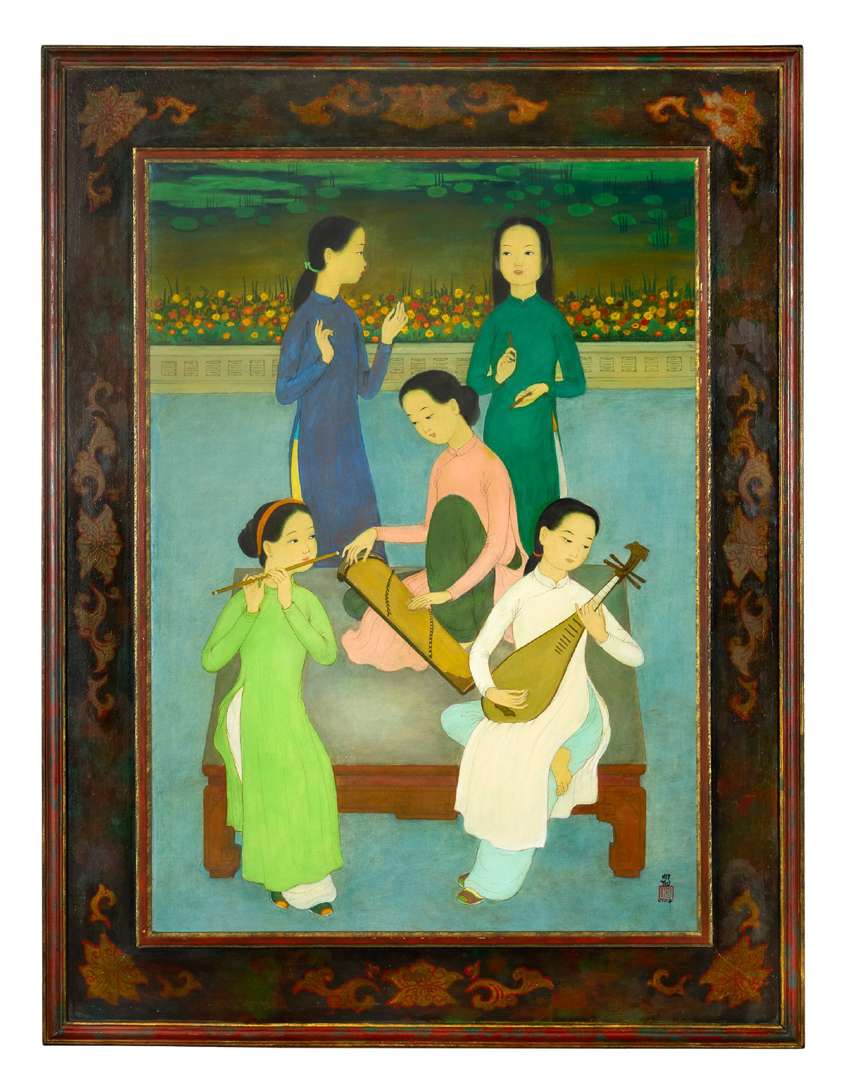
Le concert, 1978
Ink and color on silk, signed and dated lower right. In its original frame made by the artist
36 1/4 x 25 5/8 in.
A certificate of inclusion in the catalogue raisonné of the artist currently being prepared by Charlotte Aguttes-Reynier for the Association “Artistes d'Asie à Paris” will be given to the buyer.
PROVENANCE
Galerie Apesteguy, Deauville
Private collection, France (acquired from the previous owner and passed down through the family since)
EXHIBITION
1979 - 1980, “L'univers poétique de Mai-Thu” (The Poetic Universe of Mai-Thu), Galerie Vendôme, Paris (December - January)
Born in 1906 near Haiphong, Mai Trung Thứ attended the French high-school in Hanoi. Like Lê Phổ, Vũ Cao Đàm and Le Van De, he was in the first year of students at the École des Beaux-Arts d’Indochine, founded and directed by the painter Victor Tardieu. Invited to take part in the 1931 Paris Colonial Exhibition, Mai Trung Thứ discovered and fell in love with France, where he settled in the late 30’s and stayed until he died. Although strongly influenced by the teachings of Tardieu and Joseph Inguimberty, he is the one of his comrades who retained the deepest-rooted sense of Vietnamese identity. He soon abandoned oils for gouache and ink on silk: typical Asian techniques that enabled him to develop a style richly reminiscent of traditional Chinese and Vietnamese art. Although an independent artist, he remained politically committed and concerned about the future of his country.
In an interview filmed in 1967, artist Mai Trung Thứ expresses his pleasure in painting while listening to traditional Vietnamese music 1. Known for his love of music and his talents as a musician, he naturally revisits this theme in his paintings throughout his career.
In 1978, the artist produced his final version on this subject, which he titled Le concert. This composition, in an unusual format, was presented in his last exhibition, L'univers poétique de Mai-Thu, held from December 1979 to January
1980 at the Vendôme Gallery. A photograph and a video preserved in the Mai-Thu archives show this painting in situ on that occasion (ill. 1). In 1982, the Galerie Anne Apesteguy published a calendar on which it chose to reproduce it (ill. 2).
In this delicate silk painting, five young women with idealized features, dressed in áo dài, play traditional Vietnamese music. While the one at the top left seems to be singing and setting the rhythm, the others are each playing a different instrument for this musical moment. The following are depicted (from top to bottom and left to right):
- A phách, consisting of two pieces of wood that are struck together to mark the rhythm.
- A đàn tranh, a stringed instrument belonging to the zither family.
- A sáo trúc, a bamboo transverse flute.
- A đàn tỳ bà, a lute.
This large composition corresponds, in terms of technique, to those produced in the last years of Mai Trung Thứ's career, who died in 1980. This period is characterized by the use of brighter colors that enhance and illuminate his works, while the silhouettes and backgrounds are simplified 2.
1 Archive Ina, 1967, Le peintre Mai Trung Thứ lors de son exposition à Deauville, T-20240502-161846 RCF07017916 MGRCF-RO0139395- -AK.01
2 Anne Fort, « La période française de Mai-Thu : une tradition réinventée », in. Lê Phô, Mai-Thu, Vu Cao Dam: pionniers de l’art moderne vietnamien en France,
[exposition, Paris, Musée Cernuschi, 11 octobre 2024 – 4 mai 2025], Paris, Flammarion, 2024, p. 126.
Le concert, 1978
Ink and color on silk, signed and dated lower right. In its original frame made by the artist
36 1/4 x 25 5/8 in.
A certificate of inclusion in the catalogue raisonné of the artist currently being prepared by Charlotte Aguttes-Reynier for the Association “Artistes d'Asie à Paris” will be given to the buyer.
PROVENANCE
Galerie Apesteguy, Deauville
Private collection, France (acquired from the previous owner and passed down through the family since)
EXHIBITION
1979 - 1980, “L'univers poétique de Mai-Thu” (The Poetic Universe of Mai-Thu), Galerie Vendôme, Paris (December - January)
Born in 1906 near Haiphong, Mai Trung Thứ attended the French high-school in Hanoi. Like Lê Phổ, Vũ Cao Đàm and Le Van De, he was in the first year of students at the École des Beaux-Arts d’Indochine, founded and directed by the painter Victor Tardieu. Invited to take part in the 1931 Paris Colonial Exhibition, Mai Trung Thứ discovered and fell in love with France, where he settled in the late 30’s and stayed until he died. Although strongly influenced by the teachings of Tardieu and Joseph Inguimberty, he is the one of his comrades who retained the deepest-rooted sense of Vietnamese identity. He soon abandoned oils for gouache and ink on silk: typical Asian techniques that enabled him to develop a style richly reminiscent of traditional Chinese and Vietnamese art. Although an independent artist, he remained politically committed and concerned about the future of his country.
In an interview filmed in 1967, artist Mai Trung Thứ expresses his pleasure in painting while listening to traditional Vietnamese music 1. Known for his love of music and his talents as a musician, he naturally revisits this theme in his paintings throughout his career.
In 1978, the artist produced his final version on this subject, which he titled Le concert. This composition, in an unusual format, was presented in his last exhibition, L'univers poétique de Mai-Thu, held from December 1979 to January
1980 at the Vendôme Gallery. A photograph and a video preserved in the Mai-Thu archives show this painting in situ on that occasion (ill. 1). In 1982, the Galerie Anne Apesteguy published a calendar on which it chose to reproduce it (ill. 2).
In this delicate silk painting, five young women with idealized features, dressed in áo dài, play traditional Vietnamese music. While the one at the top left seems to be singing and setting the rhythm, the others are each playing a different instrument for this musical moment. The following are depicted (from top to bottom and left to right):
- A phách, consisting of two pieces of wood that are struck together to mark the rhythm.
- A đàn tranh, a stringed instrument belonging to the zither family.
- A sáo trúc, a bamboo transverse flute.
- A đàn tỳ bà, a lute.
This large composition corresponds, in terms of technique, to those produced in the last years of Mai Trung Thứ's career, who died in 1980. This period is characterized by the use of brighter colors that enhance and illuminate his works, while the silhouettes and backgrounds are simplified 2.
1 Archive Ina, 1967, Le peintre Mai Trung Thứ lors de son exposition à Deauville, T-20240502-161846 RCF07017916 MGRCF-RO0139395- -AK.01
2 Anne Fort, « La période française de Mai-Thu : une tradition réinventée », in. Lê Phô, Mai-Thu, Vu Cao Dam: pionniers de l’art moderne vietnamien en France,
[exposition, Paris, Musée Cernuschi, 11 octobre 2024 – 4 mai 2025], Paris, Flammarion, 2024, p. 126.