
&w=3840&q=75)
&w=3840&q=75)
&w=3840&q=75)
&w=3840&q=75)
&w=3840&q=75)
&w=3840&q=75)
&w=3840&q=75)
&w=3840&q=75)


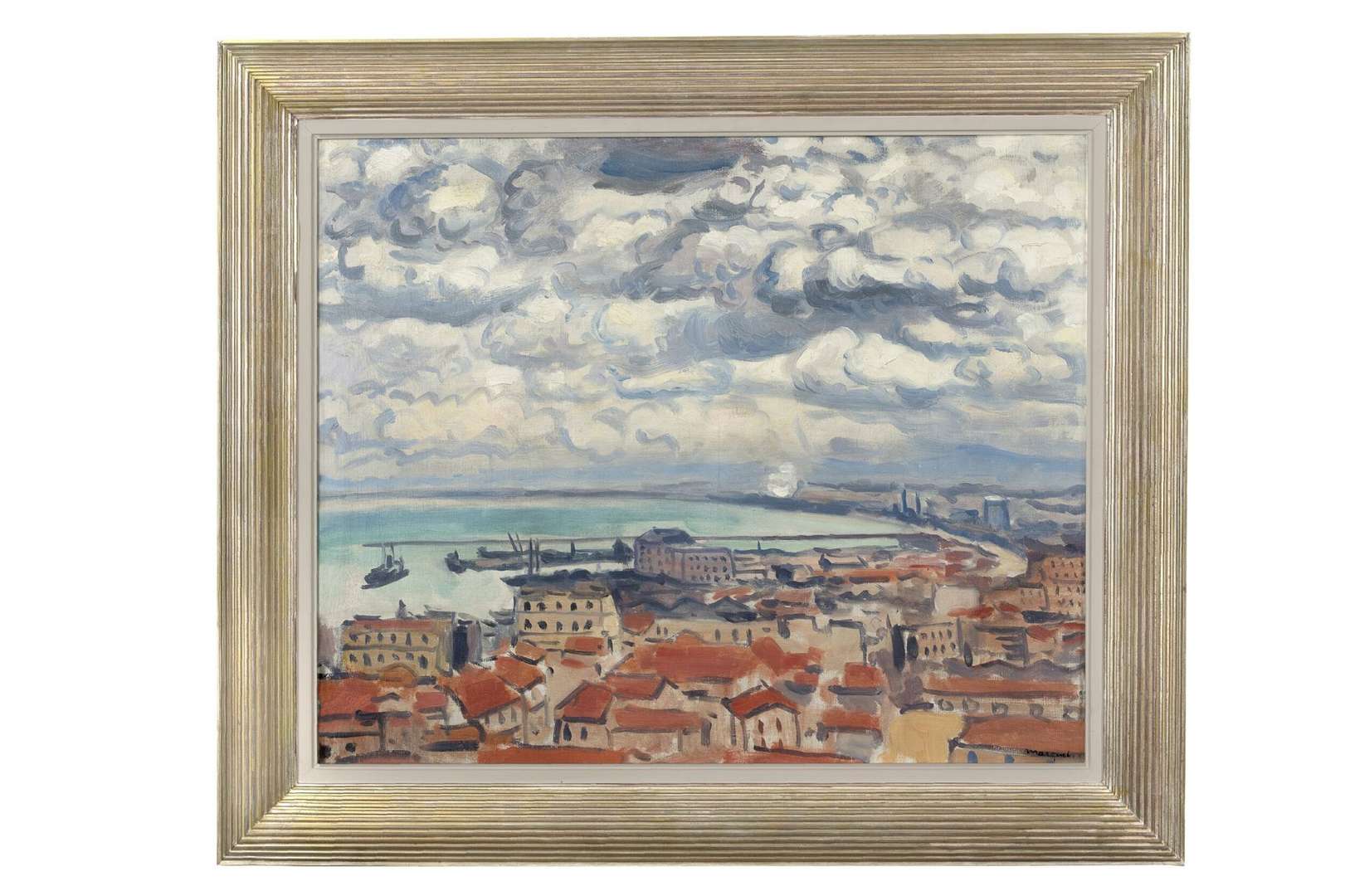
ALBERT MARQUET (1875–1947)
The city [of Algiers] beneath the clouds, circa 1938
The city [of Algiers] beneath the clouds, circa 1938
Oil on canvas
Signed lower right
Inscribed '25VB/La ville/38/mm' by Madame Albert Marquet on the reverse
50 x 61 cm - 19 3/4 x 24 in.
A certificate by Madame Katia Granoff, dated 8 January 1952, will be provided to the buyer.
Oil on canvas, signed lower right, inscribed '25VB/La ville/38/mm' by Madame Albert Marquet on the back
- Madame Albert Marquet Collection, France
- Katia Granoff Gallery, Paris (acquired from the gallery)
- Private collection, France (acquired by the owner in 1952)
Jean-Claude Martinet and Guy Wildenstein, Marquet, North Africa: Catalogue of Paintings, Milan: Skira/Seuil; Paris: Wildenstein Institute, 2001, described and reproduced under reference I-207, p. 201 (titled *The City Beneath the Clouds*)
“In early 1920, Marquet travelled to Marseille to set sail for Algiers. This first stay in Algeria was a journey of discovery. The artist was captivated by the city and the Sahara. He would subsequently return regularly to spend the winter in this sun-drenched region. In 1923, he married an Algiers native, Marcelle Martinet, who would take him to North Africa every year. During the Second World War, they never left Algiers and bought a property in the surrounding area. The sight of the city from the sea struck all travellers. Facing east and built on the mountainside, Algiers is surrounded by lush vegetation; its white houses are topped with terraces. Marquet explored it at a time when construction was beginning to take place, more intensively, around the Turkish walls. Sumptuous Moorish villas with their marvellous gardens still remained; modern buildings had not yet taken over everything, although the French quarter had grown as circumstances dictated. Architects built in the French style without taking into account the differences in environment and climate. Algiers is a large, cosmopolitan Mediterranean metropolis comprising: the Casbah, a veritable city within a city; the utterly unique Bab-el-Oued district; the Mustapha Supérieur district, which is becoming covered in modern buildings; and the lower town near the port, which boasts all the amenities of a major city. From the heights of the city and its sumptuous gardens, one discovers a magnificent panoramic view of the bay and the surrounding mountains.”
Jean-Claude Martinet and Guy Wildenstein, Marquet, North Africa, Catalogue of Paintings, Milan: Skira/Seuil; Paris: Wildenstein Institute, 2001, pp. 75 and 78
‘This painting and the ones that follow were painted from a window in a flat situated further west. The artist can admire the French Quarter spread out below him. The panorama stretches as far as Cape Matifou, with the industrial suburbs and the Agha and Mustapha docks; in the background, one can see the mountain range encircling the city from east to west—the first foothills of the Kabyle Djurdjura, the Blida Atlas and the Zaccar. ”
Jean-Claude Martinet and Guy Wildenstein, Marquet, North Africa, Catalogue of Paintings, Milan: Skira/Seuil; Paris: Wildenstein Institute, 2001, described and reproduced under reference I-207, p. 201