
&w=3840&q=75)
&w=3840&q=75)
&w=3840&q=75)
&w=3840&q=75)
&w=3840&q=75)
&w=3840&q=75)
&w=3840&q=75)
&w=3840&q=75)


240
RARE SAINTE VIERGE À L'ENFANT
The item was sold for 158 600 €
Fees include commission and taxes.
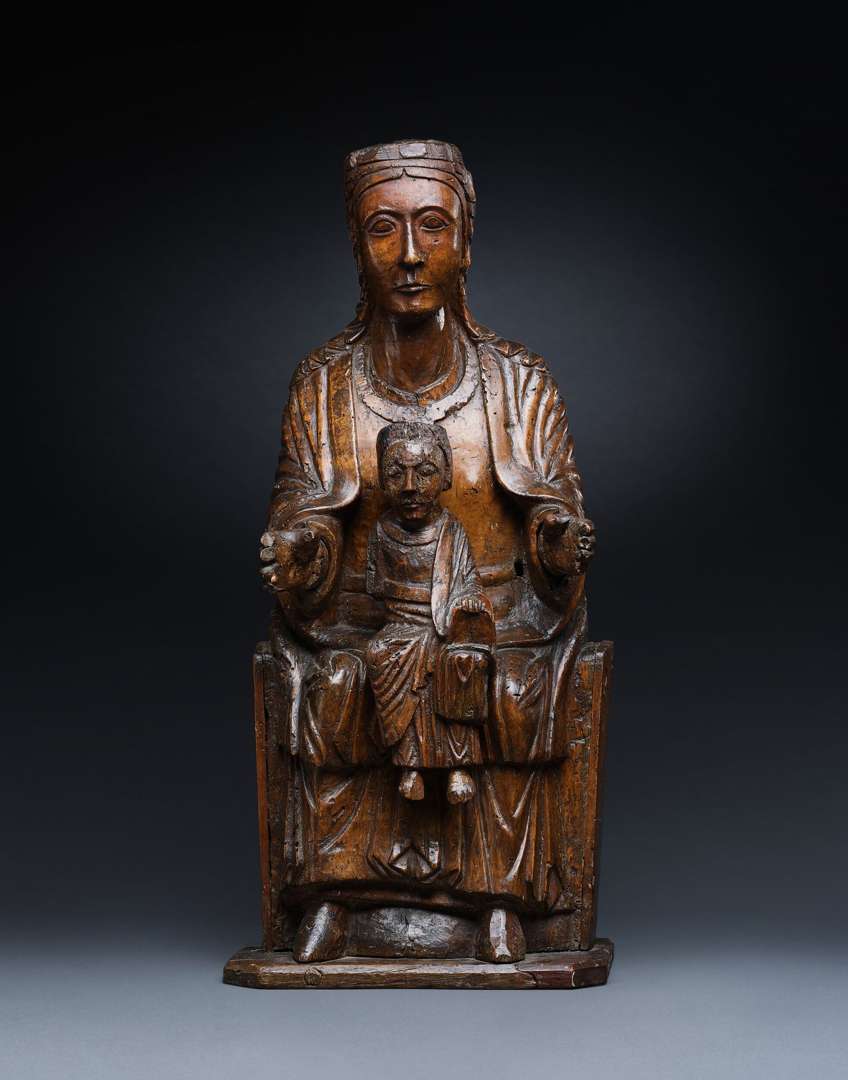
RARE HOLY VIRGIN WITH CHILD
IN MAJESTY "SEDES SAPIENTIAE
in carved walnut wood. Carved back (closed by a wooden
plate). Our Lady sits hieratically in majesty on a throne
throne, arms open to present her Divine Infant Son seated
(removable) clothed in a toga and holding in her left hand
the open book of Sacred Scripture. His right hand, which was
is missing.
France, Auvergne, late 11th century, early 12th century.
Height: 77.5 cm - Width: 36 cm - Depth: 17.5 cm
(traces of old polychromy, accidents, visible missing parts and
restorations, numerous wrought-iron spikes, added elements)
PROVENANCE
- Reputedly acquired in Auvergne around 1930 by Madame Marais
[letter from François Bigot dated January 18, 1998].
- Acquired from the Marais heirs by Madame Gabrielle
Laroche through François Bigot.
- Acquired from the previous owner by Joseph Pell Lombardi
[invoice dated December 8, 1998]
- Private collection Joseph Pell Lombardi for the chapel of
château du Sailhant (Cantal)
BIBLIOGRAPHY
"La science au secours de l'expert: une sculpture bien authentique
"article by François Bigot published in Vrai ou Faux,
l'expertise des Objets d'Art by the Union Française des Experts,
Faton (1994). Pages 48 to 51 (reproduced).
Attached is a detailed report of the tomographic examination
carried out by Gilles Perrault's laboratory in 1991, which highlights
that the Virgin's head was carved at the same time as the body
at the same time as the body, in the same mass of wood, then sawn
horizontally. A modern piece was then added to lengthen the neck.
lengthen the neck, as well as a piece placed in front of the neck to mask
a major crack in the original front wood. The analysis
also proves that the Infant Jesus is indeed original and was also
carved from the same wood and at the same time as the Virgin Mary
though in an independent mass and fixed at a later stage.
(In fact, two ancient fixing points have been filled in
on the Virgin's belly).
Our extremely rare sculpture is part of the archetypal corpus
of the Sedes Sapientiae ("Throne of Wisdom") emblematic
of Romanesque iconography.
The profusion of this type of sculpture, particularly in Auvergne
is explained by the Auvergne origin of its iconography. It was
the 10th-century vision of Abbé Robert de Mozac, recorded in the
in the Codex Claromontanus (ms. 145 of the Bibliothèque
of the Clermont-Ferrand Heritage Library) that gave rise to these
images.
From this long account by deacon Arnaud in the late 10th century, we learn that the abbot of Mozac
abbot of Mozac, near Riom, received an apparition of the Virgin Mary
apparition of the Virgin Mary in a celestial light,
enthroned in majesty, holding the Infant Jesus in her arms, seated
on his mother's lap. Our Lady spoke to Robert and commanded him
both the cathedral and her image.
So it was that the bishop of Clermont, Etienne II, had the cathedral designed
(probably under Robert's direction) the first Sedes
Sapientae: a prototypical treasure trove of gold and jewels, which was
destroyed during the French Revolution.
Fortunately, a trace of this original work can still be seen in the
the marginal pen-and-ink drawing of the "Codex Claramontanus
(Fig. 1). It was this first sculpture, in accordance with the wishes
mystically revealed to Robert de Mozac, was the source of all the
of all the Sedes Sapientiae of this type, of which our example
our example fits perfectly.
The very title Sedes Sapientiae ("Throne of Wisdom")
to designate this type of mystically revealed work
borrows directly from a Marian term. The title literally
the Blessed Virgin Mary making herself,
the throne of her Divine Son, of whom she is both mystically
mystically the Daughter, the Bride and the Mother.
Our Sedes Sapientiae is remarkable for its almost Carolingian
headdress, which suggests an earlier dating than
than usual. In particular, it is to be compared with
with the Vierge en majesté dite de Limay (Fig. 2) currently
at the Saint-Louis Cathedral in Versailles [Reference
Mérimée: PM78000261], which also probably originated in the
Auvergne. The Virgins of Orcival (Fig. 3) and Saint-Gervazy
(Fig. 4) are also good comparatives.
Intended for devotion in parish churches, these sculptures
the presence of the Virgin Mary as the privileged
as the privileged interlocutor of souls who wish to know, love
and serve her Divine Son.
IN MAJESTY "SEDES SAPIENTIAE
in carved walnut wood. Carved back (closed by a wooden
plate). Our Lady sits hieratically in majesty on a throne
throne, arms open to present her Divine Infant Son seated
(removable) clothed in a toga and holding in her left hand
the open book of Sacred Scripture. His right hand, which was
is missing.
France, Auvergne, late 11th century, early 12th century.
Height: 77.5 cm - Width: 36 cm - Depth: 17.5 cm
(traces of old polychromy, accidents, visible missing parts and
restorations, numerous wrought-iron spikes, added elements)
PROVENANCE
- Reputedly acquired in Auvergne around 1930 by Madame Marais
[letter from François Bigot dated January 18, 1998].
- Acquired from the Marais heirs by Madame Gabrielle
Laroche through François Bigot.
- Acquired from the previous owner by Joseph Pell Lombardi
[invoice dated December 8, 1998]
- Private collection Joseph Pell Lombardi for the chapel of
château du Sailhant (Cantal)
BIBLIOGRAPHY
"La science au secours de l'expert: une sculpture bien authentique
"article by François Bigot published in Vrai ou Faux,
l'expertise des Objets d'Art by the Union Française des Experts,
Faton (1994). Pages 48 to 51 (reproduced).
Attached is a detailed report of the tomographic examination
carried out by Gilles Perrault's laboratory in 1991, which highlights
that the Virgin's head was carved at the same time as the body
at the same time as the body, in the same mass of wood, then sawn
horizontally. A modern piece was then added to lengthen the neck.
lengthen the neck, as well as a piece placed in front of the neck to mask
a major crack in the original front wood. The analysis
also proves that the Infant Jesus is indeed original and was also
carved from the same wood and at the same time as the Virgin Mary
though in an independent mass and fixed at a later stage.
(In fact, two ancient fixing points have been filled in
on the Virgin's belly).
Our extremely rare sculpture is part of the archetypal corpus
of the Sedes Sapientiae ("Throne of Wisdom") emblematic
of Romanesque iconography.
The profusion of this type of sculpture, particularly in Auvergne
is explained by the Auvergne origin of its iconography. It was
the 10th-century vision of Abbé Robert de Mozac, recorded in the
in the Codex Claromontanus (ms. 145 of the Bibliothèque
of the Clermont-Ferrand Heritage Library) that gave rise to these
images.
From this long account by deacon Arnaud in the late 10th century, we learn that the abbot of Mozac
abbot of Mozac, near Riom, received an apparition of the Virgin Mary
apparition of the Virgin Mary in a celestial light,
enthroned in majesty, holding the Infant Jesus in her arms, seated
on his mother's lap. Our Lady spoke to Robert and commanded him
both the cathedral and her image.
So it was that the bishop of Clermont, Etienne II, had the cathedral designed
(probably under Robert's direction) the first Sedes
Sapientae: a prototypical treasure trove of gold and jewels, which was
destroyed during the French Revolution.
Fortunately, a trace of this original work can still be seen in the
the marginal pen-and-ink drawing of the "Codex Claramontanus
(Fig. 1). It was this first sculpture, in accordance with the wishes
mystically revealed to Robert de Mozac, was the source of all the
of all the Sedes Sapientiae of this type, of which our example
our example fits perfectly.
The very title Sedes Sapientiae ("Throne of Wisdom")
to designate this type of mystically revealed work
borrows directly from a Marian term. The title literally
the Blessed Virgin Mary making herself,
the throne of her Divine Son, of whom she is both mystically
mystically the Daughter, the Bride and the Mother.
Our Sedes Sapientiae is remarkable for its almost Carolingian
headdress, which suggests an earlier dating than
than usual. In particular, it is to be compared with
with the Vierge en majesté dite de Limay (Fig. 2) currently
at the Saint-Louis Cathedral in Versailles [Reference
Mérimée: PM78000261], which also probably originated in the
Auvergne. The Virgins of Orcival (Fig. 3) and Saint-Gervazy
(Fig. 4) are also good comparatives.
Intended for devotion in parish churches, these sculptures
the presence of the Virgin Mary as the privileged
as the privileged interlocutor of souls who wish to know, love
and serve her Divine Son.