
&w=3840&q=75)
&w=3840&q=75)
&w=3840&q=75)
&w=3840&q=75)
&w=3840&q=75)
&w=3840&q=75)
&w=3840&q=75)
&w=3840&q=75)


128
QUINZIÈME JUZ D’UN CORAN MINIATURE,
The item was sold for 10 400 €
Fees include commission and taxes.
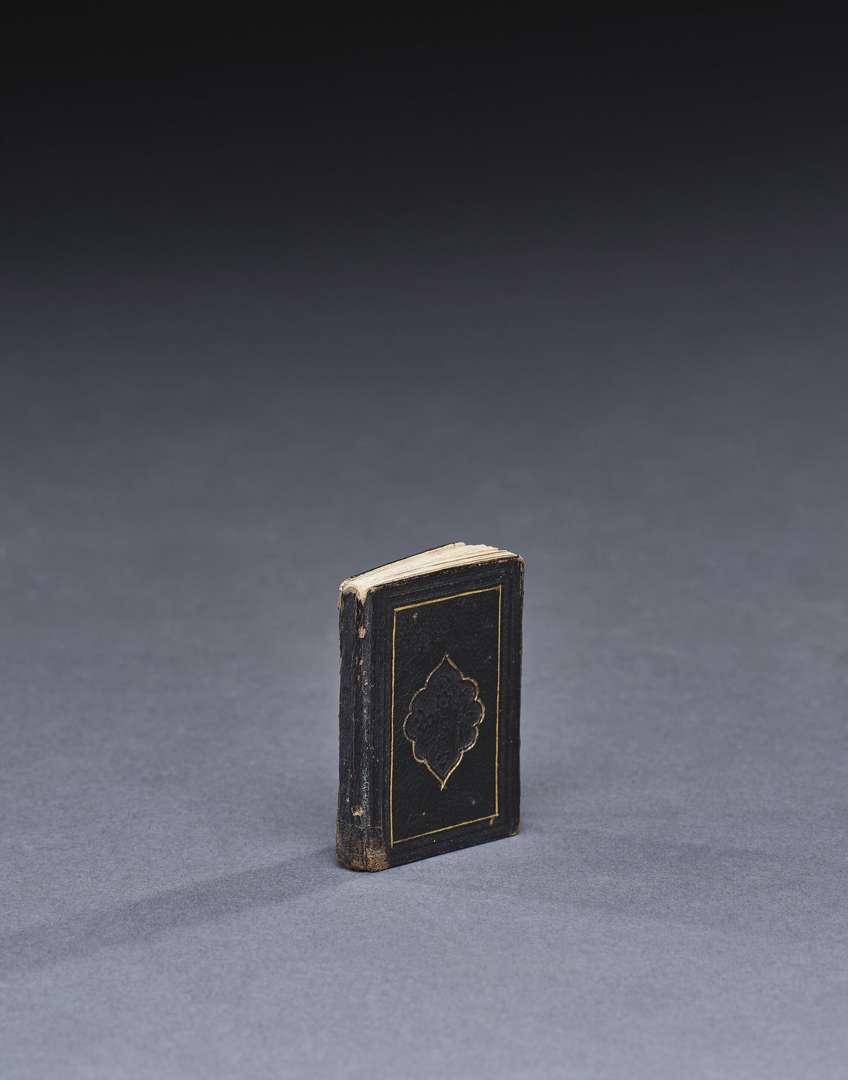
FIFTEENTH JUZ OF A MINIATURE CORAN, PROBABLY EGYPT OR SYRIA, 16th CENTURY Binding size: 6.3 x 4.4 cm A few holes, freckles, stains, small tears, folds, probably minor retouching, worn binding with missing flap.
Arabic manuscript on paper of 33 folios and 3 blank endpapers, the text of 9 lines in miniature cursive calligraphy known as ghubar in black ink, a few signs, verse separators and the title of Sura XVIII al-Kahf in red ink.
On the first page, a shamseh medallion illuminated in gold and polychrome and inscribed in thuluth calligraphy in silver letters circled in black and red "fifteenth juz", the number 15 further inscribed in black ink on the same page. The next double-page is illuminated in gold and polychrome with a frontispiece, with a five-line text in black ink in reserve on an ornate background in red ink and set in a gilded frame. The vertical sides of the frame are adorned with a braided band, while the horizontal sides are decorated with floral motifs, one of which includes an inscription in silver letters (barely legible), probably the name of the sura and the number of verses it contains (111). The frame continues into the margin with a poly-lobed mantling flanked by two rosettes and then two half-lambrequins. The manuscript text extends from Sura XVII Al-Israa to Sura XVIII Al-Kahf, verse 76. Oriental binding in black morocco, embossed on each cover with a poly-lobed mandorla outlined in gold and decorated with floral scrolls, and framed with fillets, one of which is outlined in gold.
The small format of this manuscript, with 9 lines on a page some 6 cm high, necessitated the use of a tiny script that could be described as ghubar ("dust" in Arabic). This cursive script is a variant of naskhi used on all types of small media designed to hold written text, such as amulets, talismans and miniature Korans. Some of these Qurans could be divided into 30 volumes and stored in leather boxes, as shown by an intact example preserved in the Islamic Museum in Teheran (ms. 4273) and attributed to the 13th / 14th century. The manuscript presented here therefore appears to be the orphan of a similar set, now lost... But a study of national collections seems to provide a second proof of the existence of this 30-volume Koran, of which our manuscript constitutes the fifteenth part. Indeed, the Arabic manuscript 6850 in the Bibliothèque nationale de France (BNF) follows exactly the text of our manuscript, introduced by verse 76 of Sura al-Kahf, which completes our juz. This sixteenth juz, as indicated by its introductory shamseh, would then in all likelihood be not only a volume of the same Qur'an as ours, but also the one that immediately follows it. The two manuscripts, both of the same format, have the same binding, the one on the BNF juz having retained its flap. Both manuscripts feature the introductory shamseh and double-frontispiece, with a few shades of decoration, followed by the sura titles and verse separators in red ink, which are much more prominent on our manuscript.
François Déroche, in his Catalogue des Manuscrits Arabes de la BNF, cautiously attributes Arabic manuscript 6850 to 16th-century Egypt, and so we shall situate our work with the same precautions. PROVENANCE Private European and Imperial Collection BIBLIOGRAPHY IN REPORT BLAIR, Sheila, Islamic Calligraphy, Edinburg University Press, 2006, p. 260. DÉROCHE, François, Catalogue des Manuscrits arabes. Deuxième partie. Manuscrits musulmans. Fasc. 2: Du Maghreb à l'Insulinde. Paris, Bibliothèque Nationale, 1985, n° 372, p. 67. https://gallica. bnf.fr/ark:/12148/btv1b8447036z/f1.item.r=arabe%206850 (consulted January 29, 2025) EXPERT Camille Celier
Arabic manuscript on paper of 33 folios and 3 blank endpapers, the text of 9 lines in miniature cursive calligraphy known as ghubar in black ink, a few signs, verse separators and the title of Sura XVIII al-Kahf in red ink.
On the first page, a shamseh medallion illuminated in gold and polychrome and inscribed in thuluth calligraphy in silver letters circled in black and red "fifteenth juz", the number 15 further inscribed in black ink on the same page. The next double-page is illuminated in gold and polychrome with a frontispiece, with a five-line text in black ink in reserve on an ornate background in red ink and set in a gilded frame. The vertical sides of the frame are adorned with a braided band, while the horizontal sides are decorated with floral motifs, one of which includes an inscription in silver letters (barely legible), probably the name of the sura and the number of verses it contains (111). The frame continues into the margin with a poly-lobed mantling flanked by two rosettes and then two half-lambrequins. The manuscript text extends from Sura XVII Al-Israa to Sura XVIII Al-Kahf, verse 76. Oriental binding in black morocco, embossed on each cover with a poly-lobed mandorla outlined in gold and decorated with floral scrolls, and framed with fillets, one of which is outlined in gold.
The small format of this manuscript, with 9 lines on a page some 6 cm high, necessitated the use of a tiny script that could be described as ghubar ("dust" in Arabic). This cursive script is a variant of naskhi used on all types of small media designed to hold written text, such as amulets, talismans and miniature Korans. Some of these Qurans could be divided into 30 volumes and stored in leather boxes, as shown by an intact example preserved in the Islamic Museum in Teheran (ms. 4273) and attributed to the 13th / 14th century. The manuscript presented here therefore appears to be the orphan of a similar set, now lost... But a study of national collections seems to provide a second proof of the existence of this 30-volume Koran, of which our manuscript constitutes the fifteenth part. Indeed, the Arabic manuscript 6850 in the Bibliothèque nationale de France (BNF) follows exactly the text of our manuscript, introduced by verse 76 of Sura al-Kahf, which completes our juz. This sixteenth juz, as indicated by its introductory shamseh, would then in all likelihood be not only a volume of the same Qur'an as ours, but also the one that immediately follows it. The two manuscripts, both of the same format, have the same binding, the one on the BNF juz having retained its flap. Both manuscripts feature the introductory shamseh and double-frontispiece, with a few shades of decoration, followed by the sura titles and verse separators in red ink, which are much more prominent on our manuscript.
François Déroche, in his Catalogue des Manuscrits Arabes de la BNF, cautiously attributes Arabic manuscript 6850 to 16th-century Egypt, and so we shall situate our work with the same precautions. PROVENANCE Private European and Imperial Collection BIBLIOGRAPHY IN REPORT BLAIR, Sheila, Islamic Calligraphy, Edinburg University Press, 2006, p. 260. DÉROCHE, François, Catalogue des Manuscrits arabes. Deuxième partie. Manuscrits musulmans. Fasc. 2: Du Maghreb à l'Insulinde. Paris, Bibliothèque Nationale, 1985, n° 372, p. 67. https://gallica. bnf.fr/ark:/12148/btv1b8447036z/f1.item.r=arabe%206850 (consulted January 29, 2025) EXPERT Camille Celier