
&w=3840&q=75)
&w=3840&q=75)
&w=3840&q=75)
&w=3840&q=75)
&w=3840&q=75)
&w=3840&q=75)
&w=3840&q=75)
&w=3840&q=75)

39
WILLY ARACTINGI (1930-2003)
The item was sold for 19 950 €
Fees include commission and taxes.
WILLY ARACTINGI (1930-2003)
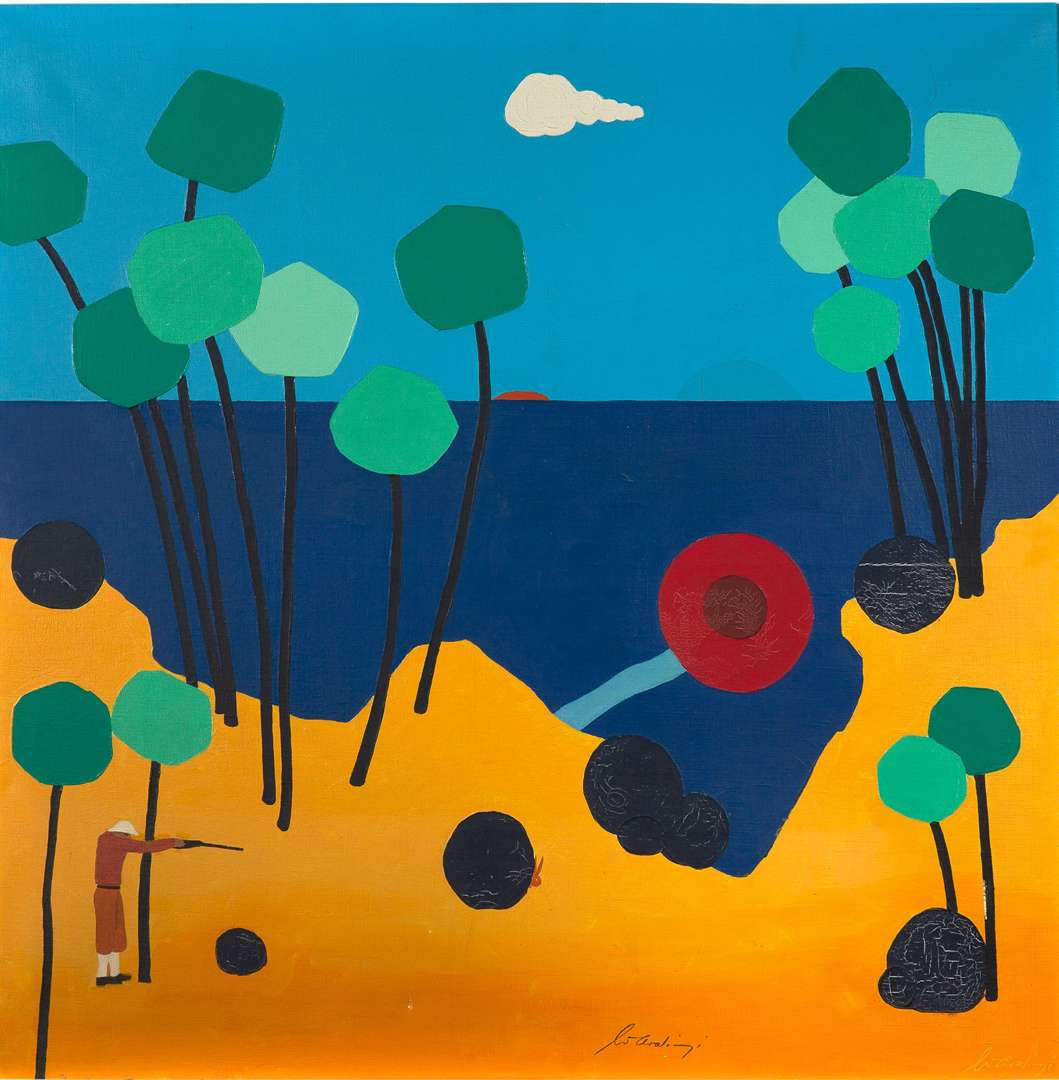
Libanais means hunter, 1973
Oil on canvas, signed lower right, dated December 1973, countersigned and titled on back
90 x 90 cm - 35 7/16 x 35 7/16 in.
Oil on canvas, signed lower right, dated December 1973, signed and titled on the reverse
PROVENANCE
Acquired directly from the artist in 1973, then passed down in the family
This work is listed under number 37-77 in the artist's catalog raisonné, currently in preparation by Madame June Aractingi- Nabaa
Willy Aractingi is a Franco-Lebanese artist born in 1930 in New York, whose work is inspired by the landscapes, myths and cultures of the Mediterranean basin. At the crossroads of Eastern and Western influences, his art is characterized by stylized forms, vibrant colors and a narrative often imbued with mystery. His work is both figurative and symbolic, where memory and the imaginary merge to create scenes that oscillate between dream and reality. In "Libanais veut dire chasseur", Aractingi offers a refined, almost dreamlike vision of a coastline bathed in light. The deep blue of the sea contrasts with the bright ochre of the sand, structuring the composition in large, brightly-colored flats. The trees, reduced to geometric shapes suspended on black stems, evoke a reinvented nature, simplified to the extreme but still recognizable. This stylization gives the work an assertive modernity, recalling certain influences from naive art and oriental miniatures, while remaining rooted in a deeply personal approach.
An intriguing element, however, disturbs this apparent serenity: on the left of the painting, a figure armed with a rifle
the horizon, adding narrative tension. This addition of an armed figure is not simply a figurative element| it embodies the intrusion of reality into a world that, until then, seemed suspended in time. The presence of the hunter adds emotional depth and contrast, enriching the picture and fusing a traditional Mediterranean aesthetic with a deeply personal, modern vision of reality.
Willy Aractingi is a Franco-Lebanese artist born in 1930 in NYC, whose work draws inspiration from the landscapes, myths, and cultures of the Mediterranean basin. At the crossroads of Eastern and Western influences, his art is characterized by stylized forms, vibrant colors, and narratives often imbued with mystery. His work, both figurative and symbolic, merges memory and imagination to create scenes that oscillate between dream and reality. In Libanais veut dire chasseur, Aractingi presents a refined, almost dreamlike vision of a sunlit coastline. The deep blue of the sea contrasts with the radiant ochre of the sand, structuring the composition into large, bold color fields. The trees, reduced to geometric shapes suspended on thin black stems, evoke a reimagined nature simplified to the extreme yet still recognizable. This stylization gives the work a distinct modernity, recalling influences from naïve art and Oriental miniatures while remaining deeply personal.
However, an intriguing element disrupts this apparent serenity: on the left side of the painting, a figure armed with a rifle stands facing the horizon, introducing a narrative tension. This armed figure is not merely a decorative detail| it represents the intrusion of reality into a world that, until then, seemed frozen in time. The hunter's presence adds emotional depth and contrast, enriching the painting by blending a traditional Mediterranean aesthetic with a deeply personal and modern vision of reality.
Libanais means hunter, 1973
Oil on canvas, signed lower right, dated December 1973, countersigned and titled on back
90 x 90 cm - 35 7/16 x 35 7/16 in.
Oil on canvas, signed lower right, dated December 1973, signed and titled on the reverse
PROVENANCE
Acquired directly from the artist in 1973, then passed down in the family
This work is listed under number 37-77 in the artist's catalog raisonné, currently in preparation by Madame June Aractingi- Nabaa
Willy Aractingi is a Franco-Lebanese artist born in 1930 in New York, whose work is inspired by the landscapes, myths and cultures of the Mediterranean basin. At the crossroads of Eastern and Western influences, his art is characterized by stylized forms, vibrant colors and a narrative often imbued with mystery. His work is both figurative and symbolic, where memory and the imaginary merge to create scenes that oscillate between dream and reality. In "Libanais veut dire chasseur", Aractingi offers a refined, almost dreamlike vision of a coastline bathed in light. The deep blue of the sea contrasts with the bright ochre of the sand, structuring the composition in large, brightly-colored flats. The trees, reduced to geometric shapes suspended on black stems, evoke a reinvented nature, simplified to the extreme but still recognizable. This stylization gives the work an assertive modernity, recalling certain influences from naive art and oriental miniatures, while remaining rooted in a deeply personal approach.
An intriguing element, however, disturbs this apparent serenity: on the left of the painting, a figure armed with a rifle
the horizon, adding narrative tension. This addition of an armed figure is not simply a figurative element| it embodies the intrusion of reality into a world that, until then, seemed suspended in time. The presence of the hunter adds emotional depth and contrast, enriching the picture and fusing a traditional Mediterranean aesthetic with a deeply personal, modern vision of reality.
Willy Aractingi is a Franco-Lebanese artist born in 1930 in NYC, whose work draws inspiration from the landscapes, myths, and cultures of the Mediterranean basin. At the crossroads of Eastern and Western influences, his art is characterized by stylized forms, vibrant colors, and narratives often imbued with mystery. His work, both figurative and symbolic, merges memory and imagination to create scenes that oscillate between dream and reality. In Libanais veut dire chasseur, Aractingi presents a refined, almost dreamlike vision of a sunlit coastline. The deep blue of the sea contrasts with the radiant ochre of the sand, structuring the composition into large, bold color fields. The trees, reduced to geometric shapes suspended on thin black stems, evoke a reimagined nature simplified to the extreme yet still recognizable. This stylization gives the work a distinct modernity, recalling influences from naïve art and Oriental miniatures while remaining deeply personal.
However, an intriguing element disrupts this apparent serenity: on the left side of the painting, a figure armed with a rifle stands facing the horizon, introducing a narrative tension. This armed figure is not merely a decorative detail| it represents the intrusion of reality into a world that, until then, seemed frozen in time. The hunter's presence adds emotional depth and contrast, enriching the painting by blending a traditional Mediterranean aesthetic with a deeply personal and modern vision of reality.