
&w=3840&q=75)
&w=3840&q=75)
&w=3840&q=75)
&w=3840&q=75)
&w=3840&q=75)
&w=3840&q=75)
&w=3840&q=75)
&w=3840&q=75)


23
GASTON CHAISSAC (1910-1964)
The item was sold for 23 616 €
Fees include commission and taxes.
GASTON CHAISSAC (1910-1964)
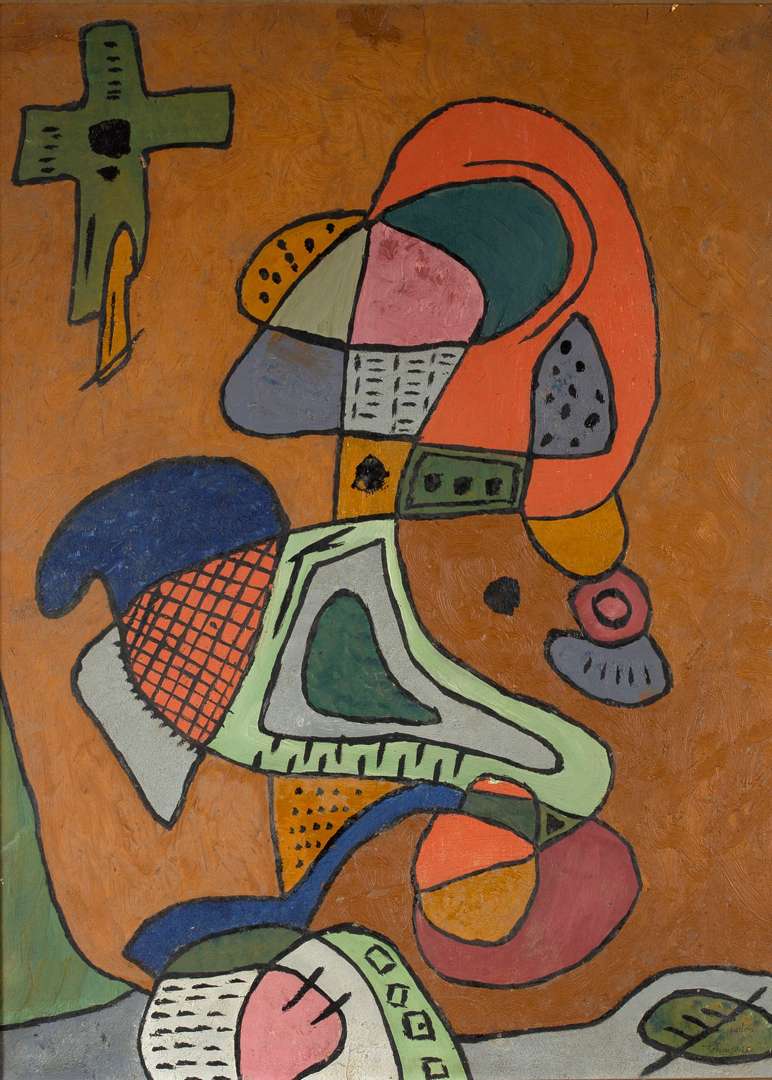
Composition, 1950
Oil on paper mounted on canvas, signed lower right
65 x 48 cm - 25 5/8 x 18 7/8 in.
Oil on paper mounted on canvas, signed lower right
EXHIBITION
Gaston Chaissac, retrospective, Musée Campredon, L'Isle-sur-la-Sorgue, June 8 - October 21, 1990, n°52
PROVENANCE
Galerie Messine-Thomas Le Guillou Paris, acquired from the latter by the current owner
Gaston Chaissac occupies a singular place in twentieth-century art, at the crossroads of several currents without ever really belonging to any of them. Self-taught, he developed a unique style combining abstraction, figuration and popular influences. Born in 1910 in Avallon, Burgundy, he led a life marked by wandering and decisive encounters, notably with the German sculptor Otto Freundlich and the painter Jeanne Kosnick-Kloss, who encouraged him to devote himself fully to painting from the 1930s onwards. He also maintained a fruitful correspondence with Jean Dubuffet, who saw him as an emblematic figure of Art Brut, although Chaissac claimed a more personal approach.
From the 1950s onwards, his artistic language began to assert itself. Refusing to confine himself to pure abstraction or simplified figuration, he drew his inspiration from everyday life, nature and the rural world that had shaped him. This period marked a turning point, when he forged a singular aesthetic, characterized by formal freedom and a dazzling palette. His work, often associated with that of the artists of the CoBrA group, was put in dialogue with them at an exhibition at the Musée Soulages in 2021, underlining his place in the artistic questioning of his time.
In our 1950 work, Chaissac is distinguished by his use of bright, contrasting colors, infusing the composition with dynamic energy. The geometric shapes, delimited by thick black circles, create a tension between the rigor of the line and the fluidity of the colors. Presented at the 1990 retrospective at the Musée Campredon, this work is part of a series exploring the essence of folk art. This exhibition, which traced the evolution of his work, revealed the full richness of his pictorial universe, imbued with humor, spontaneity and naïve poetry. Through his art, Chaissac freed himself from convention, expressing a vision of the world brimming with energy and fantasy.
Gaston Chaissac is standing at the crossroads of several movements without ever fully belonging to any of them. A self-taught artist, he developed a unique style blending abstraction, figuration, and popular influences. Born in 1910 in Avallon, Burgundy, he led a life marked by wandering and decisive encounters, notably with the German sculptor Otto Freundlich and the painter Jeanne Kosnick-Kloss, who encouraged him to devote himself entirely to painting in the 1930s. He also maintained a prolific correspondence with Jean Dubuffet, who considered him a key figure of Art Brut, although Chaissac claimed a more personal approach. From the 1950s onwards, his artistic language became more assertive. Refusing to adhere strictly to pure abstraction or simplified figuration, he drew inspiration from his everyday life, the surrounding nature, and the rural world that shaped him. This period marked a turning point in which he developed a distinctive aesthetic, characterized by formal freedom and a vibrant color palette. His work, often linked to that of the CoBrA group artists, was notably placed in dialogue with theirs during an exhibition at the Soulages Museum in 2021, highlighting his engagement with the artistic concerns of his time.
In our 1950 artwork, Chaissac stands out for his use of vivid, contrasting colors that infuse the composition with dynamic energy. The geometric forms, outlined with thick black contours, create a tension between the precision of the lines and the fluidity of the colors. Presented during the 1990 retrospective at the Campredon Museum, this piece belongs to a series exploring the essence of popular art. This exhibition, which traced the evolution of his work, revealed the richness of his pictorial universe, imbued with humor, spontaneity, and a certain naive poetry. Through his art, Chaissac broke away from conventions, striving to convey a vision of the world brimming with energy and imagination.
Composition, 1950
Oil on paper mounted on canvas, signed lower right
65 x 48 cm - 25 5/8 x 18 7/8 in.
Oil on paper mounted on canvas, signed lower right
EXHIBITION
Gaston Chaissac, retrospective, Musée Campredon, L'Isle-sur-la-Sorgue, June 8 - October 21, 1990, n°52
PROVENANCE
Galerie Messine-Thomas Le Guillou Paris, acquired from the latter by the current owner
Gaston Chaissac occupies a singular place in twentieth-century art, at the crossroads of several currents without ever really belonging to any of them. Self-taught, he developed a unique style combining abstraction, figuration and popular influences. Born in 1910 in Avallon, Burgundy, he led a life marked by wandering and decisive encounters, notably with the German sculptor Otto Freundlich and the painter Jeanne Kosnick-Kloss, who encouraged him to devote himself fully to painting from the 1930s onwards. He also maintained a fruitful correspondence with Jean Dubuffet, who saw him as an emblematic figure of Art Brut, although Chaissac claimed a more personal approach.
From the 1950s onwards, his artistic language began to assert itself. Refusing to confine himself to pure abstraction or simplified figuration, he drew his inspiration from everyday life, nature and the rural world that had shaped him. This period marked a turning point, when he forged a singular aesthetic, characterized by formal freedom and a dazzling palette. His work, often associated with that of the artists of the CoBrA group, was put in dialogue with them at an exhibition at the Musée Soulages in 2021, underlining his place in the artistic questioning of his time.
In our 1950 work, Chaissac is distinguished by his use of bright, contrasting colors, infusing the composition with dynamic energy. The geometric shapes, delimited by thick black circles, create a tension between the rigor of the line and the fluidity of the colors. Presented at the 1990 retrospective at the Musée Campredon, this work is part of a series exploring the essence of folk art. This exhibition, which traced the evolution of his work, revealed the full richness of his pictorial universe, imbued with humor, spontaneity and naïve poetry. Through his art, Chaissac freed himself from convention, expressing a vision of the world brimming with energy and fantasy.
Gaston Chaissac is standing at the crossroads of several movements without ever fully belonging to any of them. A self-taught artist, he developed a unique style blending abstraction, figuration, and popular influences. Born in 1910 in Avallon, Burgundy, he led a life marked by wandering and decisive encounters, notably with the German sculptor Otto Freundlich and the painter Jeanne Kosnick-Kloss, who encouraged him to devote himself entirely to painting in the 1930s. He also maintained a prolific correspondence with Jean Dubuffet, who considered him a key figure of Art Brut, although Chaissac claimed a more personal approach. From the 1950s onwards, his artistic language became more assertive. Refusing to adhere strictly to pure abstraction or simplified figuration, he drew inspiration from his everyday life, the surrounding nature, and the rural world that shaped him. This period marked a turning point in which he developed a distinctive aesthetic, characterized by formal freedom and a vibrant color palette. His work, often linked to that of the CoBrA group artists, was notably placed in dialogue with theirs during an exhibition at the Soulages Museum in 2021, highlighting his engagement with the artistic concerns of his time.
In our 1950 artwork, Chaissac stands out for his use of vivid, contrasting colors that infuse the composition with dynamic energy. The geometric forms, outlined with thick black contours, create a tension between the precision of the lines and the fluidity of the colors. Presented during the 1990 retrospective at the Campredon Museum, this piece belongs to a series exploring the essence of popular art. This exhibition, which traced the evolution of his work, revealed the richness of his pictorial universe, imbued with humor, spontaneity, and a certain naive poetry. Through his art, Chaissac broke away from conventions, striving to convey a vision of the world brimming with energy and imagination.