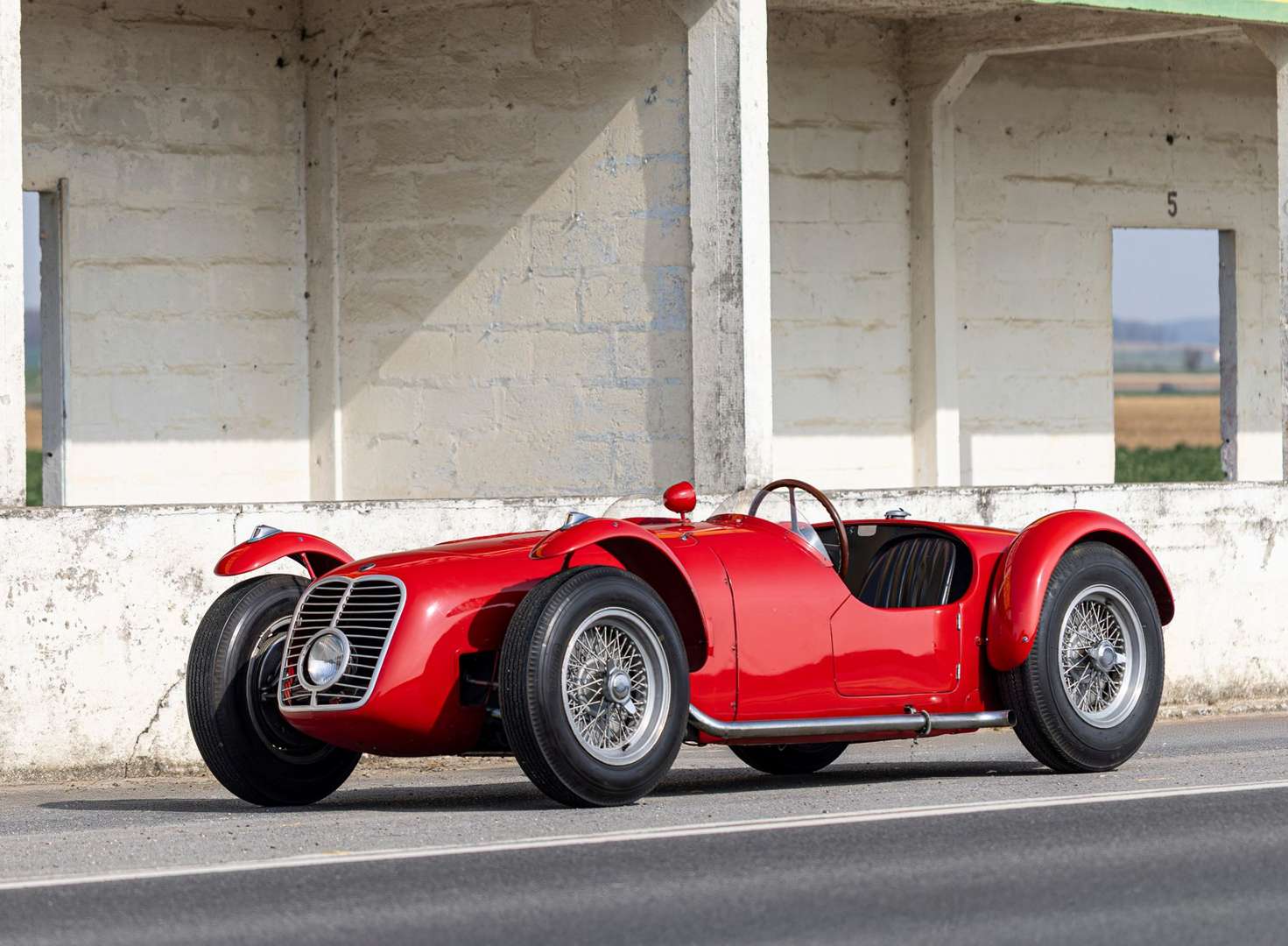
Chassis n° 2007/2010 (see text) French registration Sold without technical control
French registration title Sold without contrôle technique
In 1945, just after the end of the Second World War, Maserati was able to produce and sell the sublime A6-1500, a small sports car developed from the legendary, high-performance 6CM Grand Prix car, which had already shone in the second half of the 1930s. With its elegant coupé Extra Lusso and spyder bodywork (2 examples only) by by Pinin Farina, it enabled "Modena's other manufacturer" to establish a place for itself among the leading and foreshadowed the Trident brand's first competition car. The A6 GCS (CS standing for Corsa and Sport, a dual-purpose car), refined in 1947, nevertheless differs markedly from this car in that it features a new tubular chassis, improved suspension and new bodywork, as well as a revised engine. For the bodywork, the talented and efficient Fantuzzi was chosen, who designed a superb siluro-type two-seater body, basic but elegant, with separate fenders, to compete in F2 (without fenders) and Sport (with fenders), and whose single central headlamp integrated into the grille would distinguish this first A6 GCS: Monofaro. Under the hood, the particularly accessible engine differs from the previous A6 in that its displacement has been increased to 2 l, dry sump lubrication and a set of 3 Weber 36DO4 carburetors. Developing 130 hp at 6,000 rpm, it propels the unit, which weighs just 672 kg dry (580 kg in the F2 version!), to speeds of over 200 km/h, with disconcerting ease. The Monofaro was produced in just 14 examples, of which only 8 survived. Today, it is one of the most sought-after Maseratis, thanks to its rarity, its performance, its position in the brand's history (the last car developed by the Maserati brothers before the Orsi family took control, and an essential milestone in the genesis of 6-cylinder racing cars - A6GCS/53, A6G/54, 300S in particular - and road cars - 3500 GT) and its unrivalled versatility. versatility. Thanks to its extensive track record, the A6 GCS 2000 is eligible for the most prestigious historic events, including including the Mille Miglia, Goodwood and Monaco, where it can be raced in both single-seaters and sports cars, just as it was back in the day... The car illustrating these pages is the seventh A6 GCS produced, chassis #2007, officially recorded in the factory on June 7, 1948 as a factory car, which concerns only three other chassis (#2001, #2002 - born as a coupé - and #2003 - destroyed during the period) out of the 14 built. It is likely that the car was used for some racing, testing and development, before being renumbered #2010 at the factory, and sold to Italian businessman Giuseppe Vianini on April 4, 1949 (factory registers). 1949 was an important year in motor sport, as it was the year in which Juan Perón, the Argentine dictator, commissioned two experienced drivers to come and race in Europe, to promote their country. For the occasion, this Equipo Argentina had Gordinis and Maseratis... for hire. The names of these drivers? Juan-Manuel Fangio and Benedicto Campos, unknowns on the Old Continent... Fangio quickly made a name for himself, winning the F1 Grands Prix at San Remo, Pau, Perpignan, Marseille, Monza and Albi. He also raced in Sport and F2, and took the start of the X Grand Prix of Rome, run on the ephemeral circuit of the Baths of Caracalla, on June 2 at the wheel of the Maserati #2007/2010 entrusted to Vianini, who also had business in Argentina and dual nationality. Although the crew was forced to retire on lap 21, it is likely that the car illustrating these pages was again entered on June 26 at the Monza F2 Grand Prix (4 A6 GCS at the start) and on July 10 at the 9th Circuit del Garda (3 A6 GCS at the start), and also in the Italian F2 Grand Prix of the 1950 season. At the end of the 1950 season, Vianini exports the A6 GCS #2007/2010 to Argentina, where he sells it to Carlos Lostaló (fig. 3 and 4), an established from the Buenos Aires region, who raced on the Parque Sarmiento circuit in Cordoba on December 17, 1950. Sarmiento circuit in Cordoba, where he finished 4th.
In addition to the hammer price, the successful bidder will be required to pay the following buyer's fees per lot: - For sales in the Classic Automobiles department (sliding scale fees) : - 16% exclusive of tax + VAT at the prevailing rate, i.e. 19.2% inclusive of tax on the first €900,000 inclusive of tax - 12% excl. tax + VAT at current rate

&w=3840&q=75)
&w=3840&q=75)
&w=3840&q=75)
&w=3840&q=75)
&w=3840&q=75)
&w=3840&q=75)
&w=3840&q=75)
&w=3840&q=75)