
&w=3840&q=75)
&w=3840&q=75)
&w=3840&q=75)
&w=3840&q=75)
&w=3840&q=75)
&w=3840&q=75)
&w=3840&q=75)
&w=3840&q=75)


Jan VAN DER VENNE
Active in Mechelen and Brussels between 1574 and 1651
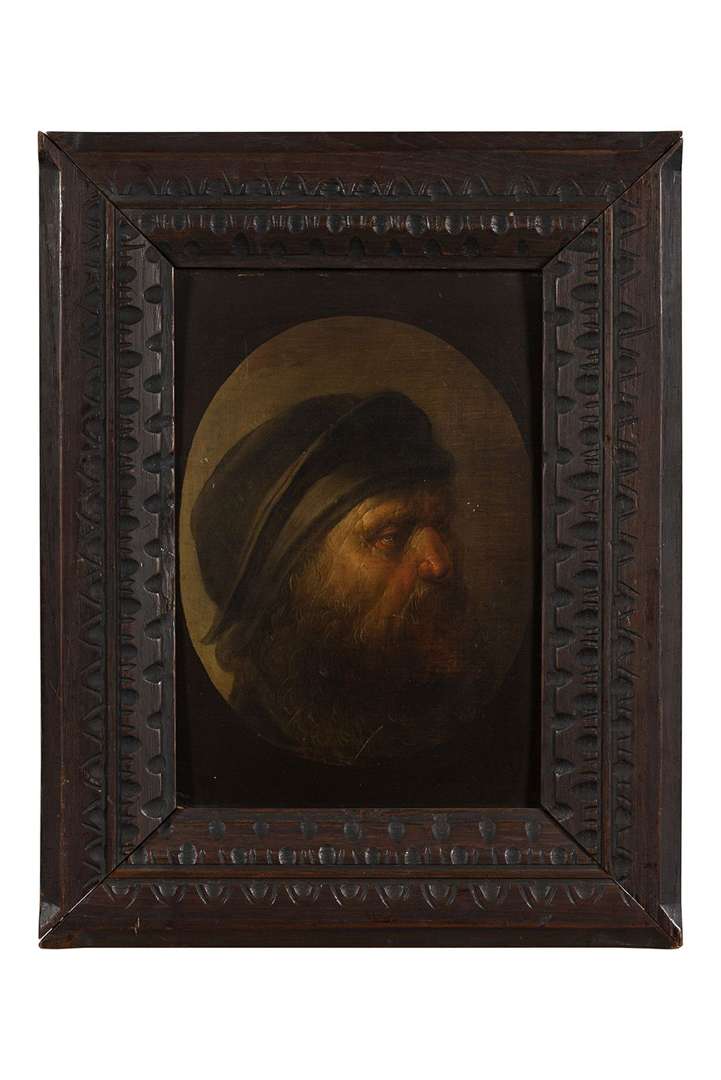
Study of a bearded man's head (tronie)
Oak panel
34.5 x 24 cm - 13 9/16 x 9 7/16 in.
Study of the head of a bearded man, oak panel
PROVENANCE
Private collection, France.
In the manner popularized by Jan Lievens (1607-1674) and Rembrandt (1606-1669) in the Netherlands in the 1620s and 1650s, Jan van der Venne here devotes himself to the genre of the tronie, a 17th-century Dutch term meaning "face". Before them, Frans Floris (1516-1570) and Hendrick Goltzius (1558-1617) had already begun by producing studies in which the artist's interest in the figure itself was already apparent. Here we are in Flanders, possibly a few years before the explosion of the genre, and yet all its characteristics are present: the painter simply offers a study of a face, in the manner of a portrait, but without singling it out. Van der Venne seems more concerned with his sitter's psychology, which he allows to shine through in the old man's features.
With his back to the light, the flesh barely emerges from the shadows, while the lower part of the figure disappears, eaten away by a thick, bushy beard with untidy hairs. The old man's withered skin, the wrinkles that run across it, absorb the light that dies in the hollows of their furrows. Modest and unassuming, with features hollowed out by time and a broad, reddish nose, the model is an ordinary man whose painter is less interested in transcribing a physical reality than the essence of a past life.
Long identified as "Pseudo-Van de Venne", it wasn't until 1978 that Jacques Foucart associated Jan van der Venne's name with this nickname. Later, in 1983, Hans Vlieghe discovered and studied new primary sources, making it possible to situate the artist and his work more precisely in time and space.
Active in Mechelen and Brussels between 1574 and 1651
Study of a bearded man's head (tronie)
Oak panel
34.5 x 24 cm - 13 9/16 x 9 7/16 in.
Study of the head of a bearded man, oak panel
PROVENANCE
Private collection, France.
In the manner popularized by Jan Lievens (1607-1674) and Rembrandt (1606-1669) in the Netherlands in the 1620s and 1650s, Jan van der Venne here devotes himself to the genre of the tronie, a 17th-century Dutch term meaning "face". Before them, Frans Floris (1516-1570) and Hendrick Goltzius (1558-1617) had already begun by producing studies in which the artist's interest in the figure itself was already apparent. Here we are in Flanders, possibly a few years before the explosion of the genre, and yet all its characteristics are present: the painter simply offers a study of a face, in the manner of a portrait, but without singling it out. Van der Venne seems more concerned with his sitter's psychology, which he allows to shine through in the old man's features.
With his back to the light, the flesh barely emerges from the shadows, while the lower part of the figure disappears, eaten away by a thick, bushy beard with untidy hairs. The old man's withered skin, the wrinkles that run across it, absorb the light that dies in the hollows of their furrows. Modest and unassuming, with features hollowed out by time and a broad, reddish nose, the model is an ordinary man whose painter is less interested in transcribing a physical reality than the essence of a past life.
Long identified as "Pseudo-Van de Venne", it wasn't until 1978 that Jacques Foucart associated Jan van der Venne's name with this nickname. Later, in 1983, Hans Vlieghe discovered and studied new primary sources, making it possible to situate the artist and his work more precisely in time and space.