
&w=3840&q=75)
&w=3840&q=75)
&w=3840&q=75)
&w=3840&q=75)
&w=3840&q=75)
&w=3840&q=75)
&w=3840&q=75)
&w=3840&q=75)


Dirck van DELEN
Heusden, 1605 - 1671, Arnemuiden
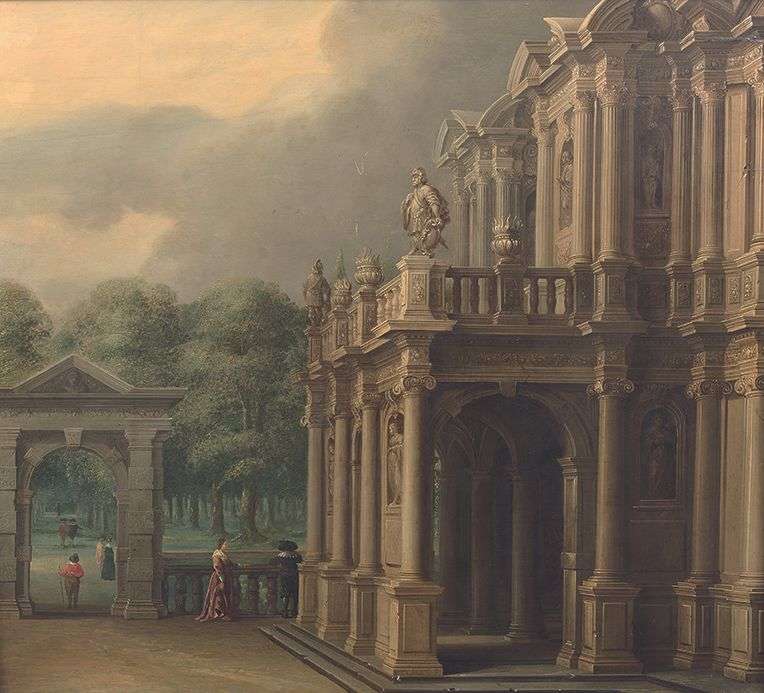
The facade of a Baroque palace
Oak panel (two boards, not parqueted)
Signed lower center D.V.DELEN.F
45x51 cm
(Old restorations)
The façade of a Baroque palace, oak panel (two boards, not cradled), signed lower middle
PROVENANCE
Private collection, France.
Under the mild skies of a clear day, the atmosphere is soft on the outskirts of this palace designed by Dirck van Delen. An architectural painter specializing in church interiors and palace facades like this one, van Delen drew his inspiration here from the Baroque and its opulent repertoire of forms. The genre had become popular, and even before him, some of his colleagues had made it their specialty, such as Hans (1527-1609) and Paul (1567-1630) Vredeman de Vries. The taste was for canons derived from ancient Greece and Rome, but also from the Renaissance, which had itself looked to the Ancients. Although there are no sources attesting to our painter's presence in Italy, this did not prevent him from frequenting other artists who had made the trip. On his return from Rome in 1609, Rubens (1577-1640) settled in Antwerp and decided to build his own house. Recalling his Italian sojourn and the palazzi he had admired there, the artist endowed his garden with a monumental entrance, whose portico motif may have inspired van Delen for the one leading beyond the palace walls.
Here, he imagines a building with a richly ornate façade and a thousand architectural effects. Featuring Ionic columns, countless sculpted elements, vaulted ceilings and terraces, this palace is a perfect counterpoint to the more common sobriety of buildings of the period. Although he never copied existing buildings (unlike some of his contemporaries, such as Pieter Saenredam (1597-1665)), van Delen blended the real with the imaginary to breathe an air of truth into the architecture he depicted. He pays particular attention to light, architectural and human proportions. His rigorous efforts to render consistent perspective effects suggest that he may have studied manuals on the subject, such as those written by the Vredeman de Vries, father and son. As time went by, the painter brightened his palette, turning his facades, ever more richly adorned with pink and white marble and sculpted groups, into veritable manifestos of the ambient Baroque.
Heusden, 1605 - 1671, Arnemuiden
The facade of a Baroque palace
Oak panel (two boards, not parqueted)
Signed lower center D.V.DELEN.F
45x51 cm
(Old restorations)
The façade of a Baroque palace, oak panel (two boards, not cradled), signed lower middle
PROVENANCE
Private collection, France.
Under the mild skies of a clear day, the atmosphere is soft on the outskirts of this palace designed by Dirck van Delen. An architectural painter specializing in church interiors and palace facades like this one, van Delen drew his inspiration here from the Baroque and its opulent repertoire of forms. The genre had become popular, and even before him, some of his colleagues had made it their specialty, such as Hans (1527-1609) and Paul (1567-1630) Vredeman de Vries. The taste was for canons derived from ancient Greece and Rome, but also from the Renaissance, which had itself looked to the Ancients. Although there are no sources attesting to our painter's presence in Italy, this did not prevent him from frequenting other artists who had made the trip. On his return from Rome in 1609, Rubens (1577-1640) settled in Antwerp and decided to build his own house. Recalling his Italian sojourn and the palazzi he had admired there, the artist endowed his garden with a monumental entrance, whose portico motif may have inspired van Delen for the one leading beyond the palace walls.
Here, he imagines a building with a richly ornate façade and a thousand architectural effects. Featuring Ionic columns, countless sculpted elements, vaulted ceilings and terraces, this palace is a perfect counterpoint to the more common sobriety of buildings of the period. Although he never copied existing buildings (unlike some of his contemporaries, such as Pieter Saenredam (1597-1665)), van Delen blended the real with the imaginary to breathe an air of truth into the architecture he depicted. He pays particular attention to light, architectural and human proportions. His rigorous efforts to render consistent perspective effects suggest that he may have studied manuals on the subject, such as those written by the Vredeman de Vries, father and son. As time went by, the painter brightened his palette, turning his facades, ever more richly adorned with pink and white marble and sculpted groups, into veritable manifestos of the ambient Baroque.