
&w=3840&q=75)
&w=3840&q=75)
&w=3840&q=75)
&w=3840&q=75)
&w=3840&q=75)
&w=3840&q=75)
&w=3840&q=75)
&w=3840&q=75)


30
Jean-Baptiste ISABEY
The item was sold for 13 650 €
Fees include commission and taxes.
Jean-Baptiste ISABEY
Nancy, 1767 - 1855, Paris
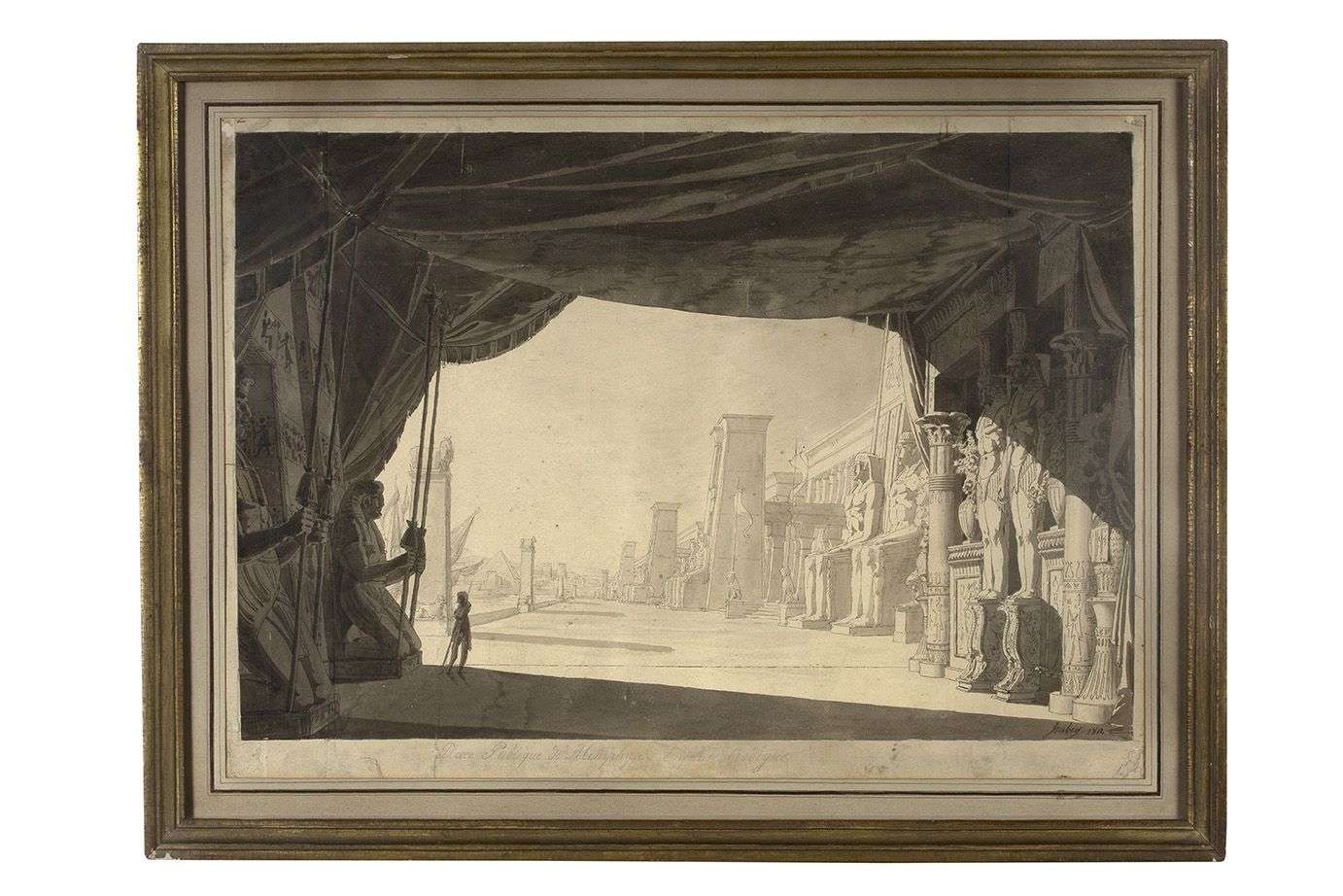
La place publique du temple de Memphis, sketch for the set of Pierre Gardel's ballet-pantomime L'Enfant prodigue, 1812
Pen, Indian ink over black pencil, gray wash
Signed and dated lower right Isabey 1812
38.5 x 57 cm - 15 3/16 x 22 7/16 in.
(Folds, tears, stains)
The prodigal son, ballet décor, ink on paper, signed lower right and dated
A talented portraitist and miniaturist, Jean-Baptiste Isabey was also involved in the creation of opera sets. In 1812, Pierre-Gabriel Gardel (1758-1840) entrusted him with the sets for his new ballet-pantomime, L'Enfant prodigue. A dancer as well as a renowned ballet master, Gardel set the action in ancient Egypt, at a time when the appeal of exoticism was nourished by travel accounts, such as those by Vivant Denon (1747-1825). For this project, Isabey collaborated with his son-in-law Pierre-Luc Charles Cicéri (1782-1868), then painter-decorator at the Opéra.
Ballet-pantomime had been born some time earlier under the impetus of Jean-Georges Noverre (1727-1810). Also a dancer and ballet master, he wished to steer dance towards a more exacerbated expression of sensibilities and greater realism. He therefore decided to combine dance with the expressive gestures of pantomime, which he theorized in 1760 in his Lettres sur la danse et sur le ballet.
Act II opens as follows: "The Theatre represents a public square in the city of Memphis. Egyptian luxury reigns on all sides: the marvels of the art of architecture shine in all the monuments: one of them is supposed to be the home of Azael". So Isabey transports us to the idealized Egypt he never visited. The curtain has risen, and under its canopy, we find ourselves in the public square of the temple of Memphis. Plunged into the darkness of the foreground, the sun illuminates the background, where the dancers will soon crowd. The modest size of the figure discreetly placed on the left accentuates the gigantism of the whole, while the almost infinite perspective creates an effect of depth that also contributes to this.
Alternating between the use of wash and pen to work his lighting effects, Isabey puts all his talents as a miniaturist at the service of a meticulous rendering of each of the elements making up his setting. This can also be seen in a drawing from the same series, preserved in the Bibliothèque-musée de l'Opéra, whose collections also include a sketch by Cicéri for the same ballet.
Nancy, 1767 - 1855, Paris
La place publique du temple de Memphis, sketch for the set of Pierre Gardel's ballet-pantomime L'Enfant prodigue, 1812
Pen, Indian ink over black pencil, gray wash
Signed and dated lower right Isabey 1812
38.5 x 57 cm - 15 3/16 x 22 7/16 in.
(Folds, tears, stains)
The prodigal son, ballet décor, ink on paper, signed lower right and dated
A talented portraitist and miniaturist, Jean-Baptiste Isabey was also involved in the creation of opera sets. In 1812, Pierre-Gabriel Gardel (1758-1840) entrusted him with the sets for his new ballet-pantomime, L'Enfant prodigue. A dancer as well as a renowned ballet master, Gardel set the action in ancient Egypt, at a time when the appeal of exoticism was nourished by travel accounts, such as those by Vivant Denon (1747-1825). For this project, Isabey collaborated with his son-in-law Pierre-Luc Charles Cicéri (1782-1868), then painter-decorator at the Opéra.
Ballet-pantomime had been born some time earlier under the impetus of Jean-Georges Noverre (1727-1810). Also a dancer and ballet master, he wished to steer dance towards a more exacerbated expression of sensibilities and greater realism. He therefore decided to combine dance with the expressive gestures of pantomime, which he theorized in 1760 in his Lettres sur la danse et sur le ballet.
Act II opens as follows: "The Theatre represents a public square in the city of Memphis. Egyptian luxury reigns on all sides: the marvels of the art of architecture shine in all the monuments: one of them is supposed to be the home of Azael". So Isabey transports us to the idealized Egypt he never visited. The curtain has risen, and under its canopy, we find ourselves in the public square of the temple of Memphis. Plunged into the darkness of the foreground, the sun illuminates the background, where the dancers will soon crowd. The modest size of the figure discreetly placed on the left accentuates the gigantism of the whole, while the almost infinite perspective creates an effect of depth that also contributes to this.
Alternating between the use of wash and pen to work his lighting effects, Isabey puts all his talents as a miniaturist at the service of a meticulous rendering of each of the elements making up his setting. This can also be seen in a drawing from the same series, preserved in the Bibliothèque-musée de l'Opéra, whose collections also include a sketch by Cicéri for the same ballet.