
&w=3840&q=75)
&w=3840&q=75)
&w=3840&q=75)
&w=3840&q=75)
&w=3840&q=75)
&w=3840&q=75)
&w=3840&q=75)
&w=3840&q=75)


207
SAINT-PIERRE Bernardin de (1737-1814).
The item was sold for 1 977 €
Fees include commission and taxes.
SAINT-PIERRE Bernardin de (1737-1814).
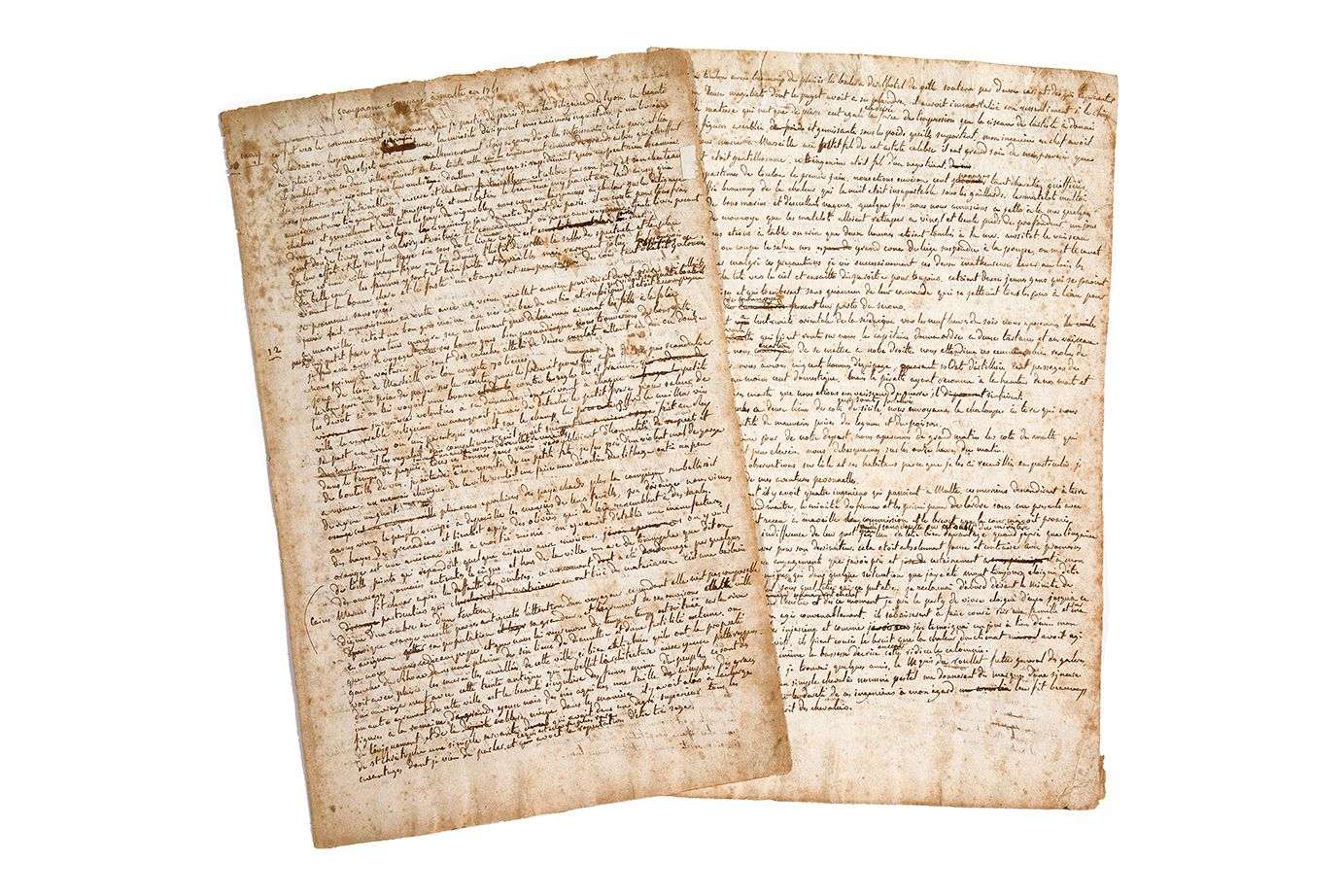
Autograph MANUSCRIT, Campagne et voyage à Malte en 1761| 7 1/2 pages in-fol (35 x 22.5 cm| slight foxing).
Precious account of a voyage to Malta, the writer's first travelogue.
Long unpublished, this account was recently published. The manuscript, in brown ink with dates in the margins, contains a number of erasures and corrections.
Bernardin de Saint-Pierre entered the École nationale des ponts et chaussées in 1757, from which he graduated as an engineer. Endowed with an adventurous spirit, he was sent at his own request to the island of Malta, threatened by the Turks, to check the fortifications. But when the war failed to materialize, he returned to Paris, humiliated and penniless.
The manuscript begins in May: "It was towards the beginning of this month that I left Paris on the Lyon stagecoach. The beauty of the season, the hope of reaching Lyon and curiosity dispelled my old worries. I gave myself over to the pleasure of seeing new things"...
The route takes in Fontainebleau, Auxerre and Chalons. "Lyon is a magnificent city [...] The women are well-built and pleasant, but rarely pretty. The Lyonnois love good food and pomp". To get to Marseille, in the company of two monks, he took "voituriers, which are carriages harnessed to two mules": Vienne, Orange, Avignon, Orgon, Aix. In Marseille, he embarked on the Saint-Jean, bound for Toulon: "The port of Toulon is magnificent for its size and safety", but the town is "small, poor and sad"... "We left Toulon on June 1st. We were about a hundred passengers, both knights and officers. I suffered greatly from the heat, which at night was unbearable under the forecastles. Maltese sailors are good sailors and excellent swimmers.
Sometimes we amused ourselves by throwing a few coins into the sea, which the sailors would catch twenty or thirty feet down"... The ship passed close to the coast of
Sardinia (fleeing pirates), then Sicily.
"Finally, on the eleventh day of our departure, we sighted the white, low-lying coast of Malta early in the morning. We disembarked at eleven o'clock in the morning. I will omit here my observations on the island and its inhabitants, as I have collected them individually. I will speak only of my personal adventures.
He complains about the behavior of the other engineers towards him, his loneliness and boredom on the island, and soon considers leaving again, embarking on the Sultane, which sails on September 1st. He recounts the difficult navigation to the islands of Sainte-Marguerite: "In my life, I have never experienced a greater pleasure than the one I felt walking on French soil".
The return journey from Marseille to Paris was marked by an altercation with a mule driver.
In Paris, he was received by the Marquis de Mirabeau, "the friend of men".
He spent the winter there, quite miserably. To escape his creditors, he managed to leave for Holland to embark and enter the service of Portugal.
Autograph MANUSCRIT, Campagne et voyage à Malte en 1761| 7 1/2 pages in-fol (35 x 22.5 cm| slight foxing).
Precious account of a voyage to Malta, the writer's first travelogue.
Long unpublished, this account was recently published. The manuscript, in brown ink with dates in the margins, contains a number of erasures and corrections.
Bernardin de Saint-Pierre entered the École nationale des ponts et chaussées in 1757, from which he graduated as an engineer. Endowed with an adventurous spirit, he was sent at his own request to the island of Malta, threatened by the Turks, to check the fortifications. But when the war failed to materialize, he returned to Paris, humiliated and penniless.
The manuscript begins in May: "It was towards the beginning of this month that I left Paris on the Lyon stagecoach. The beauty of the season, the hope of reaching Lyon and curiosity dispelled my old worries. I gave myself over to the pleasure of seeing new things"...
The route takes in Fontainebleau, Auxerre and Chalons. "Lyon is a magnificent city [...] The women are well-built and pleasant, but rarely pretty. The Lyonnois love good food and pomp". To get to Marseille, in the company of two monks, he took "voituriers, which are carriages harnessed to two mules": Vienne, Orange, Avignon, Orgon, Aix. In Marseille, he embarked on the Saint-Jean, bound for Toulon: "The port of Toulon is magnificent for its size and safety", but the town is "small, poor and sad"... "We left Toulon on June 1st. We were about a hundred passengers, both knights and officers. I suffered greatly from the heat, which at night was unbearable under the forecastles. Maltese sailors are good sailors and excellent swimmers.
Sometimes we amused ourselves by throwing a few coins into the sea, which the sailors would catch twenty or thirty feet down"... The ship passed close to the coast of
Sardinia (fleeing pirates), then Sicily.
"Finally, on the eleventh day of our departure, we sighted the white, low-lying coast of Malta early in the morning. We disembarked at eleven o'clock in the morning. I will omit here my observations on the island and its inhabitants, as I have collected them individually. I will speak only of my personal adventures.
He complains about the behavior of the other engineers towards him, his loneliness and boredom on the island, and soon considers leaving again, embarking on the Sultane, which sails on September 1st. He recounts the difficult navigation to the islands of Sainte-Marguerite: "In my life, I have never experienced a greater pleasure than the one I felt walking on French soil".
The return journey from Marseille to Paris was marked by an altercation with a mule driver.
In Paris, he was received by the Marquis de Mirabeau, "the friend of men".
He spent the winter there, quite miserably. To escape his creditors, he managed to leave for Holland to embark and enter the service of Portugal.