
&w=3840&q=75)
&w=3840&q=75)
&w=3840&q=75)
&w=3840&q=75)
&w=3840&q=75)
&w=3840&q=75)
&w=3840&q=75)
&w=3840&q=75)

196
MALRAUX André (1901-1976).
The item was sold for 910 €
Fees include commission and taxes.
MALRAUX André (1901-1976).
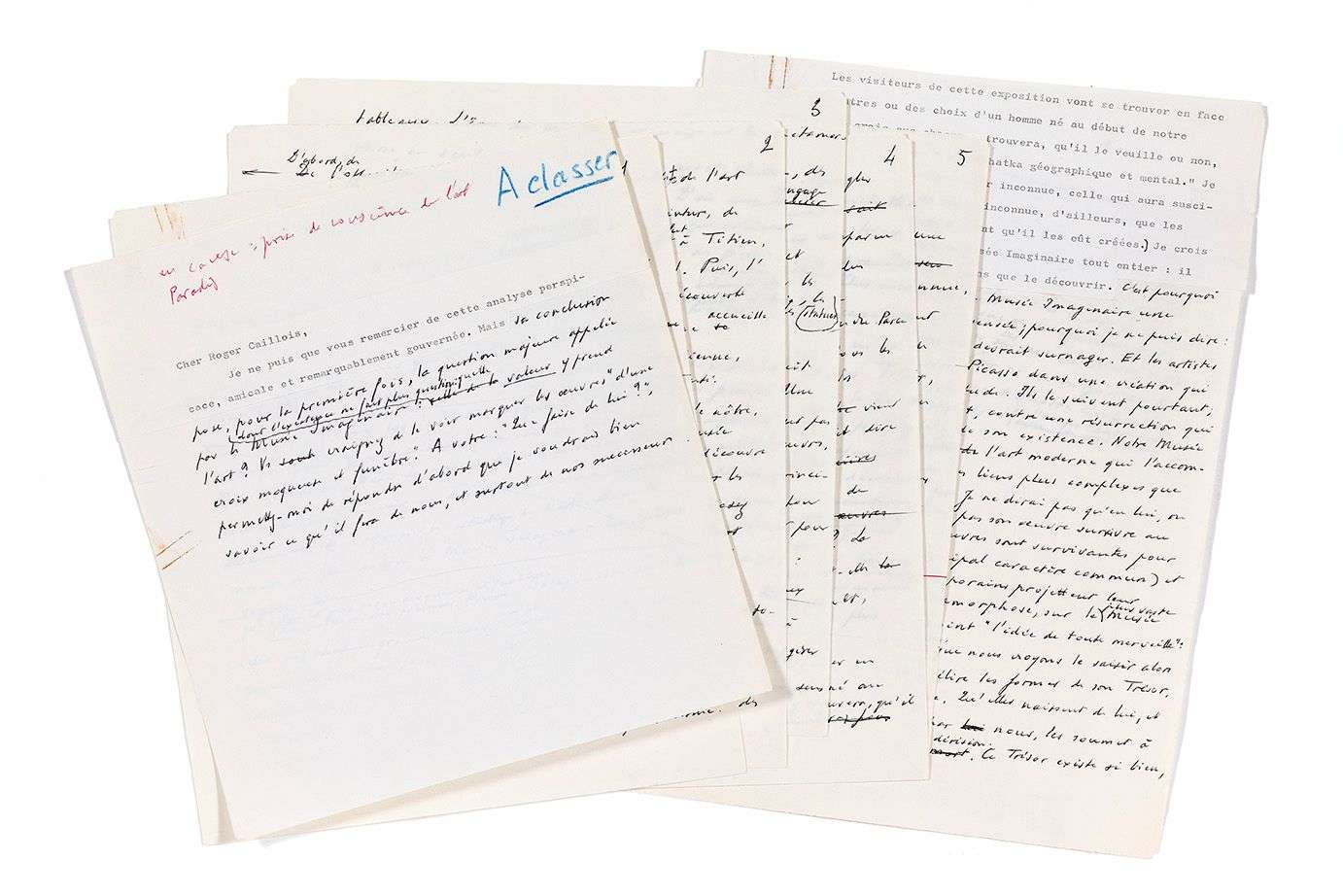
Autograph MANUSCRIT, [Letter to Roger Caillois on the Musée imaginaire, 1973]| 7 pages in-4 with 2 typewritten checkmarks.
On the Musée imaginaire.
This text was published at the head of the catalog for the André
Malraux exhibition organized at the Fondation Maeght in Saint-Paul-de-Vence in 1973 (pp. 21-23). In it, Malraux responds to the preface by Roger
CAILLOIS: "André Malraux. Esquisse de quelques-unes des conditions requises pour concevoir l'idée d'un véritable Musée imaginaire" (pp. 13-19).
The manuscript, in black ballpoint pen, contains a number of erasures and corrections, with one passage crossed out, and 2 typewritten checkmarks, notably to modify the beginning of the text.
Malraux answers the question posed by Caillois about the
Musée imaginaire: "What value does art have in it? For Malraux, it's more a question of "what it will do to us, and especially to our successors". After reviewing the three successive Musées imaginaires, he asserts: "The soul of the Musée imaginaire is the metamorphosis of gods, the dead and spirits, into sculptures, when they have lost their sacredness. Hence a new language, distinct from those that gave rise to the works: the language of the specific correlation of forms and volumes, shapes and colors, sought by artists in their own works, and found in the cathedrals and caves of Asia, in Sumerian or Maltese statues, in fetishes and masks"... Etc.
And he concludes that the visitor to the exhibition will discover his own treasure [...] he will draw from it an unknown value, the one that will have aroused this treasure [...] This is why I cannot see in our Musée imaginaire a grandiose and senseless adventure [...] Our Musée impaginaire is linked to the modern art that accompanies or arouses it, by links more complex than those of resemblance. [...] The gestures of contemporary creators cast their light, through metamorphosis, on the vastest Museum a civilization has ever known"...
OEuvres complètes (Pléiade), t. V, p. 1210-1213.
Autograph MANUSCRIT, [Letter to Roger Caillois on the Musée imaginaire, 1973]| 7 pages in-4 with 2 typewritten checkmarks.
On the Musée imaginaire.
This text was published at the head of the catalog for the André
Malraux exhibition organized at the Fondation Maeght in Saint-Paul-de-Vence in 1973 (pp. 21-23). In it, Malraux responds to the preface by Roger
CAILLOIS: "André Malraux. Esquisse de quelques-unes des conditions requises pour concevoir l'idée d'un véritable Musée imaginaire" (pp. 13-19).
The manuscript, in black ballpoint pen, contains a number of erasures and corrections, with one passage crossed out, and 2 typewritten checkmarks, notably to modify the beginning of the text.
Malraux answers the question posed by Caillois about the
Musée imaginaire: "What value does art have in it? For Malraux, it's more a question of "what it will do to us, and especially to our successors". After reviewing the three successive Musées imaginaires, he asserts: "The soul of the Musée imaginaire is the metamorphosis of gods, the dead and spirits, into sculptures, when they have lost their sacredness. Hence a new language, distinct from those that gave rise to the works: the language of the specific correlation of forms and volumes, shapes and colors, sought by artists in their own works, and found in the cathedrals and caves of Asia, in Sumerian or Maltese statues, in fetishes and masks"... Etc.
And he concludes that the visitor to the exhibition will discover his own treasure [...] he will draw from it an unknown value, the one that will have aroused this treasure [...] This is why I cannot see in our Musée imaginaire a grandiose and senseless adventure [...] Our Musée impaginaire is linked to the modern art that accompanies or arouses it, by links more complex than those of resemblance. [...] The gestures of contemporary creators cast their light, through metamorphosis, on the vastest Museum a civilization has ever known"...
OEuvres complètes (Pléiade), t. V, p. 1210-1213.