
&w=3840&q=75)
&w=3840&q=75)
&w=3840&q=75)
&w=3840&q=75)
&w=3840&q=75)
&w=3840&q=75)
&w=3840&q=75)
&w=3840&q=75)


159
BARBEY D'AUREVILLY Jules (1808-1889).
The item was sold for 3 900 €
Fees include commission and taxes.
BARBEY D'AUREVILLY Jules (1808-1889).
MANUSCRIT autograph signed "J. Barbey d'Aurevilly",
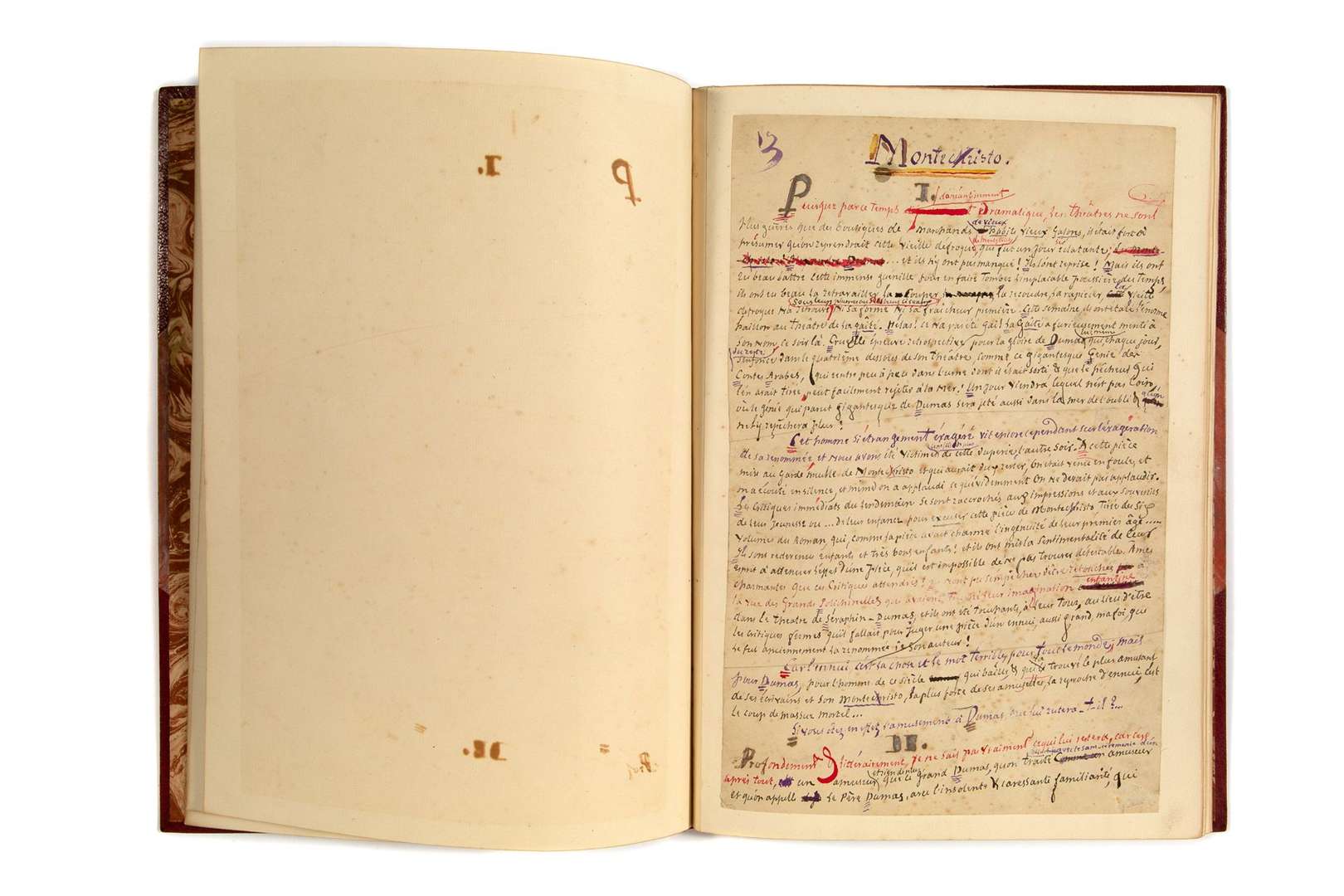
Montechristo, [1881]| 4 folio pages (31 x 19.5 cm) mounted on wove paper leaves| bound in red half-maroquin with corners.
Vigorous criticism of Alexandre Dumas.
Superb manuscript in black, violet, red and silver inks, with numerous erasures and corrections, and interlinear additions. It was cut out for printing and then reassembled.
Note that Barbey began by writing "Montechristo", which he then corrected by crossing out the h.
This dramatic chronicle, on the occasion of the revival of the stage adaptation of Le Comte de Monte-Cristo by Alexandre DUMAS and Auguste Maquet, at the Théâtre de la Gaîté on October 12, 1881, starring
Louis-François Dumaine in the title role, was published in the newspaper Triboulet on October 17, 1881| it was collected in
Théâtre contemporain, 1881-1883, dernière série (Stock, 1896, pp. 175-184). It is divided into four parts.
"Since, in these times of dramatic annihilation, theaters are little more than stores selling old clothes and old braids, it was to be expected that they would take up the old Monte Cristo garb, which was once so dazzling [...]....] But no matter how hard they beat this immense rag to remove the relentless dust of time, no matter how much they reworked it, cut it, sewed it, patched it, the old coat never regained its original shape or freshness under their feathers or scissors. [...] A cruel retrospective test for the glory of Dumas himself, who every day sinks deeper into the fourth underbelly of his theater [...] A day will come, and it is not far off, when Dumas' once gigantic genius will also be thrown into the sea of oblivion, never to be fished out again! This strangely exaggerated man still lives on the exaggeration of his fame [...].
Profoundly and literarily, I don't know what will remain of him, for he is, after all, an entertainer, and nothing more, than this great
Dumas, who is already treated with the unceremoniousness of an entertainer, and who is called Father Dumas, with the insolent and caressing familiarity that taps the thigh of his glory." And Barbey recalls the fiery Dumas of the Romantic period: "He was a doer, and an astonishingly fertile one at that! This mulatto, with his temperament, had in his mind, with the superficiality, not without grace, of the Creole, the flush invention of the improviser"...
The play has "no interest other than the momentary interest of the tableau it offers and which passes. [...] What a senseless construction! [...] The ridiculousness of such crude inventions, without which the drama would not exist, shocked no one and passed without protest. The public of this time, whose only pleasure is jokes, found this complicated joke quite simple, so accustomed has it been, for many years, to finding charming or powerful the atrocious jokes of its resident joker Dumas!"...
The actors were bad| only three deserve praise:
Dumaine, "who plays the role of Danlès, and who carries and supports the play in both senses, physically and morally"...| a certain
Noël, who plays several roles| and above all Madame Honorine, "so magnificently beautiful with energy"...
PROVENANCE: Roger MONMELIEN library (bookplate).
MANUSCRIT autograph signed "J. Barbey d'Aurevilly",
Montechristo, [1881]| 4 folio pages (31 x 19.5 cm) mounted on wove paper leaves| bound in red half-maroquin with corners.
Vigorous criticism of Alexandre Dumas.
Superb manuscript in black, violet, red and silver inks, with numerous erasures and corrections, and interlinear additions. It was cut out for printing and then reassembled.
Note that Barbey began by writing "Montechristo", which he then corrected by crossing out the h.
This dramatic chronicle, on the occasion of the revival of the stage adaptation of Le Comte de Monte-Cristo by Alexandre DUMAS and Auguste Maquet, at the Théâtre de la Gaîté on October 12, 1881, starring
Louis-François Dumaine in the title role, was published in the newspaper Triboulet on October 17, 1881| it was collected in
Théâtre contemporain, 1881-1883, dernière série (Stock, 1896, pp. 175-184). It is divided into four parts.
"Since, in these times of dramatic annihilation, theaters are little more than stores selling old clothes and old braids, it was to be expected that they would take up the old Monte Cristo garb, which was once so dazzling [...]....] But no matter how hard they beat this immense rag to remove the relentless dust of time, no matter how much they reworked it, cut it, sewed it, patched it, the old coat never regained its original shape or freshness under their feathers or scissors. [...] A cruel retrospective test for the glory of Dumas himself, who every day sinks deeper into the fourth underbelly of his theater [...] A day will come, and it is not far off, when Dumas' once gigantic genius will also be thrown into the sea of oblivion, never to be fished out again! This strangely exaggerated man still lives on the exaggeration of his fame [...].
Profoundly and literarily, I don't know what will remain of him, for he is, after all, an entertainer, and nothing more, than this great
Dumas, who is already treated with the unceremoniousness of an entertainer, and who is called Father Dumas, with the insolent and caressing familiarity that taps the thigh of his glory." And Barbey recalls the fiery Dumas of the Romantic period: "He was a doer, and an astonishingly fertile one at that! This mulatto, with his temperament, had in his mind, with the superficiality, not without grace, of the Creole, the flush invention of the improviser"...
The play has "no interest other than the momentary interest of the tableau it offers and which passes. [...] What a senseless construction! [...] The ridiculousness of such crude inventions, without which the drama would not exist, shocked no one and passed without protest. The public of this time, whose only pleasure is jokes, found this complicated joke quite simple, so accustomed has it been, for many years, to finding charming or powerful the atrocious jokes of its resident joker Dumas!"...
The actors were bad| only three deserve praise:
Dumaine, "who plays the role of Danlès, and who carries and supports the play in both senses, physically and morally"...| a certain
Noël, who plays several roles| and above all Madame Honorine, "so magnificently beautiful with energy"...
PROVENANCE: Roger MONMELIEN library (bookplate).