
&w=3840&q=75)
&w=3840&q=75)
&w=3840&q=75)
&w=3840&q=75)
&w=3840&q=75)
&w=3840&q=75)
&w=3840&q=75)
&w=3840&q=75)


88
COURBET Gustave (1819-1877).
The item was sold for 5 460 €
Fees include commission and taxes.
COURBET Gustave (1819-1877).
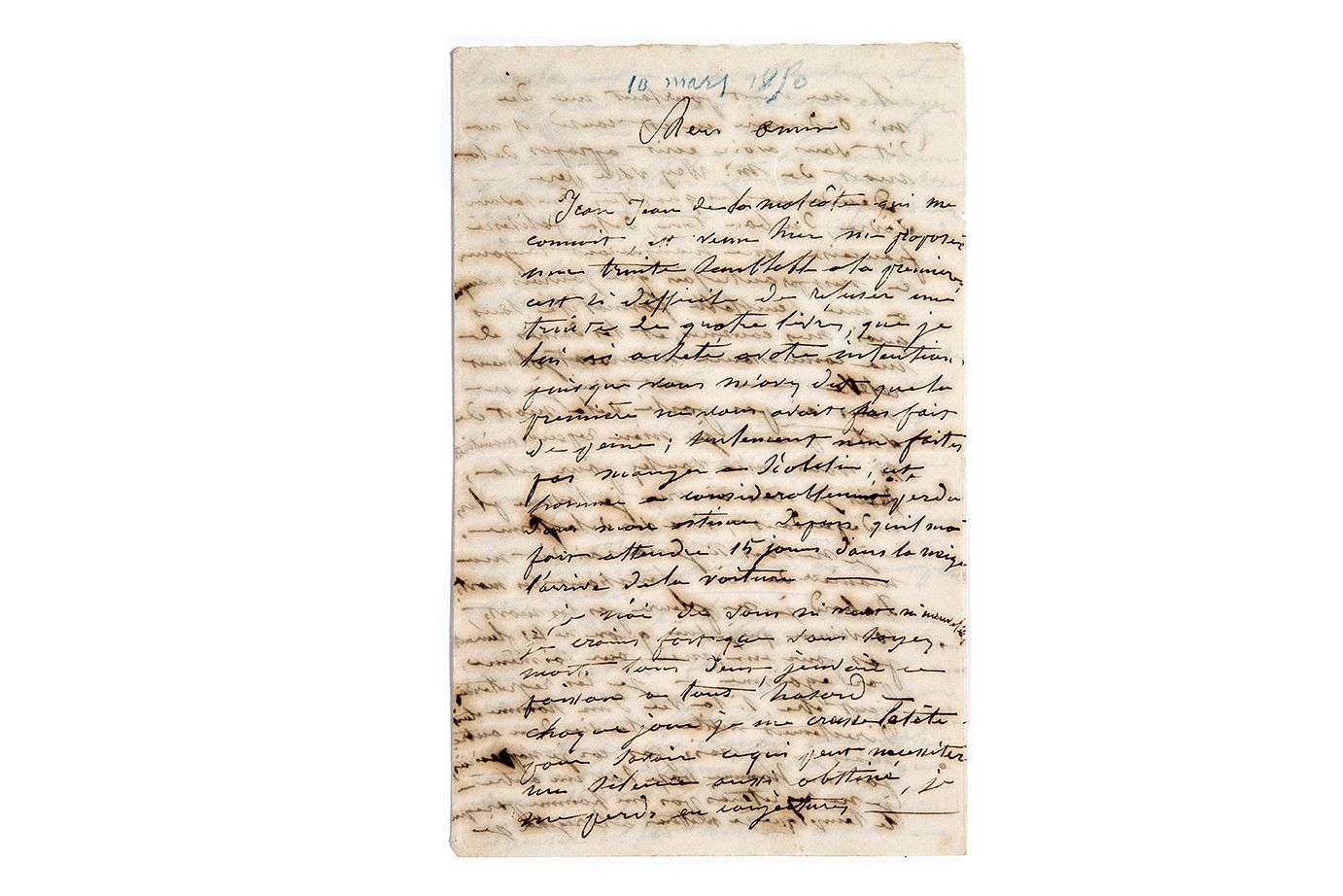
L.A.S. "Gustave Courbet", [Ornans March 10, 1850, to his friend
Francis WEY]| 4 pages in-8.
Beautiful letter on the completion of Un enterrement à Ornans.
He sends him "a four-pound trout"... He fears that Wey's silence is the result of his neglect to write to him when he lost his father. "I don't know if I've told you how I feel about the dead. First of all, I don't mourn the dead, convinced as I am that we don't mourn for them, but for ourselves, out of selfishness - I might regret them, if one man's life were directly useful to another's life, but I don't believe in that, because I wouldn't appreciate a man based on another - I wouldn't regret a man because the time I'd spend regretting him I'd use to free myself from him [...]. On the other hand, I am convinced that pain is a good thing, in person I could associate myself with it by letter never [...] Finally, if that's why you're angry with me, I beg you, forget it| leave me my freedom of thought, take me for what I am, and not for what I should be| be persuaded that I always act with knowledge of the cause, and never out of forgetfulness"...
He still works "like a Negro, my painting is three quarters and a half done, and I bring to it a perseverance, a tenacity, and I'm feeling a fatigue now, of which I thought myself incapable". But it's summer after a long winter, and it's good to "run around in nature, especially when you're in your own country and haven't seen spring for 12 years". He hopes to be in
Paris in a month, "because except for the sun, Ornans is no fun for me"...
He asks Wey to inform him of the precise date of the Exhibition, and whether "painters exempt from the jury are forced to send their paintings as soon as the others"...
Correspondance (Flammarion, 1996), letter 50-2.
L.A.S. "Gustave Courbet", [Ornans March 10, 1850, to his friend
Francis WEY]| 4 pages in-8.
Beautiful letter on the completion of Un enterrement à Ornans.
He sends him "a four-pound trout"... He fears that Wey's silence is the result of his neglect to write to him when he lost his father. "I don't know if I've told you how I feel about the dead. First of all, I don't mourn the dead, convinced as I am that we don't mourn for them, but for ourselves, out of selfishness - I might regret them, if one man's life were directly useful to another's life, but I don't believe in that, because I wouldn't appreciate a man based on another - I wouldn't regret a man because the time I'd spend regretting him I'd use to free myself from him [...]. On the other hand, I am convinced that pain is a good thing, in person I could associate myself with it by letter never [...] Finally, if that's why you're angry with me, I beg you, forget it| leave me my freedom of thought, take me for what I am, and not for what I should be| be persuaded that I always act with knowledge of the cause, and never out of forgetfulness"...
He still works "like a Negro, my painting is three quarters and a half done, and I bring to it a perseverance, a tenacity, and I'm feeling a fatigue now, of which I thought myself incapable". But it's summer after a long winter, and it's good to "run around in nature, especially when you're in your own country and haven't seen spring for 12 years". He hopes to be in
Paris in a month, "because except for the sun, Ornans is no fun for me"...
He asks Wey to inform him of the precise date of the Exhibition, and whether "painters exempt from the jury are forced to send their paintings as soon as the others"...
Correspondance (Flammarion, 1996), letter 50-2.