
&w=3840&q=75)
&w=3840&q=75)
&w=3840&q=75)
&w=3840&q=75)
&w=3840&q=75)
&w=3840&q=75)
&w=3840&q=75)
&w=3840&q=75)


ANONYMOUS
Late 18th century
Gold toc watch with quarter-repeating striking mechanism
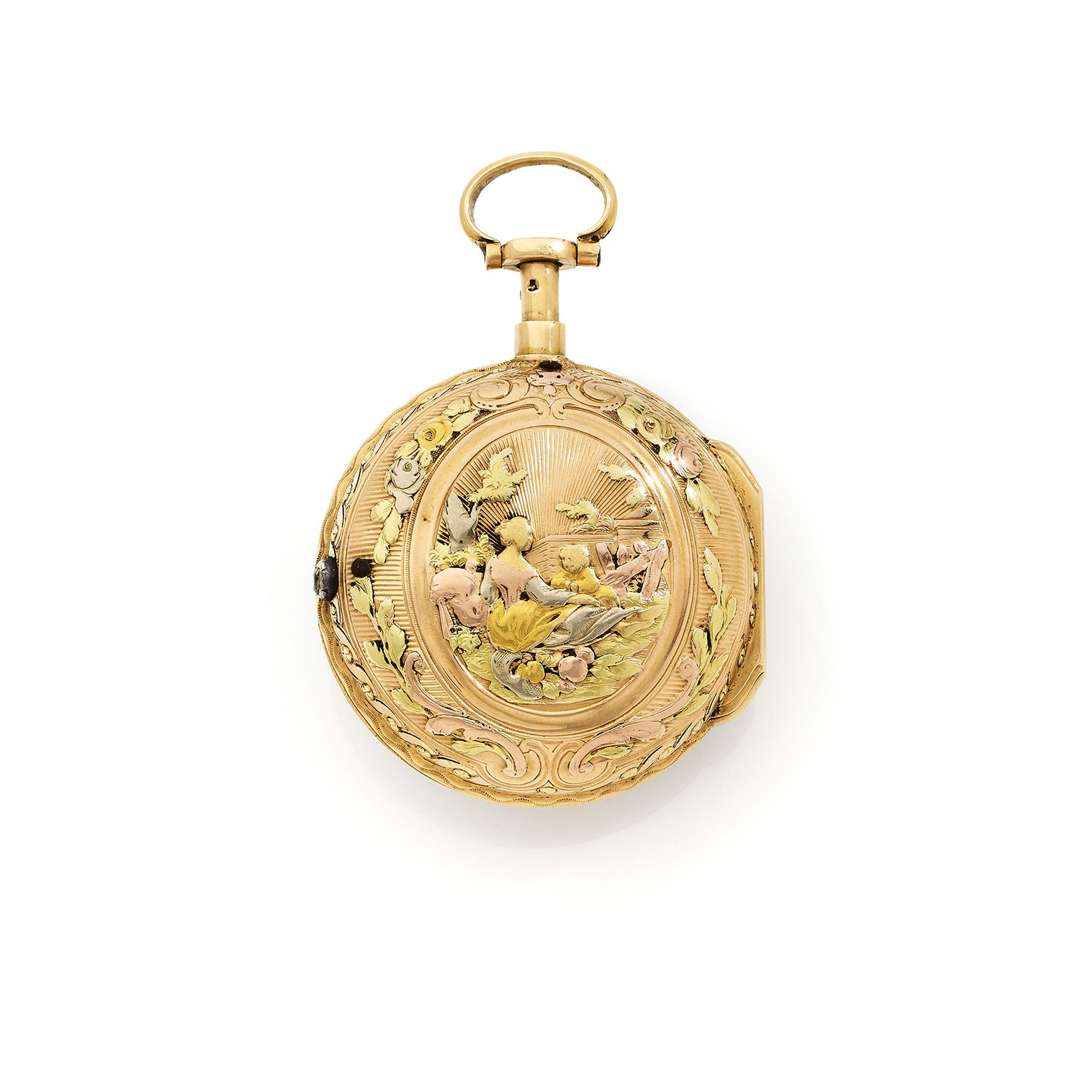
Case: round on hinge, the back decorated with a scene in relief in several gold colors, the middle decorated with rose motifs in relief, the back with a bell for the striking mechanism
Dial: white enamel with Roman numerals for the hours and Arabic numerals for the minutes, opening for the square key winding mechanism
Movement: mechanical with key winding, chased and pierced cock mounted on two feet, regulating disc, verge escapement, two-hammer striking mechanism on bell triggered by the pendant, one push-button on the edge for the toc mechanism, unsigned
Diam. 40 mm
Gross weight: 71.2 g
UNSIGNED
Late 18th century
Gold à toc quarter repeating watch
The mechanism of the toc quarter repeating watch makes it possible to trigger the striking without noise, by pressing the button on the caseband. The repeater strikes the bell with a dull thud, without emitting any sound. This system, often used on striking watches in the 18th century, was devised by Julien Le Roy around 1750.
Late 18th century
Gold toc watch with quarter-repeating striking mechanism
Case: round on hinge, the back decorated with a scene in relief in several gold colors, the middle decorated with rose motifs in relief, the back with a bell for the striking mechanism
Dial: white enamel with Roman numerals for the hours and Arabic numerals for the minutes, opening for the square key winding mechanism
Movement: mechanical with key winding, chased and pierced cock mounted on two feet, regulating disc, verge escapement, two-hammer striking mechanism on bell triggered by the pendant, one push-button on the edge for the toc mechanism, unsigned
Diam. 40 mm
Gross weight: 71.2 g
UNSIGNED
Late 18th century
Gold à toc quarter repeating watch
The mechanism of the toc quarter repeating watch makes it possible to trigger the striking without noise, by pressing the button on the caseband. The repeater strikes the bell with a dull thud, without emitting any sound. This system, often used on striking watches in the 18th century, was devised by Julien Le Roy around 1750.