
&w=3840&q=75)
&w=3840&q=75)
&w=3840&q=75)
&w=3840&q=75)
&w=3840&q=75)
&w=3840&q=75)
&w=3840&q=75)
&w=3840&q=75)


62
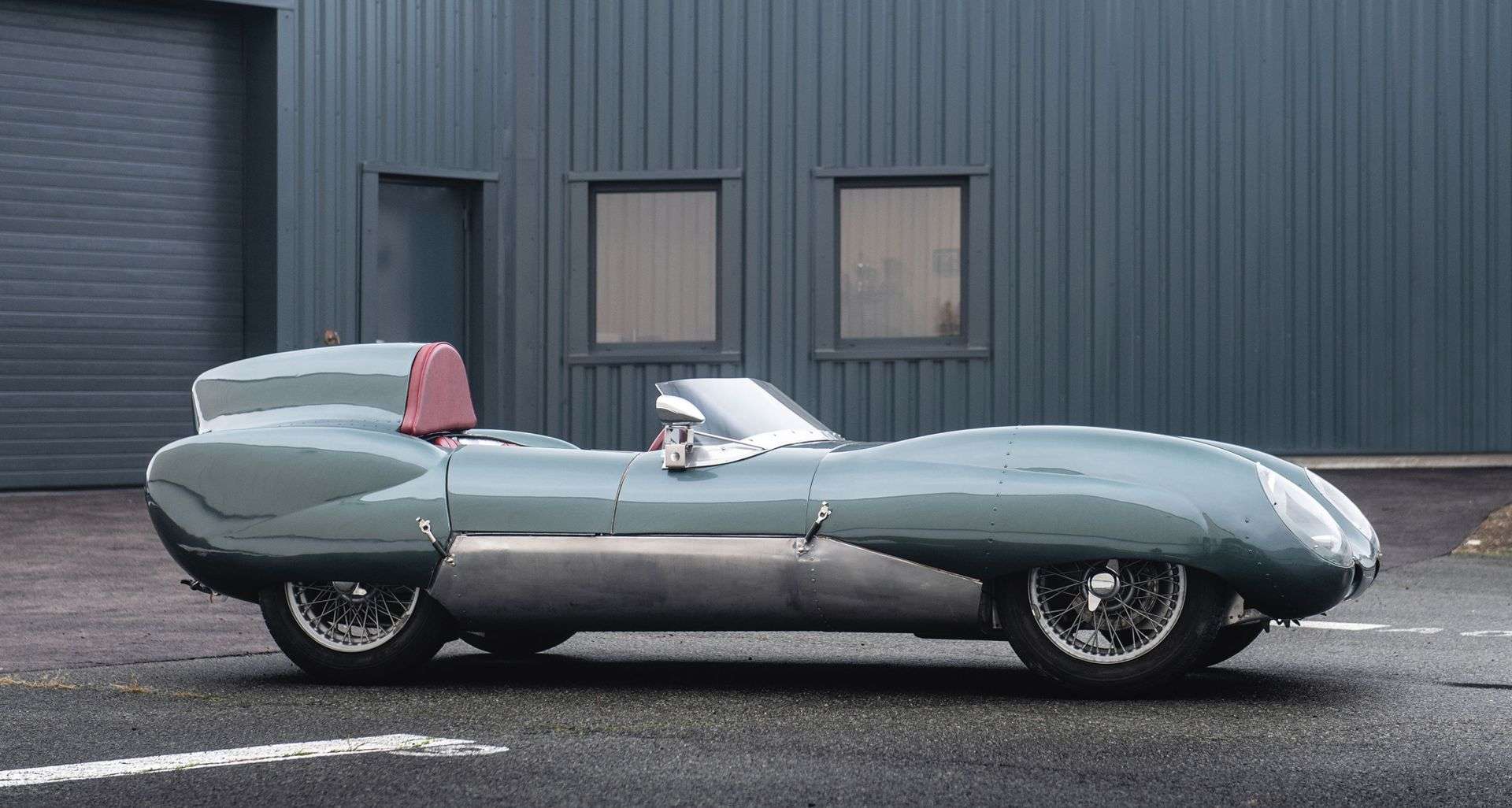
Lotus Eleven Série 1 – 1956
The item was sold for 168 000 €
Fees include commission and taxes.
Lotus Eleven Series 1 - 1956
Chassis no. 166
French historic registration title
French historic registration title
"A versatile and easy-to-use sports car, equally at home on the road or in a race".
"A versatile, easy-to-use sports car that's just as at home on the road as it is in a race"
Built in 270 examples between 1956 and 1958, the Lotus Eleven
the experience and know-how of Colin Chapman.
Colin Chapman's experience and know-how. Designed for endurance and sprint racing
and sprint racing for small cars, this new Lotus, which debuted the
E-names, quickly won over a demanding clientele of sportsmen and
gentlemen drivers. Faithful to the Chapman,
who favored lightness ("Light is right") and aerodynamic
of its machines, the Eleven features a superb chassis made from a
latticework of round and square steel tubes, weighing just 25 kg,
while ensuring astonishing rigidity. The whole thing is covered
by Frank Costin, the aircraft's chief aerodynamicist.
aerodynamicist at aircraft manufacturer De Haviland. >|
The car is available in three versions: Club, with rigid rear axle
rear axle, Ford side-valve engine and drum brakes
brakes| Sport, with a Coventry Climax engine| and
Coventry Climax engine| and Le Mans, which features a De Dion
De Dion rear axle and disc brakes (inboard rear).
rear). Depending on the category in which it competes, the Le Mans
categories in which it competes, with 4-cylinder
Coventry Climax 750 cm3, FWA 1,098 cm3 and FWB 1,460 cm3.
In the latter configuration, power exceeds
100 hp. This is more than enough to enable the unit, which
weighing in at just 450 kg.
An explosive cocktail that's set to write some of the finest lines
lines in the brand's record books, with 148 significant victories
in the model's first full season. At
a victory in the 1,100 cm3 class, and 7th place overall in the
the 1956 Le Mans 24 Hours, and further class wins at the
at the 12 Hours of Sebring and Le Mans 1957.
the Seven, it epitomizes the genius of Colin Chapman and
and the success of the small British firm.
The Lotus Eleven presented here is a 1956 Series 1,
born in the 1100 version, and sold new in the USA to Gunnar Rubini,
Volkswagen dealer (Imported Motors garage in Toledo, Ohio), and
garage in Toledo, Ohio). After a few races in 1956,
he unfortunately crashed #166 during a race in Wisconsin in
Wisconsin, in January 1957 (photos attached). The
trace of #166, which appeared again 10 years later in England,
presumably purchased earlier in Belgium. It wasn't until
1979 for an amateur to import it to France. It was
again until 1993, when Mr. S., a well-known Lotus enthusiast
enthusiast Mr. S. bought the car, which was then in need of restoration.
Mr. S. carried out an accurate restoration of the car.
the car, now powered by a 1500 Climax type FWB,
and fitted with a De Dion axle and inboard disc brakes.
Perfectly functional (it was restarted by Atelier
Rufils in March 2024 after two years of immobilization), this pretty
Eleven, very clean and elegantly patinated, will delight its next
on the road or on the track, especially at Le Mans Classic
where the car is highly eligible!
Built in 270 examples between 1956 and 1958, the Lotus Eleven
brought together all the experience and know-how of Colin
Chapman. Intended for endurance and sprint races for small
cars, this new Lotus, which introduced the E-names, quickly
won over a demanding clientele of sportsmen and gentlemen
drivers. In keeping with Chapman's philosophy of 'light is right '
and aerodynamic design, the Eleven features a superb chassis
made from a fine latticework of round and square steel tubes
that weighs just 25kg, yet is surprisingly rigid. The whole thing
is covered by a fine aluminium body designed by Frank Costin,
chief aerodynamicist at the aircraft manufacturer De Haviland. >|
The car was available in three versions: Club, with a rigid rear
axle, Ford side-valve engine and drum brakes| Sport, which
differed from the previous version in that it had a Coventry Climax
engine| and Le Mans, which featured a De Dion rear axle and
disc brakes (inboard at the rear). Depending on the class in which
it competes, the latter will be powered by Coventry Climax 750
cc, FWA 1,098 cc and FWB 1,460 cc 4-cylinder engines. In the
latter configuration, power exceeds 100 hp. Weighing in at just
450kg, that's more than enough power for a solid track record.
It was an explosive combination that would go on to write some of
the finest lines in the marque's record books, with 148 significant
victories recorded in the model's first full season. At the top of the
list was a victory in t
Chassis no. 166
French historic registration title
French historic registration title
"A versatile and easy-to-use sports car, equally at home on the road or in a race".
"A versatile, easy-to-use sports car that's just as at home on the road as it is in a race"
Built in 270 examples between 1956 and 1958, the Lotus Eleven
the experience and know-how of Colin Chapman.
Colin Chapman's experience and know-how. Designed for endurance and sprint racing
and sprint racing for small cars, this new Lotus, which debuted the
E-names, quickly won over a demanding clientele of sportsmen and
gentlemen drivers. Faithful to the Chapman,
who favored lightness ("Light is right") and aerodynamic
of its machines, the Eleven features a superb chassis made from a
latticework of round and square steel tubes, weighing just 25 kg,
while ensuring astonishing rigidity. The whole thing is covered
by Frank Costin, the aircraft's chief aerodynamicist.
aerodynamicist at aircraft manufacturer De Haviland. >|
The car is available in three versions: Club, with rigid rear axle
rear axle, Ford side-valve engine and drum brakes
brakes| Sport, with a Coventry Climax engine| and
Coventry Climax engine| and Le Mans, which features a De Dion
De Dion rear axle and disc brakes (inboard rear).
rear). Depending on the category in which it competes, the Le Mans
categories in which it competes, with 4-cylinder
Coventry Climax 750 cm3, FWA 1,098 cm3 and FWB 1,460 cm3.
In the latter configuration, power exceeds
100 hp. This is more than enough to enable the unit, which
weighing in at just 450 kg.
An explosive cocktail that's set to write some of the finest lines
lines in the brand's record books, with 148 significant victories
in the model's first full season. At
a victory in the 1,100 cm3 class, and 7th place overall in the
the 1956 Le Mans 24 Hours, and further class wins at the
at the 12 Hours of Sebring and Le Mans 1957.
the Seven, it epitomizes the genius of Colin Chapman and
and the success of the small British firm.
The Lotus Eleven presented here is a 1956 Series 1,
born in the 1100 version, and sold new in the USA to Gunnar Rubini,
Volkswagen dealer (Imported Motors garage in Toledo, Ohio), and
garage in Toledo, Ohio). After a few races in 1956,
he unfortunately crashed #166 during a race in Wisconsin in
Wisconsin, in January 1957 (photos attached). The
trace of #166, which appeared again 10 years later in England,
presumably purchased earlier in Belgium. It wasn't until
1979 for an amateur to import it to France. It was
again until 1993, when Mr. S., a well-known Lotus enthusiast
enthusiast Mr. S. bought the car, which was then in need of restoration.
Mr. S. carried out an accurate restoration of the car.
the car, now powered by a 1500 Climax type FWB,
and fitted with a De Dion axle and inboard disc brakes.
Perfectly functional (it was restarted by Atelier
Rufils in March 2024 after two years of immobilization), this pretty
Eleven, very clean and elegantly patinated, will delight its next
on the road or on the track, especially at Le Mans Classic
where the car is highly eligible!
Built in 270 examples between 1956 and 1958, the Lotus Eleven
brought together all the experience and know-how of Colin
Chapman. Intended for endurance and sprint races for small
cars, this new Lotus, which introduced the E-names, quickly
won over a demanding clientele of sportsmen and gentlemen
drivers. In keeping with Chapman's philosophy of 'light is right '
and aerodynamic design, the Eleven features a superb chassis
made from a fine latticework of round and square steel tubes
that weighs just 25kg, yet is surprisingly rigid. The whole thing
is covered by a fine aluminium body designed by Frank Costin,
chief aerodynamicist at the aircraft manufacturer De Haviland. >|
The car was available in three versions: Club, with a rigid rear
axle, Ford side-valve engine and drum brakes| Sport, which
differed from the previous version in that it had a Coventry Climax
engine| and Le Mans, which featured a De Dion rear axle and
disc brakes (inboard at the rear). Depending on the class in which
it competes, the latter will be powered by Coventry Climax 750
cc, FWA 1,098 cc and FWB 1,460 cc 4-cylinder engines. In the
latter configuration, power exceeds 100 hp. Weighing in at just
450kg, that's more than enough power for a solid track record.
It was an explosive combination that would go on to write some of
the finest lines in the marque's record books, with 148 significant
victories recorded in the model's first full season. At the top of the
list was a victory in t