
&w=3840&q=75)
&w=3840&q=75)
&w=3840&q=75)
&w=3840&q=75)
&w=3840&q=75)
&w=3840&q=75)
&w=3840&q=75)
&w=3840&q=75)


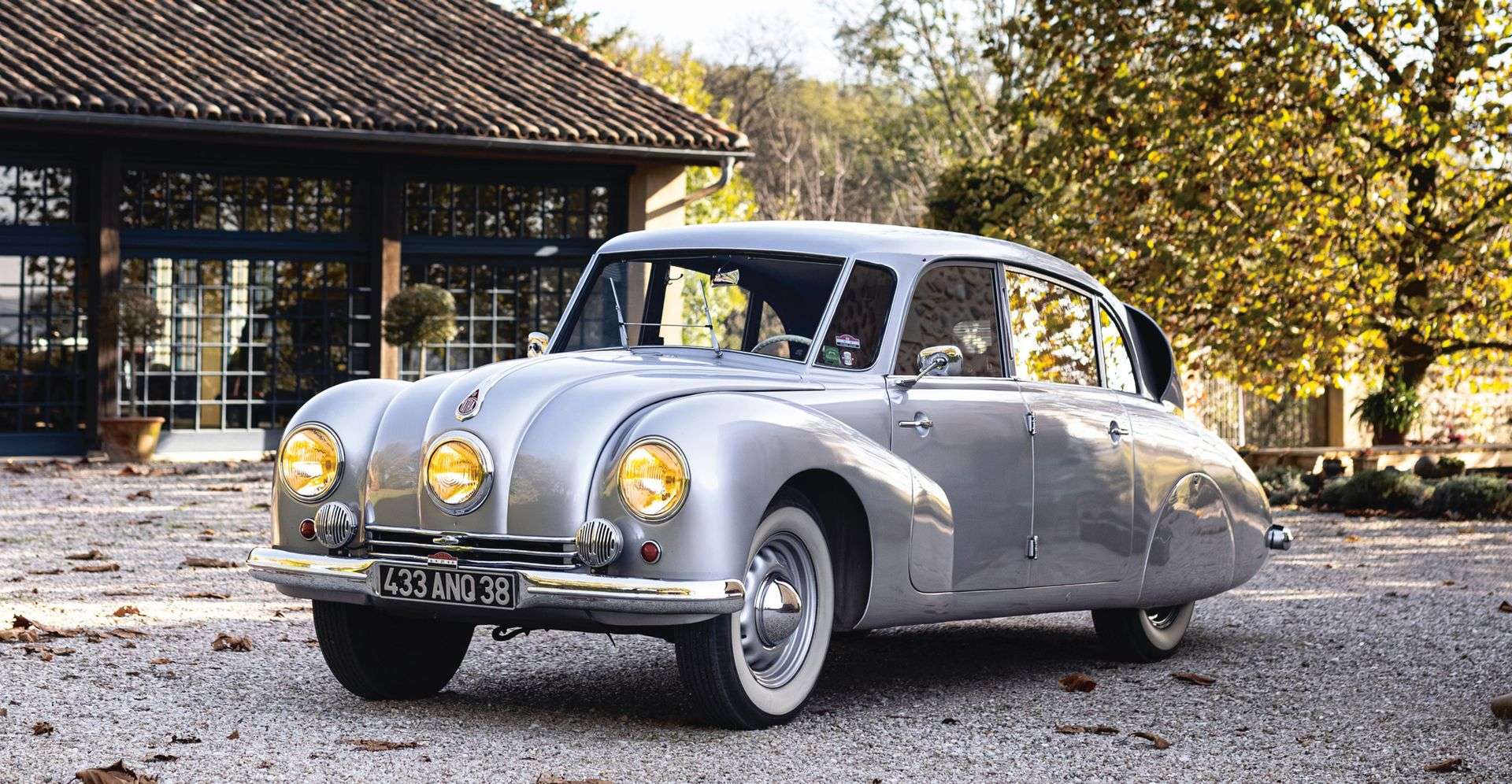
Tatra 87 - 1948
ERRATUM: Vehicle sold without technical inspection.
Chassis no. 73152
French registration title
French registration title
"A monument to automotive history like no other".
"A monument like no other in the history of the automobile "
Launched in 1936 by the indisputable Czechoslovakian
Czechoslovakian manufacturer, the T87 was the culmination of research
to revolutionize the automobile that began with the highly confidential
and even more "extreme" T77. This car is the result of the work
work of three men, all experts in their field:
Hans Ledwinka, head of technical development,
who considers it his masterpiece, Paul Jaray, a pioneer of
pioneer of Hungarian aerodynamics, with a proven track record in
in the design of Zeppelins, and Erich Ubelacker, the engineer who
engineer who imagined a car where function took precedence over form
Bauhaus spirit.
In addition to its highly exclusive body shape and high
an air penetration coefficient (Cx) of just 0.36,
made entirely of steel, with no wooden frame as was the
was the norm at the time, this Type 87 is also intriguing for its technical
technology, with its central beam chassis, four independent
four independent wheels and an air-cooled, rear-mounted V8 engine
air-cooled, rear-mounted engine (for maximum passenger space).
75 hp and a top speed of
of 150 km/h. The engine housings were made of Elektron,
a revolutionary alloy of magnesium and aluminum. The
Citroën Traction Avant and Chrysler Airflow, also highly innovative
innovative, were far behind!
Well-built, powerful and expensive, the T87 was aimed at the elite.
and arrived at a "dark period in history":
a total of 3,056 examples were built between 1936 and 1950,
including 1,652 after the war.
During this period, the sight of a Tatra on the road was exceptional.
even more so today. In
France, Jacques Poch imported seven Tatra 87s in
1948 (eight according to the Tatra archives in Koprivnice), none of which
of which appear to have survived. Three Tatra 87s have been registered in France
all from Czechoslovakia (some ex-Wehrmacht).
ex-Wehrmacht). One is in the reserves of the Musée National de l'Automobile
Musée National de l'Automobile-Collection Schlumpf, Mulhouse, awaiting restoration.
restoration. The other two belong to private collectors
collectors, like this one, sold new in Portugal, then imported
then imported into Switzerland and Germany.
Restored at great expense in Germany between 1993 and 1995,
it comes to us in very good used condition, with a very slight
with a very slight patina testifying to its sparing use
following its restoration 30 years ago. It's just waiting to
and will not fail to amaze its future owner, as well as all
its future owner, as well as all enthusiasts and neophytes
and neophytes (even anti-car enthusiasts!) it comes across.
ERRATUM: Vehicle sold without Contrôle Technique.
Launched in 1936 by the essential Czechoslovakian manufacturer,
the T87 is the culmination of research aimed at revolutionizing
the automobile that began with the very confidential and even
more "extreme" T77. This car is the result of the work of three
men, all experts in their field: Hans Ledwinka, head of technical
development, who considers it his masterpiece, Paul Jaray, a
pioneer of Hungarian aerodynamics, having proven himself in
the design of the Zeppelin and Erich Ubelacker, an engineer
who imagines an automobile where function takes precedence
over form in the spirit of the Bauhaus.
Beyond its bodywork with a very exclusive shape and benefiting
from a drag coefficient (Cx) of only 0.36, entirely made of steel,
without a wooden frame as was the rule at the time, this Typ 87
also intrigues with its technology, with in particular its central
beam chassis, its four independent wheels and its engine,
an air-cooled V8 placed at the rear (to offer maximum space
to the occupants), developing 75 hp and offering a top speed
of 150 km/h. The engine casings were also made of Elektron,
a magnesium and aluminum alloy: revolutionary. The Citroën
Traction Avant and other Chrysler Airflow, also very innovative,
were far behind!
Very well built, powerful and expensive, the T87 was aimed at
an elite and also arrived at a "dark period of history": in total,
3,056 examples were manufactured between 1936 and 1950,
including 1,652 after the war.
At that time, the sight of a Tatra in circulation was exceptional|
this is even more the case today. In France, Jacques Poch
imported seven Tatra 87s in 1948 (eight according to the Tatra
archives in Koprivnice), none of which seem to have survived.
Three Tatra 87s have been recorded in France, all originating from
Czechoslovakia (some ex-Wehrmacht). One is in the reserves
of the Musée Nationa
ERRATUM: Vehicle sold without technical inspection.
Chassis no. 73152
French registration title
French registration title
"A monument to automotive history like no other".
"A monument like no other in the history of the automobile "
Launched in 1936 by the indisputable Czechoslovakian
Czechoslovakian manufacturer, the T87 was the culmination of research
to revolutionize the automobile that began with the highly confidential
and even more "extreme" T77. This car is the result of the work
work of three men, all experts in their field:
Hans Ledwinka, head of technical development,
who considers it his masterpiece, Paul Jaray, a pioneer of
pioneer of Hungarian aerodynamics, with a proven track record in
in the design of Zeppelins, and Erich Ubelacker, the engineer who
engineer who imagined a car where function took precedence over form
Bauhaus spirit.
In addition to its highly exclusive body shape and high
an air penetration coefficient (Cx) of just 0.36,
made entirely of steel, with no wooden frame as was the
was the norm at the time, this Type 87 is also intriguing for its technical
technology, with its central beam chassis, four independent
four independent wheels and an air-cooled, rear-mounted V8 engine
air-cooled, rear-mounted engine (for maximum passenger space).
75 hp and a top speed of
of 150 km/h. The engine housings were made of Elektron,
a revolutionary alloy of magnesium and aluminum. The
Citroën Traction Avant and Chrysler Airflow, also highly innovative
innovative, were far behind!
Well-built, powerful and expensive, the T87 was aimed at the elite.
and arrived at a "dark period in history":
a total of 3,056 examples were built between 1936 and 1950,
including 1,652 after the war.
During this period, the sight of a Tatra on the road was exceptional.
even more so today. In
France, Jacques Poch imported seven Tatra 87s in
1948 (eight according to the Tatra archives in Koprivnice), none of which
of which appear to have survived. Three Tatra 87s have been registered in France
all from Czechoslovakia (some ex-Wehrmacht).
ex-Wehrmacht). One is in the reserves of the Musée National de l'Automobile
Musée National de l'Automobile-Collection Schlumpf, Mulhouse, awaiting restoration.
restoration. The other two belong to private collectors
collectors, like this one, sold new in Portugal, then imported
then imported into Switzerland and Germany.
Restored at great expense in Germany between 1993 and 1995,
it comes to us in very good used condition, with a very slight
with a very slight patina testifying to its sparing use
following its restoration 30 years ago. It's just waiting to
and will not fail to amaze its future owner, as well as all
its future owner, as well as all enthusiasts and neophytes
and neophytes (even anti-car enthusiasts!) it comes across.
ERRATUM: Vehicle sold without Contrôle Technique.
Launched in 1936 by the essential Czechoslovakian manufacturer,
the T87 is the culmination of research aimed at revolutionizing
the automobile that began with the very confidential and even
more "extreme" T77. This car is the result of the work of three
men, all experts in their field: Hans Ledwinka, head of technical
development, who considers it his masterpiece, Paul Jaray, a
pioneer of Hungarian aerodynamics, having proven himself in
the design of the Zeppelin and Erich Ubelacker, an engineer
who imagines an automobile where function takes precedence
over form in the spirit of the Bauhaus.
Beyond its bodywork with a very exclusive shape and benefiting
from a drag coefficient (Cx) of only 0.36, entirely made of steel,
without a wooden frame as was the rule at the time, this Typ 87
also intrigues with its technology, with in particular its central
beam chassis, its four independent wheels and its engine,
an air-cooled V8 placed at the rear (to offer maximum space
to the occupants), developing 75 hp and offering a top speed
of 150 km/h. The engine casings were also made of Elektron,
a magnesium and aluminum alloy: revolutionary. The Citroën
Traction Avant and other Chrysler Airflow, also very innovative,
were far behind!
Very well built, powerful and expensive, the T87 was aimed at
an elite and also arrived at a "dark period of history": in total,
3,056 examples were manufactured between 1936 and 1950,
including 1,652 after the war.
At that time, the sight of a Tatra in circulation was exceptional|
this is even more the case today. In France, Jacques Poch
imported seven Tatra 87s in 1948 (eight according to the Tatra
archives in Koprivnice), none of which seem to have survived.
Three Tatra 87s have been recorded in France, all originating from
Czechoslovakia (some ex-Wehrmacht). One is in the reserves
of the Musée Nationa