
&w=3840&q=75)
&w=3840&q=75)
&w=3840&q=75)
&w=3840&q=75)
&w=3840&q=75)
&w=3840&q=75)
&w=3840&q=75)
&w=3840&q=75)


2
Rembrandt Bugatti (1885-1916)
The item was sold for 11 704 €
Fees include commission and taxes.
Rembrandt Bugatti (1885-1916)
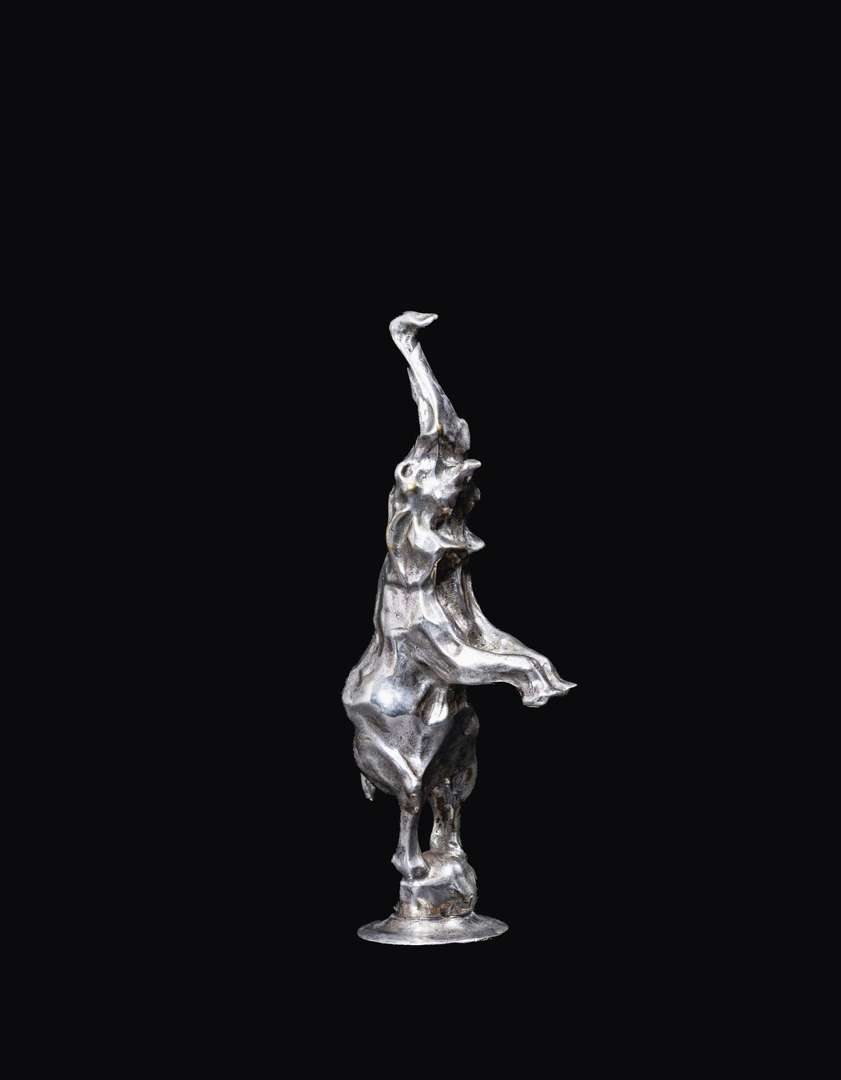
Elephant Dressé" Mascot, based on the model created for the Royal Bugatti, 1928.
"Éléphant Dressé" Mascot, based on the model created for the Royal Bugatti, 1928.
Provenance
Schlumpf Collection
Dans la famille par descendance / In the family by descent
Details
Epreuve en bronze argenté / Proof in silver-plated bronze
Hauteur / High: 19 cm (7½ in.)
The Bugatti Royale or Coupé Napoléon is undoubtedly the most
most beautiful classic car of its time, but also the most
expensive car in the world. Its creators Ettore and Jean Bugatti wanted
this car to surpass all the competition in terms of quality
qualities, power and reputation. All the aesthetic
the aesthetic principles of Ettore and Jean Bugatti.
the prestige of this achievement,
a silver radiator cap on the front grille.
the radiator grille. They then had the idea of paying tribute to
Rembrandt, who had died a few years earlier, and chose the
model of the 1904 trained elephant.
Fritz Schlumpf, a devotee of the Molsheim brand,
acquired as many as 120 Bugattis, until 1976. In 1963, he bought
Ettore Bugatti's personal Bugatti Royale at the company's sale.
less than a year later, he acquired a second Bugatti at the
at the Shakespeare sale. These will be the two jewels of his
future museum. To imitate the legend - or reality - according to which
Jean Bugatti himself screwed the radiator cap onto the
the car when it was delivered, Fritz Schlumpf always kept the two
the two radiator caps from his Royales and screwed them onto
screw them onto his cars every time he visited the museum.
One was sold in 2009, the second in April 2015 for
229,500.
Found a few years ago by the sole heiress of the Schlumpf
Schlumpf family in the belongings of her grandmother, Arlette, this third
third elephant was carefully wrapped and stored in a box
a box containing the passports of Fritz Schlumpf and Arlette
Schlumpf-Naas and a number of letters between the two
spouses. Not stamped by the Valsuani art studio, but bearing the
stamped by the Valsuani art studio, but bearing a foundryman's
suggests that this trained elephant mascot had a special significance.
importance. Now rediscovered, it takes on a certain
the exceptional collection assembled by the Schlumpf brothers until
Schlumpf brothers until 1977.
The Bugatti Royale, also known as the Coupé Napoléon is without question
question the most beautiful classic car of its time, as well as
the most expensive. Ettore and Jean Bugatti wanted this car
to surpass those of all their competitors in quality, power and
reputation. All of Ettore and Jean Bugatti's aesthetic principles
came together in this magnificent model. To top off the prestige
of their creation they envisioned topping the hood of the car with
a silver ornament. They also conceived the idea to pay tribute
to Rembrandt, who passed away a few years earlier, and chose
to model the ornament on éléphant dressé (1904).
By 1976 Fritz Schlumpf, an unconditional admirer of the Molsheim
brand, had acquired around 120 Bugatti. Among these was
a Bugatti Royale which he bought in 1963 from the personal
collection of Ettore Bugatti. Less than a year later he acquired a
second one from the Shakespeare sale. These two cars were to
be the jewels of his future museum. According to the legend - or
truth- Jean Bugatti came in person to attach the silver mascot to
each car before its delivery. Fritz Schlumpf kept the two mascots
of his Royales separate from the cars themselves and used to
attach them personally each time he visited the museum. One
of the two mascots was sold in 2009, the second one was sold
in 2009, the second in April 2015 for €229,500.
Found a few years ago by the sole heiress of the Schlumpf
family in the belongings of her grandmother, Arlette, this third
elephant was carefully wrapped and stored in a box containing
the passports of Fritz Schlumpf and Arlette Schlumpf-Naas and a
number of letters between the couple. Unstamped by the Valsuani
art studio, but bearing the hidden marks of a foundryman, there
is every reason to believe that this trained elephant mascot had
a special significance. Now that it has been rediscovered, it
takes on a certain mystery, just like the exceptional collection
assembled by the Schlumpf brothers until 1977.
Elephant Dressé" Mascot, based on the model created for the Royal Bugatti, 1928.
"Éléphant Dressé" Mascot, based on the model created for the Royal Bugatti, 1928.
Provenance
Schlumpf Collection
Dans la famille par descendance / In the family by descent
Details
Epreuve en bronze argenté / Proof in silver-plated bronze
Hauteur / High: 19 cm (7½ in.)
The Bugatti Royale or Coupé Napoléon is undoubtedly the most
most beautiful classic car of its time, but also the most
expensive car in the world. Its creators Ettore and Jean Bugatti wanted
this car to surpass all the competition in terms of quality
qualities, power and reputation. All the aesthetic
the aesthetic principles of Ettore and Jean Bugatti.
the prestige of this achievement,
a silver radiator cap on the front grille.
the radiator grille. They then had the idea of paying tribute to
Rembrandt, who had died a few years earlier, and chose the
model of the 1904 trained elephant.
Fritz Schlumpf, a devotee of the Molsheim brand,
acquired as many as 120 Bugattis, until 1976. In 1963, he bought
Ettore Bugatti's personal Bugatti Royale at the company's sale.
less than a year later, he acquired a second Bugatti at the
at the Shakespeare sale. These will be the two jewels of his
future museum. To imitate the legend - or reality - according to which
Jean Bugatti himself screwed the radiator cap onto the
the car when it was delivered, Fritz Schlumpf always kept the two
the two radiator caps from his Royales and screwed them onto
screw them onto his cars every time he visited the museum.
One was sold in 2009, the second in April 2015 for
229,500.
Found a few years ago by the sole heiress of the Schlumpf
Schlumpf family in the belongings of her grandmother, Arlette, this third
third elephant was carefully wrapped and stored in a box
a box containing the passports of Fritz Schlumpf and Arlette
Schlumpf-Naas and a number of letters between the two
spouses. Not stamped by the Valsuani art studio, but bearing the
stamped by the Valsuani art studio, but bearing a foundryman's
suggests that this trained elephant mascot had a special significance.
importance. Now rediscovered, it takes on a certain
the exceptional collection assembled by the Schlumpf brothers until
Schlumpf brothers until 1977.
The Bugatti Royale, also known as the Coupé Napoléon is without question
question the most beautiful classic car of its time, as well as
the most expensive. Ettore and Jean Bugatti wanted this car
to surpass those of all their competitors in quality, power and
reputation. All of Ettore and Jean Bugatti's aesthetic principles
came together in this magnificent model. To top off the prestige
of their creation they envisioned topping the hood of the car with
a silver ornament. They also conceived the idea to pay tribute
to Rembrandt, who passed away a few years earlier, and chose
to model the ornament on éléphant dressé (1904).
By 1976 Fritz Schlumpf, an unconditional admirer of the Molsheim
brand, had acquired around 120 Bugatti. Among these was
a Bugatti Royale which he bought in 1963 from the personal
collection of Ettore Bugatti. Less than a year later he acquired a
second one from the Shakespeare sale. These two cars were to
be the jewels of his future museum. According to the legend - or
truth- Jean Bugatti came in person to attach the silver mascot to
each car before its delivery. Fritz Schlumpf kept the two mascots
of his Royales separate from the cars themselves and used to
attach them personally each time he visited the museum. One
of the two mascots was sold in 2009, the second one was sold
in 2009, the second in April 2015 for €229,500.
Found a few years ago by the sole heiress of the Schlumpf
family in the belongings of her grandmother, Arlette, this third
elephant was carefully wrapped and stored in a box containing
the passports of Fritz Schlumpf and Arlette Schlumpf-Naas and a
number of letters between the couple. Unstamped by the Valsuani
art studio, but bearing the hidden marks of a foundryman, there
is every reason to believe that this trained elephant mascot had
a special significance. Now that it has been rediscovered, it
takes on a certain mystery, just like the exceptional collection
assembled by the Schlumpf brothers until 1977.