
&w=3840&q=75)
&w=3840&q=75)
&w=3840&q=75)
&w=3840&q=75)
&w=3840&q=75)
&w=3840&q=75)
&w=3840&q=75)
&w=3840&q=75)


= CHINA
QING DYNASTY (1644-1911)
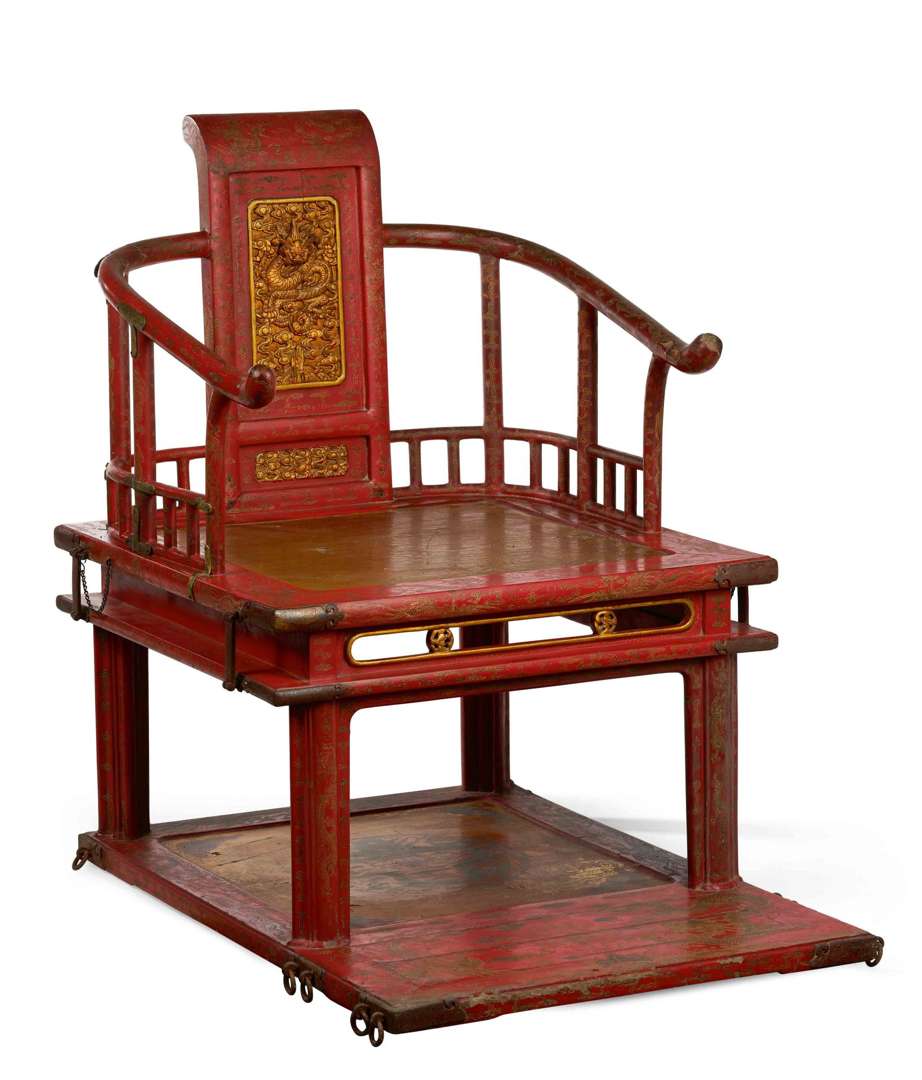
Rare qiangjin and tianqi lacquer sedan chair
Resting on a footrest-like base, with a wide seat and horseshoe-shaped armrests. The backrest is decorated with an ascending dragon on one side and the symbols of the "Five Sacred Peaks" (Wuyue) on the other. The entire structure is red lacquered and adorned with imperial dragons and phoenixes chasing the pearl among clouds in engraved lacquer enhanced with gold and polychrome.
Size: 99 x 93 x 63.5 cm
NOTE
This rare sedan chair features an interesting and unusual iconography, that of the "Five Sacred Mountains" (Wuyue). More precisely, the motifs on the back of the backrest are Taoist talismanic diagrams known as the "True Forms of the Five Sacred Mountains" (Zhenxing Wuyue). According to Taoist tradition, these symbols were transmitted by the immortal Xiwangmu (Queen Mother of the West) to Emperor Wudi of the Han dynasty. These mountains represent the five cardinal points in Chinese geomancy: East (Tai Shan in Shandong), West (Hua Shan in Shanxi), South (Heng Shan in Hunan), North (Heng Shan in Shanxi) and Center (Song Shan in Henan). They also symbolize the balance of cosmic order and the Five Elements of Chinese cosmogonic tradition (metal, fire, wood, water and earth).
This chair is also particularly interesting for the lacquer technique used to decorate it. Indeed, the particularly fragile and expensive "qiangjin" and "tianqi" techniques are rarely used on armchairs. Instead, they are more frequently used on tables and consoles. These techniques, developed early in Chinese artistic history, were particularly in vogue during the Ming and Qing dynasties, among the imperial power and high aristocracy.
QING DYNASTY (1644-1911)
Rare qiangjin and tianqi lacquer sedan chair
Resting on a footrest-like base, with a wide seat and horseshoe-shaped armrests. The backrest is decorated with an ascending dragon on one side and the symbols of the "Five Sacred Peaks" (Wuyue) on the other. The entire structure is red lacquered and adorned with imperial dragons and phoenixes chasing the pearl among clouds in engraved lacquer enhanced with gold and polychrome.
Size: 99 x 93 x 63.5 cm
NOTE
This rare sedan chair features an interesting and unusual iconography, that of the "Five Sacred Mountains" (Wuyue). More precisely, the motifs on the back of the backrest are Taoist talismanic diagrams known as the "True Forms of the Five Sacred Mountains" (Zhenxing Wuyue). According to Taoist tradition, these symbols were transmitted by the immortal Xiwangmu (Queen Mother of the West) to Emperor Wudi of the Han dynasty. These mountains represent the five cardinal points in Chinese geomancy: East (Tai Shan in Shandong), West (Hua Shan in Shanxi), South (Heng Shan in Hunan), North (Heng Shan in Shanxi) and Center (Song Shan in Henan). They also symbolize the balance of cosmic order and the Five Elements of Chinese cosmogonic tradition (metal, fire, wood, water and earth).
This chair is also particularly interesting for the lacquer technique used to decorate it. Indeed, the particularly fragile and expensive "qiangjin" and "tianqi" techniques are rarely used on armchairs. Instead, they are more frequently used on tables and consoles. These techniques, developed early in Chinese artistic history, were particularly in vogue during the Ming and Qing dynasties, among the imperial power and high aristocracy.