
&w=3840&q=75)
&w=3840&q=75)
&w=3840&q=75)
&w=3840&q=75)
&w=3840&q=75)
&w=3840&q=75)


MAISON CARTIER
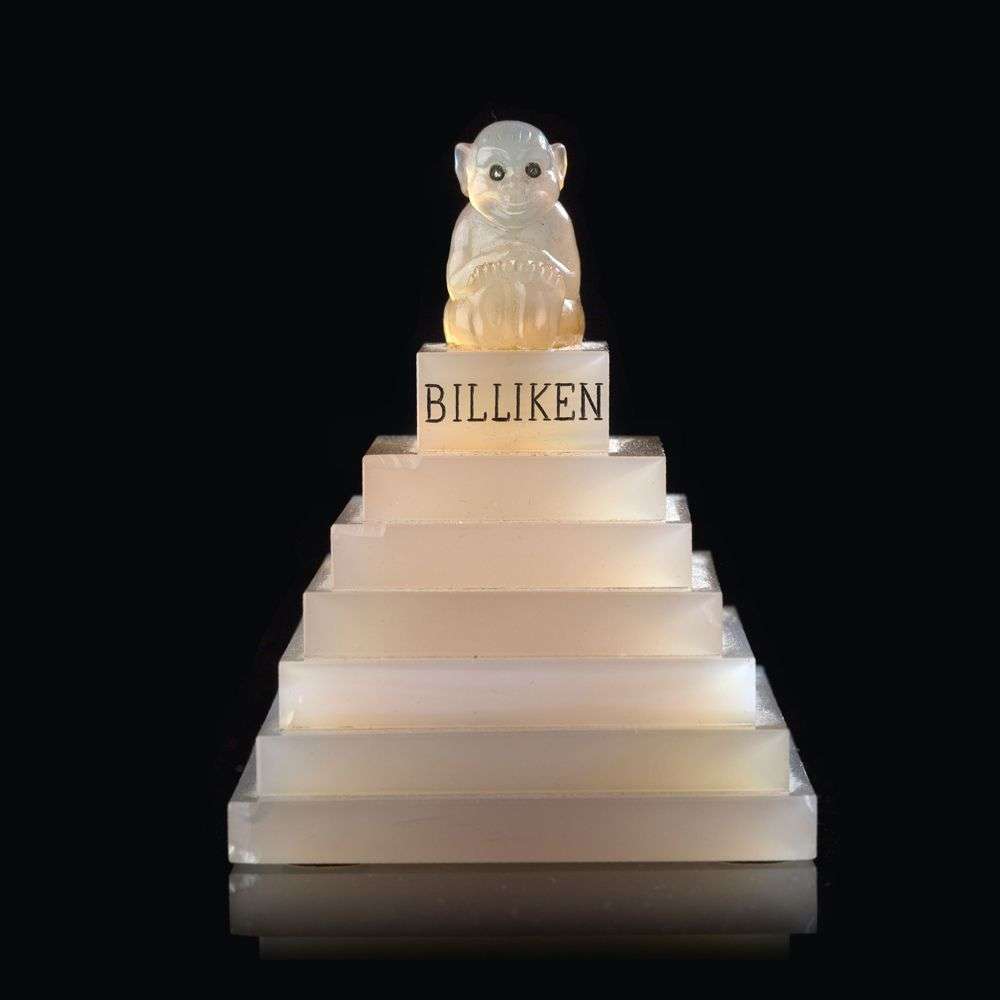
Billiken" decorative subject, 1910
Carved agate proof, rose-cut diamond eyes, silver (> 800) surround, stepped pyramidal base in agate plaques.
Titled "Billiken" at the top of the pyramid.
Numbered "642".
H. 7.8 cm, W. 6.3 cm, D. 6.3 cm
H. 3 1/8 in. w. 2 1/2 in. d. 2 1/2 in.
(Two cracks and a few chips at the corners and on the edges of the steps)
A table ornament, 1910, carved agate, pink diamonds and silver. Titled. Numbered.
A letter of expertise from IAJA, dated July 4, 2024, will be delivered to the buyer.
PROVENANCE Acquired from Cartier in New York in 1978.
BIBLIOGRAPHY Olivier Bachet, "Cartier: Objets d'exception",
Éditions du Palais Royal, Paris, 2019, model reproduced p. 458.
"In 1908, Pierre Cartier married Elma Rumsey in Saint-Louis, Missouri, where she was originally from.
In the same city, at the same time,
Florence Pretz, an art teacher, created a small, debonair figure she had seen in a dream. The figure resembles a seated Buddha. We call him Billiken. The name comes from the diminutive "Billy" given to the then President of the United States,
William Taft. Others claim that its name comes from the verses of Canadian poet William
Bliss Carman. The success of the little character was immediate. [...] Evoking Hotei, the Japanese god of abundance and contentment with whom he is often confused, Billiken was also a great success in the land of the rising sun, where he became the god of "things that ought to be". [...] It must be that, during his stay in Saint-Louis,
Pierre Cartier must have caught wind of the Billiken's runaway success, for as early as 1910, the little character appeared, carved in agate, on a sort of ivory perch to which he was held by a gold chain. [...] Cartier described him as the "Anglo-Saxon god of happiness", a god who of course never existed. [...]
The little character's good-naturedness and whimsical, pixie-like expression made him a hit.
Nadelhoffer reported that Queen Alexandra, wife of King Edward VII, was very happy with her Billiken, as was Prince Yusupov, who bought one for himself.
Youssoupov, who bought one in 1913. [...]
Billikens are mostly made of agate, sometimes with diamond-set eyes, and are often displayed on objects such as tiered pyramid paperweights in aventurine, agate or rose quartz. Beneath the witty, laughing little Billiken is the word "BILLIKEN".
Responding both to the Belle Epoque taste for objects inherited from the Age of Enlightenment and to the Orientalist fashion in vogue after 1920, magots, Buddhas and Billikens were present in Cartier's production throughout the first third of the 20th century. [...] They remained part of the House's decorative repertoire for a long time to come."
Olivier Bachet, "Cartier: Objets d'exception".
Billiken" decorative subject, 1910
Carved agate proof, rose-cut diamond eyes, silver (> 800) surround, stepped pyramidal base in agate plaques.
Titled "Billiken" at the top of the pyramid.
Numbered "642".
H. 7.8 cm, W. 6.3 cm, D. 6.3 cm
H. 3 1/8 in. w. 2 1/2 in. d. 2 1/2 in.
(Two cracks and a few chips at the corners and on the edges of the steps)
A table ornament, 1910, carved agate, pink diamonds and silver. Titled. Numbered.
A letter of expertise from IAJA, dated July 4, 2024, will be delivered to the buyer.
PROVENANCE Acquired from Cartier in New York in 1978.
BIBLIOGRAPHY Olivier Bachet, "Cartier: Objets d'exception",
Éditions du Palais Royal, Paris, 2019, model reproduced p. 458.
"In 1908, Pierre Cartier married Elma Rumsey in Saint-Louis, Missouri, where she was originally from.
In the same city, at the same time,
Florence Pretz, an art teacher, created a small, debonair figure she had seen in a dream. The figure resembles a seated Buddha. We call him Billiken. The name comes from the diminutive "Billy" given to the then President of the United States,
William Taft. Others claim that its name comes from the verses of Canadian poet William
Bliss Carman. The success of the little character was immediate. [...] Evoking Hotei, the Japanese god of abundance and contentment with whom he is often confused, Billiken was also a great success in the land of the rising sun, where he became the god of "things that ought to be". [...] It must be that, during his stay in Saint-Louis,
Pierre Cartier must have caught wind of the Billiken's runaway success, for as early as 1910, the little character appeared, carved in agate, on a sort of ivory perch to which he was held by a gold chain. [...] Cartier described him as the "Anglo-Saxon god of happiness", a god who of course never existed. [...]
The little character's good-naturedness and whimsical, pixie-like expression made him a hit.
Nadelhoffer reported that Queen Alexandra, wife of King Edward VII, was very happy with her Billiken, as was Prince Yusupov, who bought one for himself.
Youssoupov, who bought one in 1913. [...]
Billikens are mostly made of agate, sometimes with diamond-set eyes, and are often displayed on objects such as tiered pyramid paperweights in aventurine, agate or rose quartz. Beneath the witty, laughing little Billiken is the word "BILLIKEN".
Responding both to the Belle Epoque taste for objects inherited from the Age of Enlightenment and to the Orientalist fashion in vogue after 1920, magots, Buddhas and Billikens were present in Cartier's production throughout the first third of the 20th century. [...] They remained part of the House's decorative repertoire for a long time to come."
Olivier Bachet, "Cartier: Objets d'exception".