
&w=3840&q=75)
&w=3840&q=75)
&w=3840&q=75)
&w=3840&q=75)
&w=3840&q=75)
&w=3840&q=75)
&w=3840&q=75)
&w=3840&q=75)


42
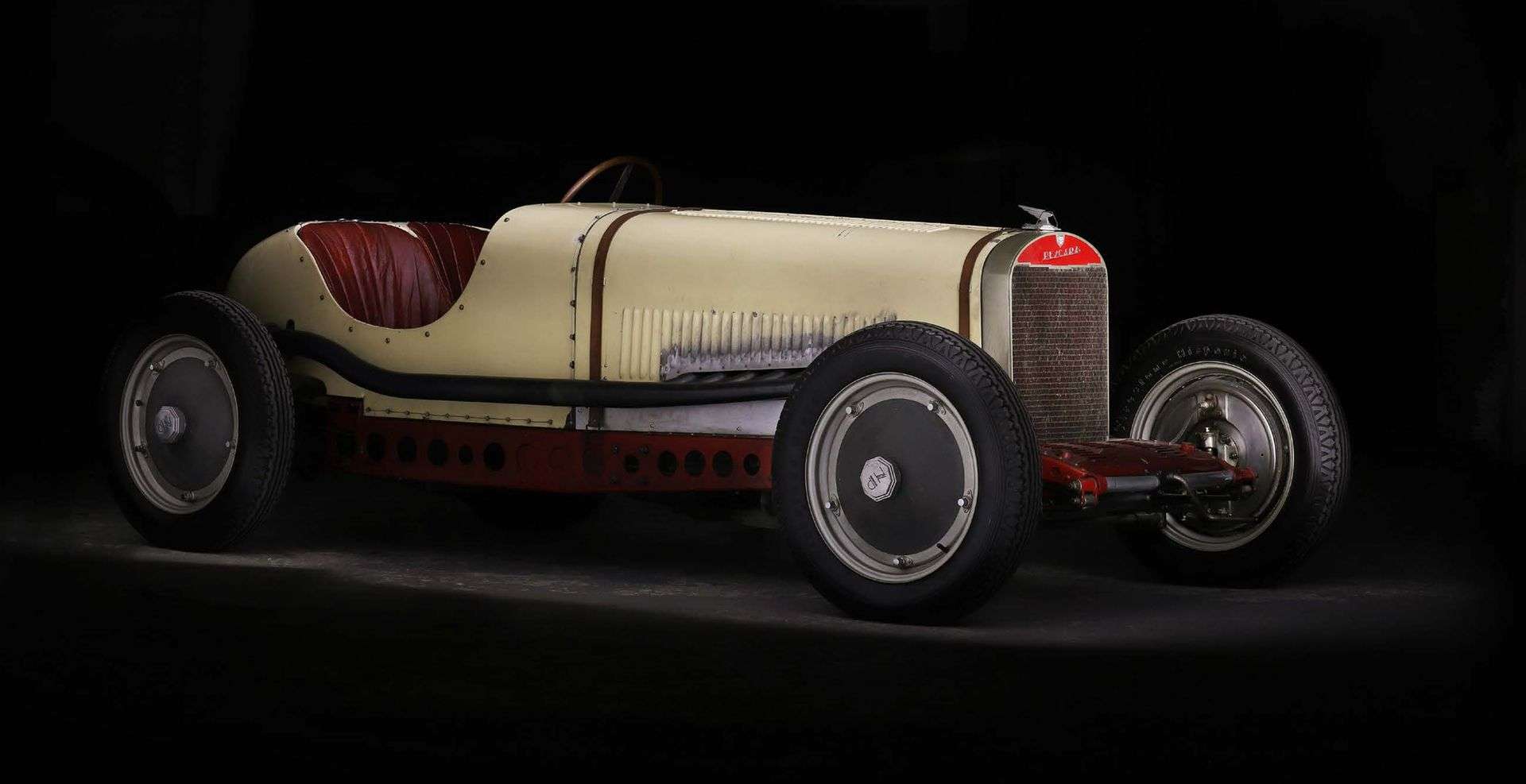
Nacional Pescara 3 Litres Competition Usine – 1929
The item was sold for 588 000 €
Fees include commission and taxes.
Nacional Pescara 3 Litres Competition Usine – 1929
Spanish registration title
Sold without contrôle technique
Unique and authentic Grand Prix car
Never seen before on the market, in the same family for over 70 years
Incredible competition technology, with a 3-litre, 8-cylinder, twincam, supercharged engine
Remarkable, documented track record, driven by ace Juan Zanelli
A national monument in Spanish motoring history
The history of the Nacional Pescara brand is closely linked to that of the Spanish Marquis Raul Pateras Pescara de Castellucio. An eccentric man with a passion for aeronautics, he built the first helicopters! While he filed a large number of patents between 1917 and 1955, in a whole host of fields, he first came to prominence for his astonishing flying machines. And, in the field that interests us, for a car brand that he created with his brother at the end of the 1920s, with the aim of restoring the reputation of the Spanish car industry. No less! The brand, backed by King Alfonso XIII, took the name Fabrica Nacional de Automoviles - Pescara, or Nacional Pescara. Right from the start in 1928, the company’s ambitions were...
pretentious! From the outset, they aimed to build a complete range, with small, popular 4-cylinder cars, mid-range 6-cylinder cars and, at the top of the range, 8-cylinder cars, and even 16-cylinder cars. As the company was supported by the King and his Prime Minister, and heavily subsidised, the Pescara brothers were able to attract a number of renowned engineers who had already proved their worth, including a certain Edmond Moglia, a Franco-Italian already famous for his racing engines (Sunbeam and Omega-Six 8-cylinder double overhead camshafts in particular), his streamlined bodywork (including the Ballot and Bugatti with cigar bodywork at the 1922 ACF Grand Prix) and the development of the Roots-type compressor adopted by Bugatti on its compressor-powered thoroughbreds... He also designed the legendary and short-lived record-breaking Djelmo.
For Nacional Pescara, he developed - at no cost - the 8-cylinder double overhead camshaft racing car, an architecture
that he was particularly fond of. Although it is known that the young brand employed nearly 200 people, it went bankrupt in
the early 1930s, and collapsed with the fall of the monarchy and the advent of the 2nd Spanish Republic. In the end, production was very limited, with around a dozen civilian cars built and 2 or 3 racers.
Urban legend has it that all 3 engines survived. But to date we have no proof, and the car that illustrates these pages is the
only survivor from the Iberian marque. This is fortunate, as it is technically and historically the most interesting. With its short, low-slung, lightened chassis, hydraulic brakes, forged front axle, close-ratio 3-speed gearbox and exceptional 8-cylinder, 3-litre, double overhead camshaft engine developing 125 hp to propel its 750 kg weight, it is, on paper, the most serious competitor to the Bugatti Type 51 Grand Prix and the Alfa Romeo 8C Monza...
Two racers skimmed - and shone - in the European Mountain Championship in 1931 (Kesselberg, Shelsey Walsh, etc. ) and in
Spanish races (Grand Prix of Barcelona, at Montjuic, in particular) in the hands of drivers Enrique Tort and Juan Zanelli. After the brand’s bankruptcy, one of these racers continued to be developed (shortened chassis, improved suspension, bodywork modified and shaped in Electron, engine compressed and boosted to 180 hp, 2-speed gearbox! ) and continued to race (now weighing in at 595 kg dry!) with Zanelli, notably in hill-climbing races (Les Alpilles, La Turbie, Mont Ventoux, La Rabassada, etc.), who even entered it in the 1932 Monaco Grand Prix, from which it eventually failed to start.
At the end of the 1940s, the car was acquired by a shrewd Spanish gentleman driver, el señor Juan Coma Cros, who used it and kept it all his life, while at the same time gathering as much information as possible about its history and achievements. His family has now entrusted Aguttes with the task of finding a new custodian who can restore its engine and bring it back to life, either as a two-seater as it is today, or as a single-seater in its most elegant form. The choice is yours...
“A genuine Grand Prix car, eligible for Monaco, with an 8-cylinder, 3-litre, double overhead camshaft, supercharged engine - what more could you ask for?”
Spanish registration title
Sold without contrôle technique
Unique and authentic Grand Prix car
Never seen before on the market, in the same family for over 70 years
Incredible competition technology, with a 3-litre, 8-cylinder, twincam, supercharged engine
Remarkable, documented track record, driven by ace Juan Zanelli
A national monument in Spanish motoring history
The history of the Nacional Pescara brand is closely linked to that of the Spanish Marquis Raul Pateras Pescara de Castellucio. An eccentric man with a passion for aeronautics, he built the first helicopters! While he filed a large number of patents between 1917 and 1955, in a whole host of fields, he first came to prominence for his astonishing flying machines. And, in the field that interests us, for a car brand that he created with his brother at the end of the 1920s, with the aim of restoring the reputation of the Spanish car industry. No less! The brand, backed by King Alfonso XIII, took the name Fabrica Nacional de Automoviles - Pescara, or Nacional Pescara. Right from the start in 1928, the company’s ambitions were...
pretentious! From the outset, they aimed to build a complete range, with small, popular 4-cylinder cars, mid-range 6-cylinder cars and, at the top of the range, 8-cylinder cars, and even 16-cylinder cars. As the company was supported by the King and his Prime Minister, and heavily subsidised, the Pescara brothers were able to attract a number of renowned engineers who had already proved their worth, including a certain Edmond Moglia, a Franco-Italian already famous for his racing engines (Sunbeam and Omega-Six 8-cylinder double overhead camshafts in particular), his streamlined bodywork (including the Ballot and Bugatti with cigar bodywork at the 1922 ACF Grand Prix) and the development of the Roots-type compressor adopted by Bugatti on its compressor-powered thoroughbreds... He also designed the legendary and short-lived record-breaking Djelmo.
For Nacional Pescara, he developed - at no cost - the 8-cylinder double overhead camshaft racing car, an architecture
that he was particularly fond of. Although it is known that the young brand employed nearly 200 people, it went bankrupt in
the early 1930s, and collapsed with the fall of the monarchy and the advent of the 2nd Spanish Republic. In the end, production was very limited, with around a dozen civilian cars built and 2 or 3 racers.
Urban legend has it that all 3 engines survived. But to date we have no proof, and the car that illustrates these pages is the
only survivor from the Iberian marque. This is fortunate, as it is technically and historically the most interesting. With its short, low-slung, lightened chassis, hydraulic brakes, forged front axle, close-ratio 3-speed gearbox and exceptional 8-cylinder, 3-litre, double overhead camshaft engine developing 125 hp to propel its 750 kg weight, it is, on paper, the most serious competitor to the Bugatti Type 51 Grand Prix and the Alfa Romeo 8C Monza...
Two racers skimmed - and shone - in the European Mountain Championship in 1931 (Kesselberg, Shelsey Walsh, etc. ) and in
Spanish races (Grand Prix of Barcelona, at Montjuic, in particular) in the hands of drivers Enrique Tort and Juan Zanelli. After the brand’s bankruptcy, one of these racers continued to be developed (shortened chassis, improved suspension, bodywork modified and shaped in Electron, engine compressed and boosted to 180 hp, 2-speed gearbox! ) and continued to race (now weighing in at 595 kg dry!) with Zanelli, notably in hill-climbing races (Les Alpilles, La Turbie, Mont Ventoux, La Rabassada, etc.), who even entered it in the 1932 Monaco Grand Prix, from which it eventually failed to start.
At the end of the 1940s, the car was acquired by a shrewd Spanish gentleman driver, el señor Juan Coma Cros, who used it and kept it all his life, while at the same time gathering as much information as possible about its history and achievements. His family has now entrusted Aguttes with the task of finding a new custodian who can restore its engine and bring it back to life, either as a two-seater as it is today, or as a single-seater in its most elegant form. The choice is yours...
“A genuine Grand Prix car, eligible for Monaco, with an 8-cylinder, 3-litre, double overhead camshaft, supercharged engine - what more could you ask for?”