
&w=3840&q=75)
&w=3840&q=75)
&w=3840&q=75)
&w=3840&q=75)
&w=3840&q=75)
&w=3840&q=75)
&w=3840&q=75)
&w=3840&q=75)


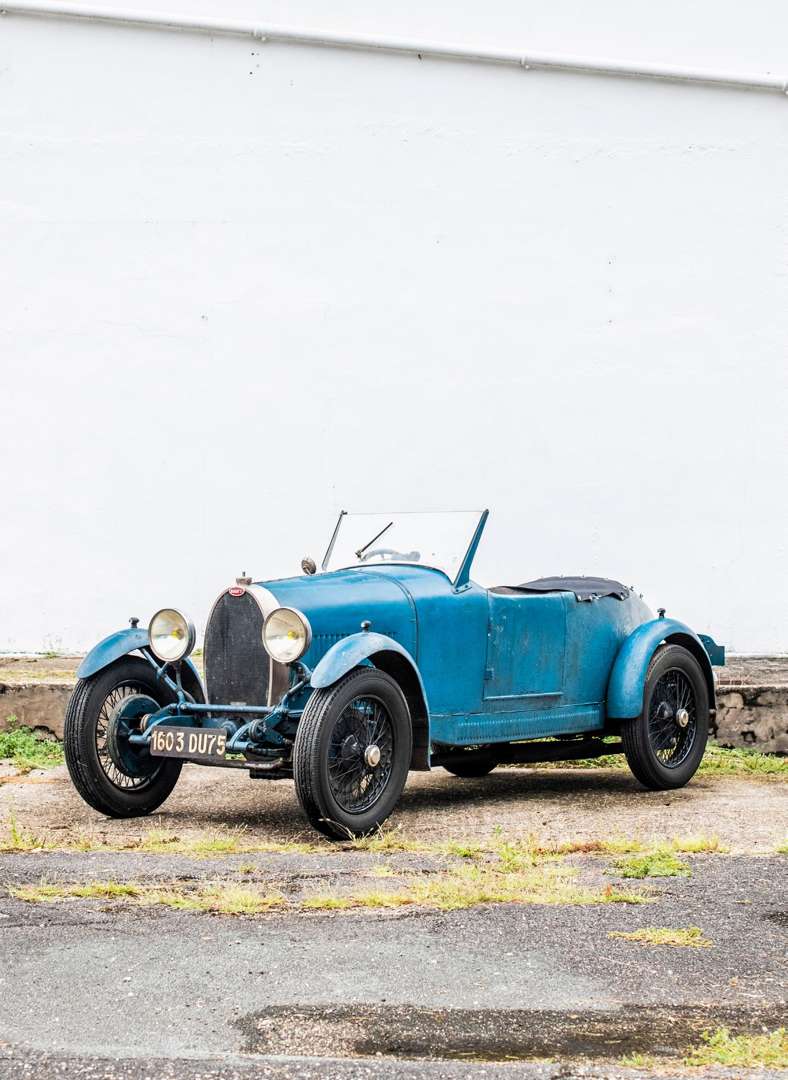
Bugatti Type 40A Grand Sport – 1929
French registration title
Sold without contrôle technique
Incredible and moving original condition
Sublime original Grand Sport bodywork: a sports car in formal wear
High-performance and extremely rare 40A version
A car known only to insiders, not seen since the 1950s
A serious contender to win the Preservation Class of the greatest events...
After the advent of the legendary Grand Prix Type 35 Grand Prix, Ettore Bugatti decided, as was his wont, to turn his thoroughbred racing car into a host of promising colts. This was done with the Type 35 A (or ‘Course Imitation Tecla’) and its 8-cylinder engine with 3-bearing crankshaft derived from the Type 30, and the Type 37, with its 4-cylinder 1500 engine. The Brescia had outlived its usefulness, so the Touring version was replaced by the Type 40, which borrowed the engine from the 37 (with a modified lower casing to match the curvature of the Touring chassis), and other elements from the Type 38 (8-cylinder Touring), including a radiator, gearbox, rear axle - narrower and with a shorter ratio - and Type 44 brakes, with a new front axle.
The Type 40 was a great success, particularly with its factory Grand Sport 3-seater body (and-a-half, according to Hugh
Conway!), derived from the bodies already seen on the Type 38 and - above all - the Type 43. Capable of a speed of 125 km/h in Grand Sport bodywork (the lightest version), it offered remarkable performance compared to its rivals, and more than 830 examples (in all body styles) were produced by 1933, a remarkable figure in the history of the marque. In 1929, Ettore and Jean Bugatti succumbed to the temptation of the American market and developed the Type 40 into the Type 40 A, which featured Jean Bugatti’s Roadster bodywork. To compensate for the excess weight of this bodywork, the Type 40 A benefited from a more powerful engine, borrowing a Type 49 block and now offering a displacement of almost 1,650 cc, fuelled by an electric Autoflux pump and powered by dual ignition. It is now well known that a handful of chassis and Grand Sports cars benefited from this Type 40 A engine.
Hugh Conway, in his 1963 reference book, lists what appears to be one of the earliest Type 40 A’s under chassis number
#40748, so it is entirely consistent that our car, chassis #40776, should have had this ‘A’ finish. The Type 49 block, dual ignition, two-coil assembly, ‘auto-régulatrice’ Purflux fuel pump under the bonnet, and the extremely rare Marchal et Vaucansson ‘Double Ignition’ switch for feeding one or two coils on the dashboard: all these details suggest that this Grand Sport was a special order, and it is presented to us in exceptional original condition.
The paintwork, woodwork and leathers tell the story of almost 100 years of what was certainly a rich and fantastic history,
with two tiny Saint-Christophe statues inlaid in the centre of the steering wheel. If cars could talk!
The history of our car is not known until the 1950s. It was registered in March 1955, under number 1603 DU 75, in the name
of a certain J. V. Richard, residing at 7 rue Bapts, in Asnièressur- Seine, then in the Seine département (75). The car was then
stored for a long time in the back room of a bistro in Levallois, still in the Seine department, a stone’s throw from Asnières-sur- Seine, where a number of Parisian bugattists tried for a long time to buy it, after bitter discussions with Mr Richard, but to no avail.
The car was finally acquired by a Renault agent in the Sarthe region, who stored it for decades, without touching it, until his
death in the early 2000s. Mr T. then bought the car and had the engine checked and overhauled by a recognised Bugatti
specialist, who merely changed the oil pump pinion and piston rings, noting that the car was in very good mechanical condition and taking care to preserve its patina.
In 2024, how many Bugatti cars are still in their original condition, untouched for almost 100 years and little or not seen for over 60 years? We’re offering you the chance to take a trip back in time like no other, at the wheel of a car capable of shining in the Preservation Class of the biggest events of its kind. Attention enthusiasts.
Mr T. was lucky enough to have a mother who loved cars, and who drove him to school in a Jaguar XK 150 Coupé in the early 1960s. At the age of 13, he bought a rare 1939 GMF Cabriolet, which had only covered a few hundred kilometres and is still in his collection... A precocious and well-informed enthusiast, he was lucky enough to start driving sports cars at the age of 18, with a succession of Fiat Osca, Facel Vega HK 500 and Iso Rivolta, before falling under the spell of the Prancing Horse.
His passion quickly turned to older cars, with cyclecars, and in 1981, his first Bugatti, and not the least, the Type 30 Grand
Prix in our catalogue... In the 1980s/1990s, pre-1914 cars were in fashion, and he began to buy some very fine antiques, which were worth much more than they are today. The racing cars in his garage were not to be outdone, from the Stanguelini Formule Junior to the Rondeau M379, not forgetting a Panhard Le Mans racer from 1954 and the Maserati A6 GCS Monofaro that opens this catalogue. Not to mention Hispano-Suiza, Delahaye and Bugatti touring cars. Over the years, Mr T. has built up a collection of some fifty cars, behind the wheel of which he and his wife have taken part in some of Europe’s greatest events, covering thousands of kilometres in rallies, scouring hundreds of kilometres of the world’s most prestigious motor racing circuits and competing in some of the world’s most prestigious events.
Today, Mr T. has decided to refocus his collection on antiques in original condition, and modern sports cars, the two latest arrivals being an 1899 Decauville and a Ferrari 550 Maranello.
Let’s get bidding!
The three cars of Mister. T's collection are running, but will need to be serviced before being driven again.
“Maybe the last Bugatti to be discovered in its original condition...”
French registration title
Sold without contrôle technique
Incredible and moving original condition
Sublime original Grand Sport bodywork: a sports car in formal wear
High-performance and extremely rare 40A version
A car known only to insiders, not seen since the 1950s
A serious contender to win the Preservation Class of the greatest events...
After the advent of the legendary Grand Prix Type 35 Grand Prix, Ettore Bugatti decided, as was his wont, to turn his thoroughbred racing car into a host of promising colts. This was done with the Type 35 A (or ‘Course Imitation Tecla’) and its 8-cylinder engine with 3-bearing crankshaft derived from the Type 30, and the Type 37, with its 4-cylinder 1500 engine. The Brescia had outlived its usefulness, so the Touring version was replaced by the Type 40, which borrowed the engine from the 37 (with a modified lower casing to match the curvature of the Touring chassis), and other elements from the Type 38 (8-cylinder Touring), including a radiator, gearbox, rear axle - narrower and with a shorter ratio - and Type 44 brakes, with a new front axle.
The Type 40 was a great success, particularly with its factory Grand Sport 3-seater body (and-a-half, according to Hugh
Conway!), derived from the bodies already seen on the Type 38 and - above all - the Type 43. Capable of a speed of 125 km/h in Grand Sport bodywork (the lightest version), it offered remarkable performance compared to its rivals, and more than 830 examples (in all body styles) were produced by 1933, a remarkable figure in the history of the marque. In 1929, Ettore and Jean Bugatti succumbed to the temptation of the American market and developed the Type 40 into the Type 40 A, which featured Jean Bugatti’s Roadster bodywork. To compensate for the excess weight of this bodywork, the Type 40 A benefited from a more powerful engine, borrowing a Type 49 block and now offering a displacement of almost 1,650 cc, fuelled by an electric Autoflux pump and powered by dual ignition. It is now well known that a handful of chassis and Grand Sports cars benefited from this Type 40 A engine.
Hugh Conway, in his 1963 reference book, lists what appears to be one of the earliest Type 40 A’s under chassis number
#40748, so it is entirely consistent that our car, chassis #40776, should have had this ‘A’ finish. The Type 49 block, dual ignition, two-coil assembly, ‘auto-régulatrice’ Purflux fuel pump under the bonnet, and the extremely rare Marchal et Vaucansson ‘Double Ignition’ switch for feeding one or two coils on the dashboard: all these details suggest that this Grand Sport was a special order, and it is presented to us in exceptional original condition.
The paintwork, woodwork and leathers tell the story of almost 100 years of what was certainly a rich and fantastic history,
with two tiny Saint-Christophe statues inlaid in the centre of the steering wheel. If cars could talk!
The history of our car is not known until the 1950s. It was registered in March 1955, under number 1603 DU 75, in the name
of a certain J. V. Richard, residing at 7 rue Bapts, in Asnièressur- Seine, then in the Seine département (75). The car was then
stored for a long time in the back room of a bistro in Levallois, still in the Seine department, a stone’s throw from Asnières-sur- Seine, where a number of Parisian bugattists tried for a long time to buy it, after bitter discussions with Mr Richard, but to no avail.
The car was finally acquired by a Renault agent in the Sarthe region, who stored it for decades, without touching it, until his
death in the early 2000s. Mr T. then bought the car and had the engine checked and overhauled by a recognised Bugatti
specialist, who merely changed the oil pump pinion and piston rings, noting that the car was in very good mechanical condition and taking care to preserve its patina.
In 2024, how many Bugatti cars are still in their original condition, untouched for almost 100 years and little or not seen for over 60 years? We’re offering you the chance to take a trip back in time like no other, at the wheel of a car capable of shining in the Preservation Class of the biggest events of its kind. Attention enthusiasts.
Mr T. was lucky enough to have a mother who loved cars, and who drove him to school in a Jaguar XK 150 Coupé in the early 1960s. At the age of 13, he bought a rare 1939 GMF Cabriolet, which had only covered a few hundred kilometres and is still in his collection... A precocious and well-informed enthusiast, he was lucky enough to start driving sports cars at the age of 18, with a succession of Fiat Osca, Facel Vega HK 500 and Iso Rivolta, before falling under the spell of the Prancing Horse.
His passion quickly turned to older cars, with cyclecars, and in 1981, his first Bugatti, and not the least, the Type 30 Grand
Prix in our catalogue... In the 1980s/1990s, pre-1914 cars were in fashion, and he began to buy some very fine antiques, which were worth much more than they are today. The racing cars in his garage were not to be outdone, from the Stanguelini Formule Junior to the Rondeau M379, not forgetting a Panhard Le Mans racer from 1954 and the Maserati A6 GCS Monofaro that opens this catalogue. Not to mention Hispano-Suiza, Delahaye and Bugatti touring cars. Over the years, Mr T. has built up a collection of some fifty cars, behind the wheel of which he and his wife have taken part in some of Europe’s greatest events, covering thousands of kilometres in rallies, scouring hundreds of kilometres of the world’s most prestigious motor racing circuits and competing in some of the world’s most prestigious events.
Today, Mr T. has decided to refocus his collection on antiques in original condition, and modern sports cars, the two latest arrivals being an 1899 Decauville and a Ferrari 550 Maranello.
Let’s get bidding!
The three cars of Mister. T's collection are running, but will need to be serviced before being driven again.
“Maybe the last Bugatti to be discovered in its original condition...”