
&w=3840&q=75)
&w=3840&q=75)
&w=3840&q=75)
&w=3840&q=75)
&w=3840&q=75)
&w=3840&q=75)
&w=3840&q=75)
&w=3840&q=75)


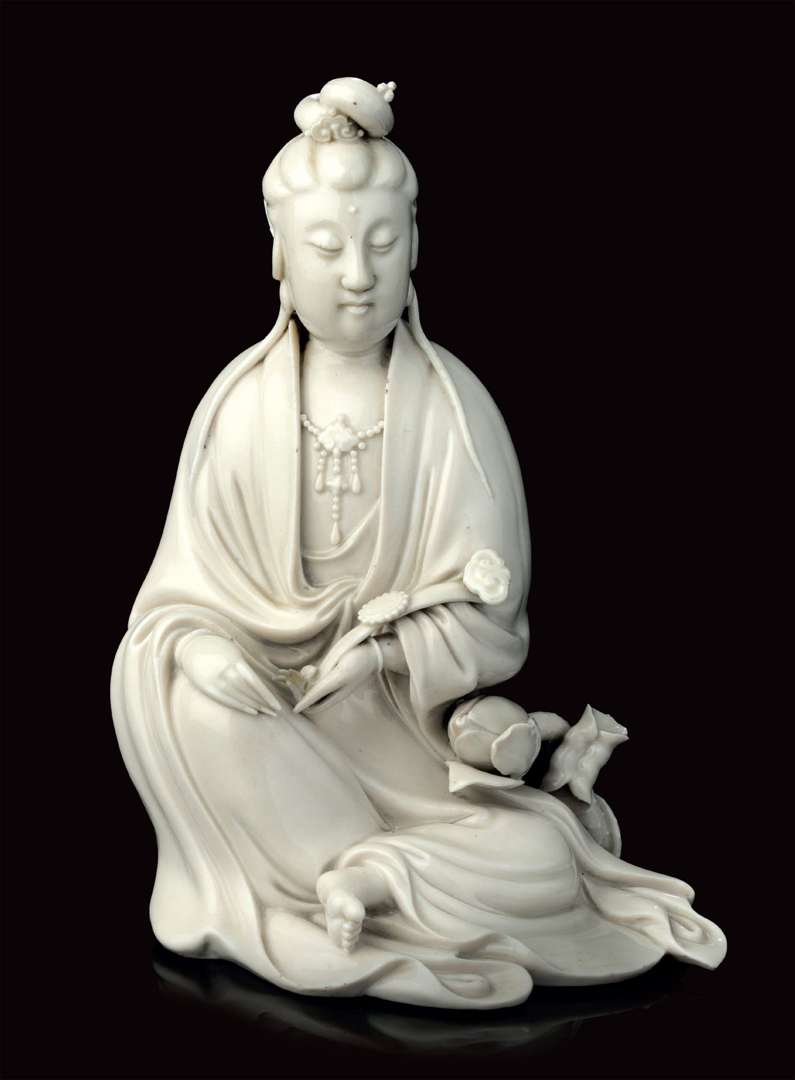
CHINE, FOURS DE DEHUADYNASTIE QING, XVIIIe SIÈCLE
= "Blanc-de-Chine" Guanyin statuette
The bodhisattva seated in lalitasana with a lotus bud resting on her leg, holding a ruyi scepter in her left hand, dressed in a long robe falling in soft folds. Her hair is tied back in an elegant bun with a ruyi pin. With a "Zhang Shoushan" mark in a double-gourd embossed on the back.
PROVENANCE
Sotheby's sale, Amsterdam n°568, October 20, 1992.
NOTE
The kilns of Dehua (Fujian) date back to the Song dynasty (960 - 1279), but it was not until the Ming dynasty (1368 - 1644) that their production reached the technical perfection and excellence for which they are renowned. The porcelain paste produced in Dehua is characterized by its unrivalled density and transparency. The glaze developed from the 16th century onwards is remarkable for its purity, brilliance and velvety texture, giving the milky white color so sought-after. Dehua artists excelled in the production of porcelain sculptures, pushing this art to its apogee. Among the many Buddhist subjects, there was a certain predilection for the representation of the bodhisattva Guanyin, in various forms, like the piece we are presenting today.
= "Blanc-de-Chine" Guanyin statuette
The bodhisattva seated in lalitasana with a lotus bud resting on her leg, holding a ruyi scepter in her left hand, dressed in a long robe falling in soft folds. Her hair is tied back in an elegant bun with a ruyi pin. With a "Zhang Shoushan" mark in a double-gourd embossed on the back.
PROVENANCE
Sotheby's sale, Amsterdam n°568, October 20, 1992.
NOTE
The kilns of Dehua (Fujian) date back to the Song dynasty (960 - 1279), but it was not until the Ming dynasty (1368 - 1644) that their production reached the technical perfection and excellence for which they are renowned. The porcelain paste produced in Dehua is characterized by its unrivalled density and transparency. The glaze developed from the 16th century onwards is remarkable for its purity, brilliance and velvety texture, giving the milky white color so sought-after. Dehua artists excelled in the production of porcelain sculptures, pushing this art to its apogee. Among the many Buddhist subjects, there was a certain predilection for the representation of the bodhisattva Guanyin, in various forms, like the piece we are presenting today.