
&w=3840&q=75)
&w=3840&q=75)
&w=3840&q=75)
&w=3840&q=75)
&w=3840&q=75)
&w=3840&q=75)


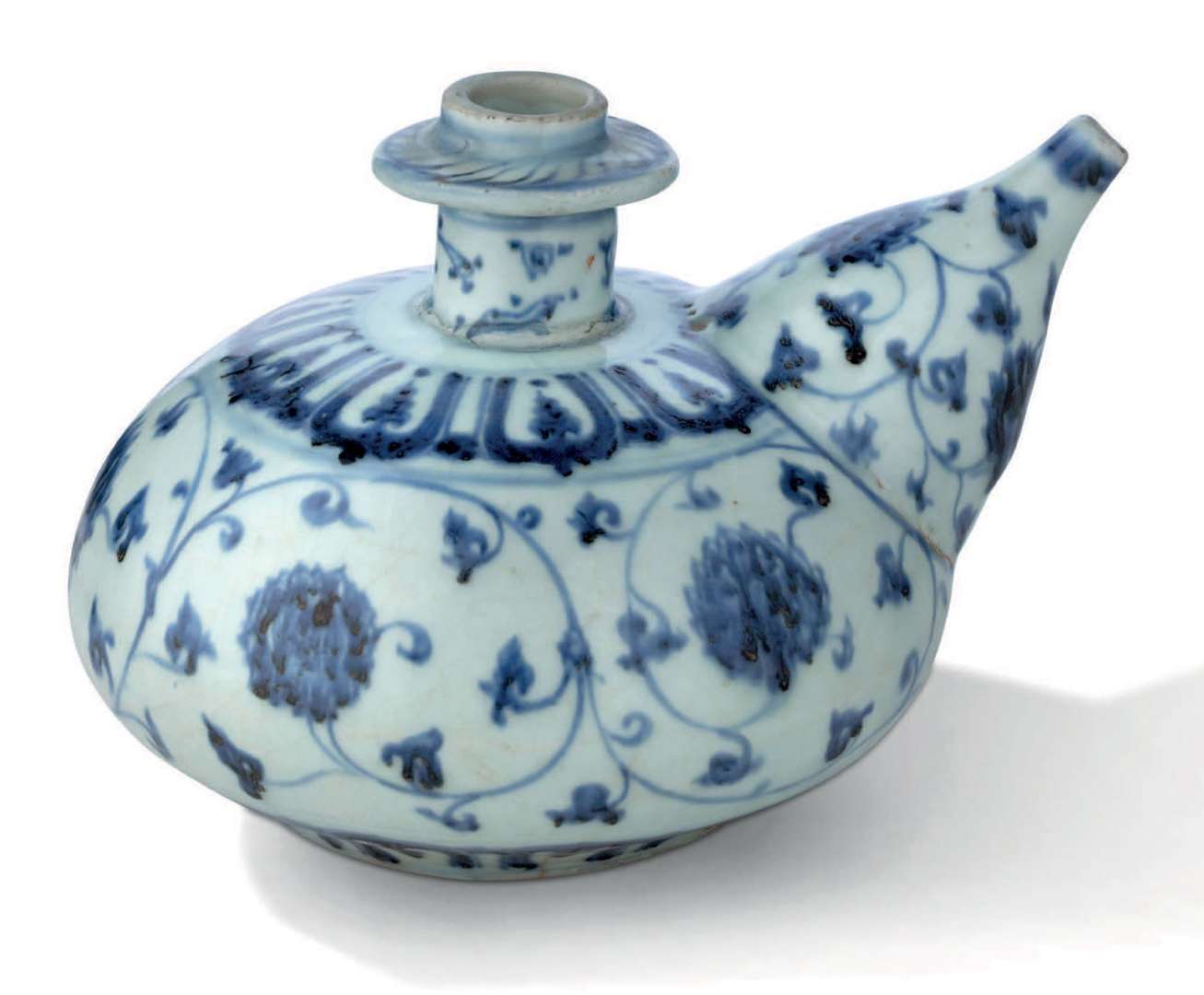
CHINE DYNASTIE MING, MILIEU DU XVe SIÈCLE
= Rare blue-white porcelain kendi
The flattened globular body decorated with blossoming lotuses and spiral foliage, the bulbous spout also decorated with foliage. The whole is topped by a short neck decorated with motifs of precious objects. The lip is completed by a wide rim with a swirling motif. Base and neck highlighted by a frieze of lotus petals.
H. 12.8 cm
PROVENANCE
Acquired in Vietnam in the 1970s.
NOTE
"Kendi" is a Malay word derived from the Sanskrit word "kundika", which designates a ritual water pot. The kendi takes the form of a pot with a rounded belly topped by a narrow neck through which it can be filled, and is completed by a short pouring spout. Known since at least the 9th century, it was originally used by Buddhist monks as a ritual pourer. Extremely popular in Southeast Asia, this shaped piece became a domestic object for regal drinking.
The kendi presented here is an interesting and rare example from the mid-15th century. Its flattened globular body, surmounted by a short, wide-rimmed neck, echoes the shape of models from the late 14th - early 15th century, such as the copper-red decorated Jianwen-period kendi in the Musée National des Arts Asiatiques Guimet, Paris (G 4700) or the Hongwu-period kendi also decorated in copper-red in the Victoria & Albert Museum, London (C.132:1, 2-1928). This piece, intended for export, borrows an imposing bulbous spout from 15th-century Vietnamese stoneware models (examples of 15th-century Vietnamese kendi in the collections of the Asian Civilisations Museum, Singapore, no. C-1232). Its decoration of blossoming lotuses encircled by scrolls forming spirals is characteristic of mid-15th-century production, as are the decorations on a Guan jar and a meiping dated to the Interregnum period (1436 - 1464) by John Alexander POPE in "Chinese Porcelains from the Ardebil Shrine", plate 56, no. 29.496 and 29.415. The lower part is highlighted by a particularly detailed frieze of lotus petals. A mid-15th-century bowl (TKS 15/1694) and kendi (TKS 15/1939) decorated with similar petals can be found in the Topkapi Saray collections (see KRAHL Regina "Chinese Ceramics in the Topkapi Saray Museum, Istanbul: A Complete Catalogue", vol. Very few similar pieces from this period have come down to us, a later kendi from the late 15th century in POPE John Alexander "Chinese Porcelains from the Ardebil Shrine", plate 69, no. 29.472. Another kendi, also from the late 15th century, is in the collections of the Philadelphia Museum of Art (no. 1979-54-1). Finally, another kendi sold by Bonhams Hong Kong on November 30, 2022, lot 46 and dated to the Zhengtong/Jingtai periods.
= Rare blue-white porcelain kendi
The flattened globular body decorated with blossoming lotuses and spiral foliage, the bulbous spout also decorated with foliage. The whole is topped by a short neck decorated with motifs of precious objects. The lip is completed by a wide rim with a swirling motif. Base and neck highlighted by a frieze of lotus petals.
H. 12.8 cm
PROVENANCE
Acquired in Vietnam in the 1970s.
NOTE
"Kendi" is a Malay word derived from the Sanskrit word "kundika", which designates a ritual water pot. The kendi takes the form of a pot with a rounded belly topped by a narrow neck through which it can be filled, and is completed by a short pouring spout. Known since at least the 9th century, it was originally used by Buddhist monks as a ritual pourer. Extremely popular in Southeast Asia, this shaped piece became a domestic object for regal drinking.
The kendi presented here is an interesting and rare example from the mid-15th century. Its flattened globular body, surmounted by a short, wide-rimmed neck, echoes the shape of models from the late 14th - early 15th century, such as the copper-red decorated Jianwen-period kendi in the Musée National des Arts Asiatiques Guimet, Paris (G 4700) or the Hongwu-period kendi also decorated in copper-red in the Victoria & Albert Museum, London (C.132:1, 2-1928). This piece, intended for export, borrows an imposing bulbous spout from 15th-century Vietnamese stoneware models (examples of 15th-century Vietnamese kendi in the collections of the Asian Civilisations Museum, Singapore, no. C-1232). Its decoration of blossoming lotuses encircled by scrolls forming spirals is characteristic of mid-15th-century production, as are the decorations on a Guan jar and a meiping dated to the Interregnum period (1436 - 1464) by John Alexander POPE in "Chinese Porcelains from the Ardebil Shrine", plate 56, no. 29.496 and 29.415. The lower part is highlighted by a particularly detailed frieze of lotus petals. A mid-15th-century bowl (TKS 15/1694) and kendi (TKS 15/1939) decorated with similar petals can be found in the Topkapi Saray collections (see KRAHL Regina "Chinese Ceramics in the Topkapi Saray Museum, Istanbul: A Complete Catalogue", vol. Very few similar pieces from this period have come down to us, a later kendi from the late 15th century in POPE John Alexander "Chinese Porcelains from the Ardebil Shrine", plate 69, no. 29.472. Another kendi, also from the late 15th century, is in the collections of the Philadelphia Museum of Art (no. 1979-54-1). Finally, another kendi sold by Bonhams Hong Kong on November 30, 2022, lot 46 and dated to the Zhengtong/Jingtai periods.