
&w=3840&q=75)
&w=3840&q=75)
&w=3840&q=75)
&w=3840&q=75)
&w=3840&q=75)
&w=3840&q=75)
&w=3840&q=75)
&w=3840&q=75)


144
GRANDE PILE COMPLÈTE DE NUREMBERG
The item was sold for 18 200 €
Fees include commission and taxes.
GRANDE PILE COMPLÈTE DE NUREMBERG
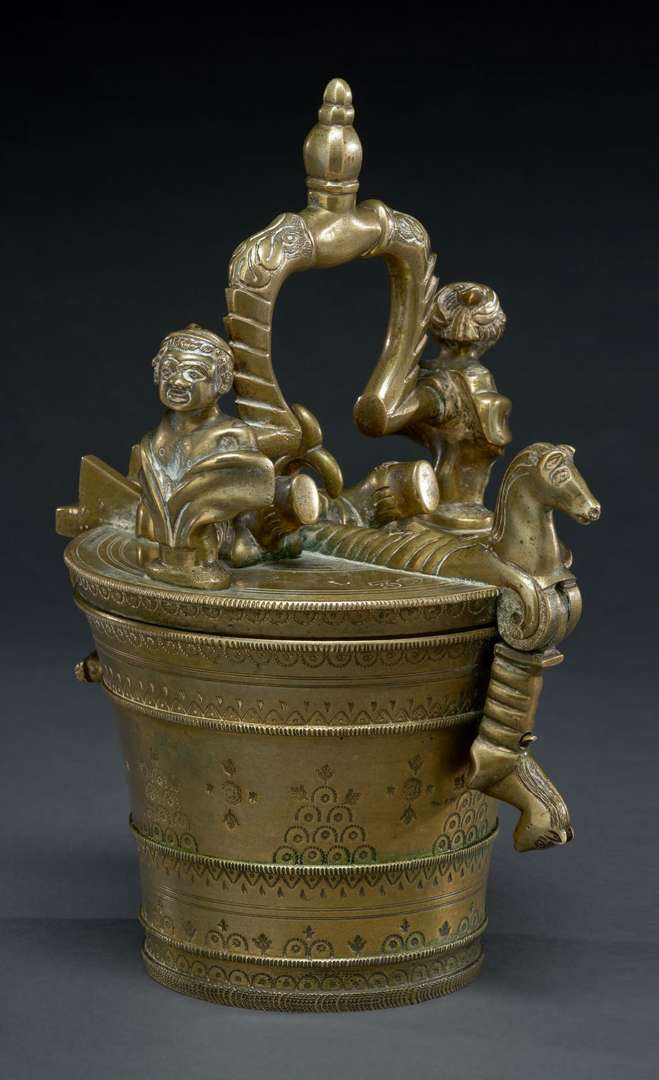
in copper alloy (brass) consisting of fourteen weights calibrated to the Leipzig pound, the largest of which is a truncated-cone case with friezes stamped with small-punch motifs of flowers, dotted lines, inflorescences and fleurons. The hinged lid is decorated with stylized horses. Handle with two stylized snakes facing each other, surmounted by a pinnacle mounted on busts of Moorish figures.
The buckets are hallmarked. On the large weight: hallmark L for Liepzig, hallmark 32 and Hans Leonhard Abend L.A.'s personal hallmark.
with stork (received master in 1690).
Nuremberg, late 17th century, early 18th century.
Height : 28 cm - Width : 21 cm
Approximate total weight: 14.8 kg (Very good condition, complete)
A large, complete and extremely rare weight stack.
BIBLIOGRAPHY
- F. Lavagne - Les piles à godets du Musée de Genève
Genève in Genava : revue d'histoire de l'art et d'archéologie, tome XIII, 1965 pages 113 to 128.
- Hermann P. Lockner: "Les marques des forgerons de Nuremberg". Munich, 1986.
Hans Leonhard Abend, from a Nuremberg foundry family, is cited as a master in this city in 1690 as a "gewichtmacher" (literally "weight maker") [Archives Municipales de Nuremberg E 5/56 n° 2]. His mark is a stork between his initials "LA" (Lockner no. 1027). He inherited this symbol from his father Leonhard Abend (Lockner no. 780| Houben no. 141). The Leipzig pound was 467.5 g.
For centuries, Nuremberg held a monopoly position in the production of weights. Weights were highly coveted, as they were used as a control measure by all calibration masters. From the mid
18th century, craftsmen from many European countries and cities tried to wrest their supremacy from the Nuremberg blacksmiths, but this was not achieved until the 19th century.
in copper alloy (brass) consisting of fourteen weights calibrated to the Leipzig pound, the largest of which is a truncated-cone case with friezes stamped with small-punch motifs of flowers, dotted lines, inflorescences and fleurons. The hinged lid is decorated with stylized horses. Handle with two stylized snakes facing each other, surmounted by a pinnacle mounted on busts of Moorish figures.
The buckets are hallmarked. On the large weight: hallmark L for Liepzig, hallmark 32 and Hans Leonhard Abend L.A.'s personal hallmark.
with stork (received master in 1690).
Nuremberg, late 17th century, early 18th century.
Height : 28 cm - Width : 21 cm
Approximate total weight: 14.8 kg (Very good condition, complete)
A large, complete and extremely rare weight stack.
BIBLIOGRAPHY
- F. Lavagne - Les piles à godets du Musée de Genève
Genève in Genava : revue d'histoire de l'art et d'archéologie, tome XIII, 1965 pages 113 to 128.
- Hermann P. Lockner: "Les marques des forgerons de Nuremberg". Munich, 1986.
Hans Leonhard Abend, from a Nuremberg foundry family, is cited as a master in this city in 1690 as a "gewichtmacher" (literally "weight maker") [Archives Municipales de Nuremberg E 5/56 n° 2]. His mark is a stork between his initials "LA" (Lockner no. 1027). He inherited this symbol from his father Leonhard Abend (Lockner no. 780| Houben no. 141). The Leipzig pound was 467.5 g.
For centuries, Nuremberg held a monopoly position in the production of weights. Weights were highly coveted, as they were used as a control measure by all calibration masters. From the mid
18th century, craftsmen from many European countries and cities tried to wrest their supremacy from the Nuremberg blacksmiths, but this was not achieved until the 19th century.